So, what exactly is franchise business management? It's the whole system—the strategies, the processes, and the support structure—that a brand uses to grow and scale without losing its soul. It's about ensuring a predictable customer experience and unit-level profitability, from the first location to the thousandth.
This isn't just about keeping the lights on. It's about building a framework that actively fuels growth, from the moment a potential franchisee shows interest to the day-to-day operations of a local store.
The Pillars of a Modern Franchise System
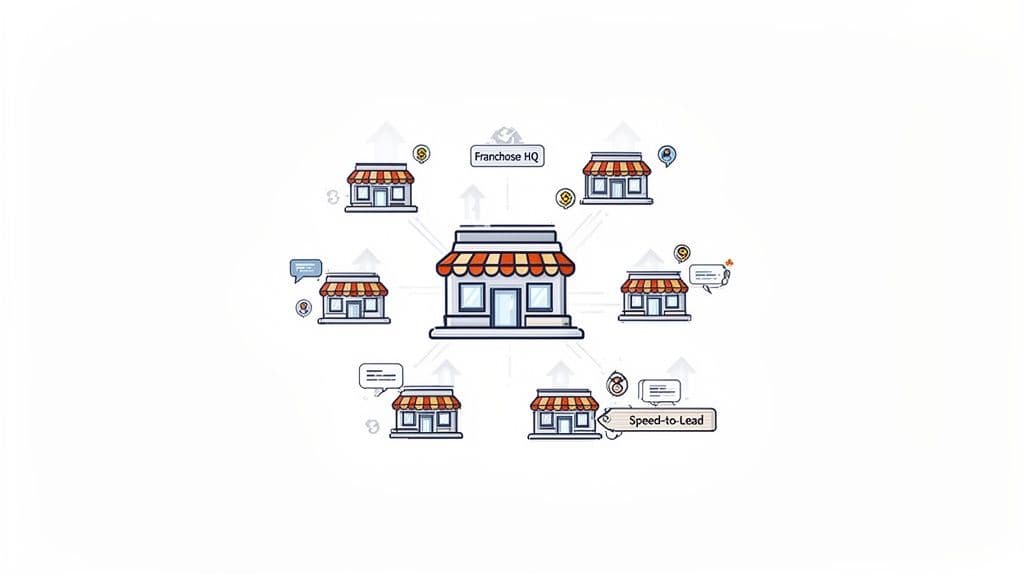
Forget dusty textbooks and rigid corporate flowcharts. Today's franchise management is about creating a real partnership between the franchisor and franchisees, where everyone wins. This practical approach is built on three core pillars that must work in tandem.
- Operational Excellence: This is your brand's DNA. It means rock-solid, standardized procedures for everything from marketing campaigns to customer greetings. It ensures a predictable, high-quality experience no matter which location someone visits.
- Franchisee Support: Great franchisors don't just enforce rules; they act as partners. This pillar is about providing comprehensive training, ongoing coaching, and the tools franchisees need to succeed in their local markets.
- Strategic Growth: This is about expanding the brand's footprint smartly. It covers everything from finding and signing the right franchisees to market analysis and long-term financial planning.
The First Point of Contact: A Critical Modern Challenge
While all three pillars are essential for a franchise's long-term health, a breakdown in strategic growth—especially at the very start of the sales process—can stop a brand in its tracks.
Let's be clear: franchising is a massive, competitive space. With over 792,000 franchise units generating $826.6 billion in economic output in the U.S. alone, the fight for qualified franchisees is fierce. This economic report on the franchise model paints a clear picture of just how big the opportunity—and the competition—really is.
This competitive environment exposes a huge vulnerability for many franchise development teams: the crippling cost of slow or manual lead follow-up. When a prospective franchisee reaches out, their excitement is at its peak. Every minute you wait to respond kills that momentum and drastically lowers your chances of having a real conversation.
The single biggest point of failure in franchise development isn't a lack of leads—it's a lack of speed. The brand that responds first, with a relevant and personal message, wins the conversation.
This is where franchise business management must start. The entire health of the system, from hitting growth targets to unit-level profitability, is directly tied to the brand’s ability to engage prospects the second they show interest. A high-speed, text-first outreach strategy isn't a luxury; it’s the foundational piece that feeds the growth engine and sets the stage for a stronger, more profitable network.
Building a Franchise Structure for Scalable Growth
Think of your franchise's organizational structure as more than a chart of who reports to whom. It’s the blueprint that determines if you can scale—or if you’ll collapse under your own success. A flat, reactive structure might work with a handful of locations, but it’s a bottleneck when you start to expand.
Real, sustainable growth demands a proactive, tiered model. It’s a framework designed to empower your franchisees while fiercely protecting the brand consistency you’ve worked so hard to build.
Effective franchise business management isn’t about building a bloated corporate office. It's about creating a lean, supportive framework with crystal-clear communication channels. The goal is to strike that delicate balance between centralized brand control and the local autonomy your franchisees need to win in their communities.
From Org Chart to Growth Engine
A well-designed structure does more than manage your current units; it actively fuels your growth. Take your franchise development team, for example. In a clunky system, this team is often siloed, buried in manual tasks, and struggling to keep up with new leads. It's a classic bottleneck.
But this is where smart organizational design and technology create a massive advantage.
When you arm a lean, well-organized development team with smart automation, you can handle a huge volume of prospective franchisees without adding headcount. It’s a practical way for franchise teams to respond faster and more consistently. You shift your team's focus from administrative work to having meaningful conversations with qualified candidates.
A franchise structure built for scale doesn't just add more people to handle more work. It uses systems and technology to make the team you already have exponentially more effective, ensuring no opportunity is lost.
The Power of a Shared, Automated Inbox
Let’s picture your franchise development process as a central communications hub. In the old model, leads pour in and are assigned manually. This almost always leads to slow response times, and good prospects fall through the cracks.
A much better structure integrates a shared, automated inbox that acts as the team's "first responder."
This system ensures every single lead gets an instant, professional, and personalized response via text and email. That immediate touchpoint is crucial for capturing a candidate’s interest while it’s at its peak. It’s how a small team can perform like one three times its size, whether they use it as a fully automated engagement engine or a simple shared inbox for team collaboration.
Here’s how this simple structural shift fuels your growth:
- Instant Engagement: No lead ever feels ignored. Automation handles that critical first contact within seconds.
- Efficient Qualification: You can use text and voice AI to ask initial qualifying questions, speeding up the "low stakes" elements of the funnel.
- Seamless Handoff: Once a prospect is qualified and engaged, the conversation moves seamlessly to the right team member inside a shared platform, with all context intact.
This model is the perfect marriage of a solid organizational framework and smart technology. It’s a core part of designing an organizational structure for scalable growth that can flex as you expand. You end up with a system where your team isn't just putting out fires but actively nurturing every potential franchisee from the moment they first click.
The Essential Technology Stack for Modern Franchises
Let's be honest. Your franchise tech stack shouldn't be a tangled mess of expensive, underused tools. A modern, effective stack is simple, powerful, and built for one thing: growth. It really boils down to two distinct but complementary layers that work together.
The first layer is your System of Record. This is your franchise CRM, like FranConnect or Salesforce. It’s a fantastic database, built to store huge amounts of information—candidate details, franchisee data, legal documents, you name it.
Think of it as your franchise’s library. It's a secure vault where all your critical information is carefully cataloged and stored for the long term.
But a library isn't built for high-speed action. While essential for storing data, a traditional CRM often fails at the one thing that drives new growth: instant, multi-channel communication with prospective franchisees. This is where the second layer comes in, and it's a game-changer.
The Rise of the Engagement Layer
The second, more dynamic layer is your System of Engagement. This is a lightweight, specialized tool that sits right on top of your CRM, acting as the high-speed engine for your sales outreach. It’s not a CRM replacement; it’s a powerful, lightweight sales engagement layer that complements your CRM by handling the fast-paced, time-sensitive work of engaging new leads the second they show interest.
This engagement layer is built for speed-to-lead. Its sole job is to ensure every potential franchisee is contacted immediately, consistently, and on the channels they actually use—which today is overwhelmingly text message. It turns your follow-up process from a slow, manual chore into a powerful, automated advantage.
A CRM tells you who your leads are. An engagement layer ensures you actually talk to them. One is for passive storage; the other is for active growth.
This two-layer approach creates a seamless workflow. The engagement tool handles that critical first contact, qualifies leads with text and voice AI, and gets meetings on the calendar. All the while, your CRM remains the pristine, organized system of record where this activity is logged automatically.
The diagram below shows why organized, tiered systems are so crucial for scaling a franchise business.
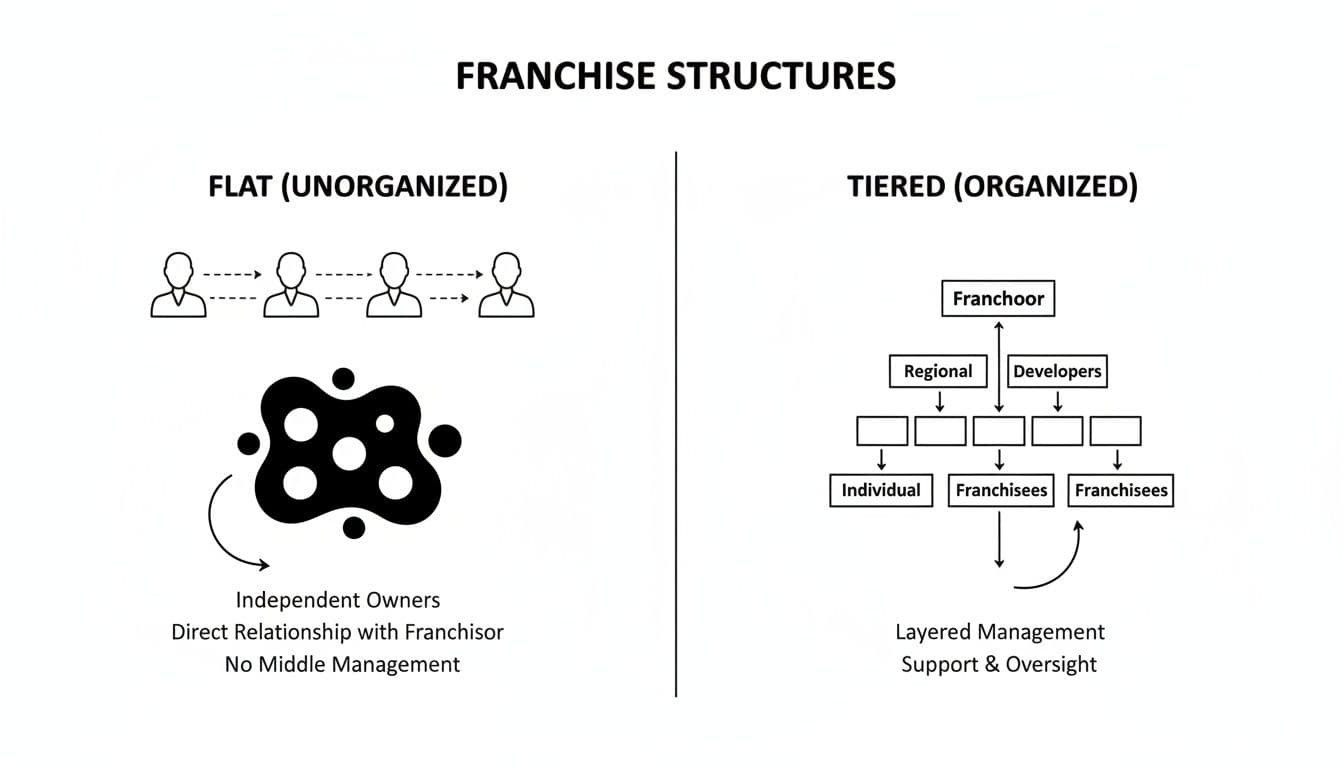
Just like a well-defined tech stack, a tiered, systems-driven approach provides the structure you need for sustainable growth. A flat, disorganized model just can't keep up.
CRM vs. Engagement Layer: A Functional Comparison
To see how these two systems work together, it helps to break down their core jobs. A traditional CRM is built for long-term data management, while an engagement layer is designed for immediate, high-volume outreach.
| Function | Traditional CRM (e.g., Salesforce, FranConnect) | Engagement Layer (e.g., FranFunnel) |
|---|---|---|
| Primary Goal | Data storage and long-term pipeline management. | Immediate lead response and multi-channel outreach. |
| Speed | Slow. Designed for manual data entry and reporting. | Instant. Built to respond in seconds, 24/7. |
| Communication Focus | Primarily email and logged calls. Not built for SMS. | Text-first. Optimized for high-response channels. |
| Automation | Complex workflow rules that require expert setup. | Simple, pre-built campaigns for instant engagement. |
| Best For... | Storing franchisee records, legal docs, and history. | Contacting every new lead and booking qualified calls. |
This table makes it clear: you need both. A CRM acts as your franchise's brain, storing memories and important information. An engagement layer acts as its central nervous system, reacting instantly to new opportunities.
Driving Efficiency Without Bloat
The beauty of this lean tech stack is how cost-effective and efficient it is. Many franchises fall into the trap of buying clunky, all-in-one platforms that promise the world but don't do anything particularly well. Others burn thousands a month on agencies just to handle lead follow-up.
This modern stack delivers far better results for a fraction of the cost.
- Eliminates Redundancy: A dedicated engagement tool like FranFunnel, at just $249/mo per seat, often completely replaces 3-5 other tools (like auto-dialers, scheduling software, and separate SMS platforms) and costly agency retainers, offering a massive value compared to a $2,000+ monthly spend.
- Increases Team Capacity: With automation that feels personal, not robotic, a small development team can handle a huge volume of leads without adding headcount. They spend their time on qualified conversations, not chasing down leads.
- Maintains Data Integrity: Because the engagement layer complements your CRM, all interactions are automatically synced back. Your system of record stays clean and up-to-date without anyone lifting a finger.
By separating your system of record from your system of engagement, you get the best of both worlds: a robust database for long-term management and a high-speed engine for driving new growth. You can explore a deeper dive into software for franchise management to see how these tools work together in practice. It's a powerful and practical approach that's quickly becoming the new standard for franchise business management.
Mastering Operations, Training, and Compliance
A great brand is built on consistency. While your franchise development process gets new owners in the door, it’s the day-to-day operational excellence that keeps them—and their customers—coming back. World-class franchise business management comes down to creating operations that are simple to teach, easy to follow, and straightforward to enforce.
This is about more than handing someone a dusty, three-ring binder. Modern training and compliance are dynamic, tech-powered processes that empower franchisees to succeed. It's not about policing them; it's about giving them a clear, supportive path to profitability that protects the brand for everyone involved.
Moving Beyond the Operations Manual
The old-school operations manual still has a place, but on its own, it’s not enough anymore. Today's most successful franchise systems blend a few scalable training methods to ensure every person, from the franchisee down to their newest hire, understands the brand's DNA.
A modern training system has a few key parts:
- Learning Management Systems (LMS): These are digital hubs for on-demand video courses, quick quizzes, and resource libraries. They let franchisees and their staff learn at their own pace, which is huge for maintaining consistency across all locations.
- Virtual Coaching and Onboarding: Live, interactive sessions with corporate trainers add that crucial personal touch. It’s a space for new owners to ask questions and build real relationships from day one.
- In-Person Training: For any hands-on business, there's just no substitute for being on-site. This is absolutely critical for mastering specific equipment or nailing customer service protocols.
Think about a food service franchise. To get that consistent quality and service across every unit, mastering operations is non-negotiable. A detailed guide to commercial kitchen equipment training can make a massive difference in safety, efficiency, and food quality—all things that directly impact the customer experience. That's the level of detail that separates good brands from great ones.
Compliance as a Supportive Partnership
Compliance shouldn't feel like a chore or a constant battle. The real goal is to make it incredibly easy for franchisees to do the right thing. Technology makes this much simpler, turning compliance from a "gotcha" game into a supportive process that helps owners spot and fix issues before they become problems.
This can be done with simple digital checklists, automated performance reports, and regular field visits that are more about coaching than just inspecting. When you frame compliance as a partnership, franchisees start to see brand standards as tools for their own success, not just a bunch of rules.
The ultimate test of your operational systems isn't just whether they are followed, but whether they become a competitive advantage. Robust, well-documented operations are one of the most powerful selling points you have during franchise development.
Connecting Operations to Franchise Growth
This is where it all comes full circle. Your deep commitment to operational excellence is a huge differentiator for potential franchisees. When a candidate sees you have a real, turnkey business system, it validates their investment and builds a massive amount of trust.
It proves that your brand is more than just a logo—it’s a proven recipe for success. You can find excellent examples in our guide to standard operating procedure templates.
This shows that your dedication to systems and efficiency isn't just talk. It starts with that first, lightning-fast text a lead gets and carries all the way through to the daily checklists that guarantee a perfect customer experience. This consistent, systems-driven approach is the core value of franchising, and it makes your opportunity far more attractive than the competition’s.
Measuring the KPIs That Actually Drive Growth
Are you tracking numbers, or are you tracking progress? It's a critical distinction. Smart franchise business management isn’t about drowning in data; it’s about cutting through the noise to focus on the key performance indicators (KPIs) that actually grow your bottom line.
This means measuring what matters for both franchise development and franchisee success. You need a clear scorecard for the whole system.
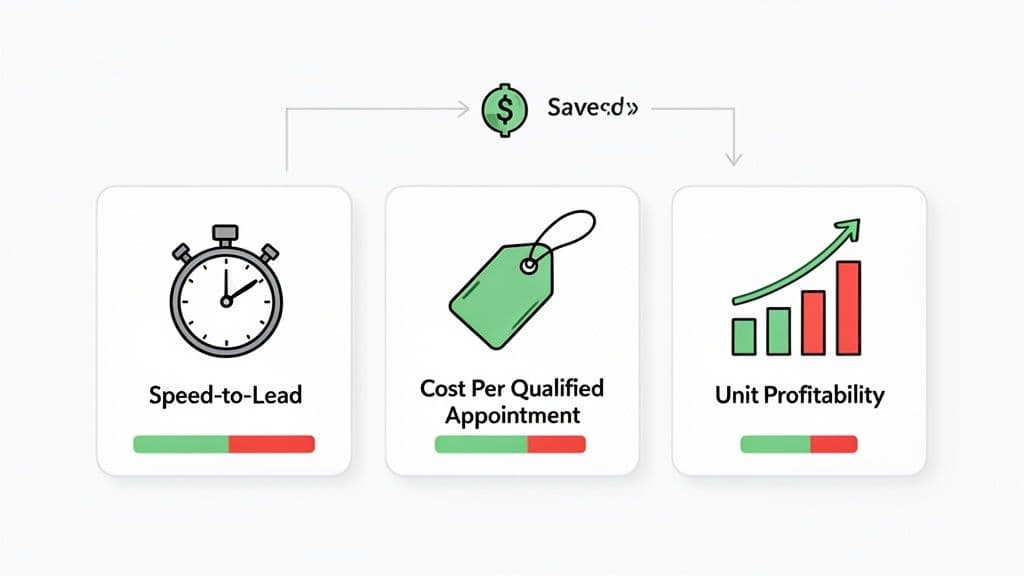
For your development pipeline, that means metrics revealing the health and speed of your sales process. For your franchisees, the focus has to be on unit-level profitability and sustainable local growth.
Franchise Development KPIs: The Engine of Growth
Your growth pipeline lives and dies by a few critical numbers. Many teams get stuck tracking cost-per-lead, but the real story is in how efficiently you turn those leads into signed franchise agreements.
- Speed-to-Lead: How long does it take for your team to make the first contact attempt after a lead comes in? In today's world, anything over five minutes is a killer. This isn't just a metric; it's the single most powerful lever you can pull to improve your entire funnel.
- Contact Rate: What percentage of new leads do you actually speak with? A low contact rate is a massive red flag, usually pointing to slow follow-up and wasted marketing dollars.
- Cost Per Qualified Appointment: This is where marketing spend meets real sales activity. It tells you exactly how much it costs to get a genuinely interested, qualified candidate on the phone with your development team.
Of all these, speed-to-lead is the undisputed champion. A candidate's interest is white-hot in the first few minutes. Any delay gives them time to get distracted, lose excitement, or worse—start talking to your competitor who responded instantly.
Every minute you wait to respond to a new franchise lead, your odds of connecting with them plummet. An instant, automated text-first response isn't just about being fast; it's about respecting the candidate's momentum and fundamentally changing your conversion economics.
The Staggering Cost of Slow Follow-Up
Let's make this real. Imagine your brand generates 200 leads this month at $100 per lead. That’s a $20,000 ad spend. Your team is swamped, so it takes them an average of six hours to follow up. Because of that delay, they only manage to contact 30% of those leads (60 people).
Now, picture this: you implement an automated engagement layer. Every one of those 200 leads gets a personalized text and email within 30 seconds. Your contact rate jumps to 70% (140 people) because you’re catching them at their peak interest.
That's 80 additional conversations from the exact same marketing spend. If just a handful of those talks turn into new franchisees, the ROI is massive. The cost of slow follow-up isn't just lost time—it's thousands in torched ad spend and missed franchise fees, month after month.
Franchisee Performance KPIs: The Foundation of Health
Once a franchisee is open for business, a new set of KPIs takes center stage. These numbers help both of you monitor the health of their local unit and spot opportunities before they become problems.
- Unit-Level Profitability: Forget top-line revenue for a second. This is about net profit at the individual location. It's the ultimate measure of a franchisee's success and the true viability of your model.
- Same-Store Sales Growth: This compares a store's sales today to the same period last year. It’s a vital sign of brand health and local market penetration, filtering out the noise from new store openings.
- Customer Satisfaction Score (CSAT/NPS): Happy customers drive a profitable business. Tracking their feedback gives you a direct look at how well the brand promise is being delivered on the front lines.
By zeroing in on these essential KPIs—at both the development and operational levels—you build a data-driven culture. This is how your franchise business management shifts from putting out fires to proactively engineering growth.
To dig deeper into tracking progress, you can learn more about various sales KPI examples and how to apply them to your system.
Solving Your Toughest Franchise Management Challenges
Franchise business management is really just problem-solving on a bigger scale. Most franchise development leaders are wrestling with the same handful of issues that bottleneck growth and create friction across their entire system.
Let's break down three of the most common headaches: the stalled sales pipeline, inconsistent brand experiences, and franchisees who’ve checked out. Each one has a practical solution, and it usually comes down to better processes and smarter tech.
Challenge 1: The Stalled Growth Pipeline
A slow-moving sales pipeline is one of the most expensive problems a franchise can have. A good lead comes in, everyone's excited, but manual follow-up means delays. By the time a sales rep finally reaches out, the candidate has gone cold or—even worse—is already talking to your competitor. This isn't a lead quality issue; it's a speed issue.
The fix is a simple but powerful one: an instant, automated, text-first engagement strategy.
- Respond Instantly: The second a lead fills out a form, an automated, personalized text hits their phone. This immediate touchpoint catches them at their highest point of interest and massively increases your chances of getting a real conversation started.
- Nurture Consistently: Automated workflows make sure every single lead gets consistent follow-up. No one falls through the cracks, no matter how slammed your team is.
- Handoff Seamlessly: When a candidate texts back, the conversation is automatically routed to the right person on your team within a shared platform. It’s a smooth transition from automation to a direct conversation with your team.
This approach stops you from losing hot leads to slow response times. It fundamentally plugs the biggest leak in your sales funnel.
Challenge 2: The Inconsistent Brand Experience
Brand consistency is everything. When a customer has a fantastic experience at one location and a terrible one at another, it chips away at the trust you've worked so hard to build. This usually happens when franchisees don't have clear, easy-to-access operational guides or just feel disconnected from the home office.
The solution is to build a single, central hub for all your operations and communication.
A strong brand isn't built on rigid rules alone; it's built on clear systems that make it easy for franchisees to deliver excellence consistently. Technology should be the bridge that connects brand standards to daily execution.
By using technology to support franchisees instead of just policing them, you build a culture of partnership, not just compliance. Think on-demand training modules, digital checklists for daily tasks, and direct lines of communication. When your franchisees feel supported and have the right tools, they’re far more likely to deliver the kind of high-quality experience your customers expect, every single time.
Challenge 3: Disengaged Franchisees
A checked-out franchisee is a major liability. They might start cutting corners on brand standards, letting customer service slip, or just coasting instead of growing. All of it reflects poorly on the entire system. Disengagement almost always starts with a franchisee feeling like they're not being heard or supported by corporate.
The key is turning your headquarters into a responsive support center. This means creating simple, accessible channels for feedback and making sure franchisees get answers to their questions in a timely manner. Modern communication platforms let even a small corporate team manage franchisee inquiries like a shared inbox, ensuring nothing gets missed.
When you create a collaborative environment where franchisees feel like true partners, you end up with a healthier, more profitable, and more consistent network.
Answering Your Top Franchise Management Questions
As franchise leaders look to scale, a few questions always seem to pop up. Here are some clear, straightforward answers to the challenges we see franchise development teams grappling with every day.
How Can We Respond To Leads Faster Without Hiring More People?
The secret is using smart automation as your team’s “first responder.” Instead of having a human manually chase down every single new inquiry, an engagement platform can fire off a personalized text and email the second a lead hits your system.
This guarantees that 100% of your inquiries get an immediate, 24/7 response.
From there, AI-powered workflows can ask the initial qualifying questions and even get meetings booked directly on your team's calendar. It's a practical way to handle more leads and be more responsive without bloating your payroll. This frees up your team to spend their time on what they do best: having meaningful conversations with qualified, genuinely interested candidates.
Our CRM Has Automation, So Why Do We Need Another Tool?
This is a great question, and it’s one we hear all the time. Think of your CRM as your library—it’s the perfect place to store huge amounts of information and serves as your long-term system of record. An engagement platform, on the other hand, is your high-speed messenger, built purely for action.
While most CRMs do have some basic automation, they simply weren't designed for the instant, text-first communication that modern franchise development requires. A dedicated engagement layer works with your CRM, not against it, by specializing in a few key areas:
- Speed: Reacting in seconds, not the minutes or hours a CRM might take.
- Text-First Outreach: Meeting candidates on the channel they actually use and prefer.
- Flexible Workflows: Nurturing leads with intelligent follow-up until they’re ready for a human.
It owns the critical first few minutes and hours of the relationship, then syncs every interaction back to your CRM. Your data stays clean and your library stays organized, all without creating extra work for your team.
Can Automated Messages Really Feel Personal?
Absolutely, as long as they’re designed the right way. The goal of modern automation isn't to replace human connection—it’s to create a faster path to it.
Good automation uses a natural, conversational tone and personalization tokens (like the candidate's name and the franchise they’re interested in). It’s perfect for handling those first, time-sensitive steps, like acknowledging an inquiry and asking one or two simple qualifying questions.
Once a candidate replies, a team member can jump in and take over the conversation seamlessly in the very same thread. This creates a smooth, professional handoff from an automated assistant to a real person, making the entire experience feel both incredibly responsive and genuinely human.
Ready to eliminate slow follow-up and make sure every single lead gets an instant response? FranFunnel is the text-first engagement layer that complements your CRM, drives more conversations, and helps you sign more franchisees—all without adding headcount. Learn how FranFunnel can transform your franchise development process.