
Here’s the thing about growing a franchise: you’re not just selling a product or a service. You're selling an entire business in a box. That’s the essence of franchise development marketing. It’s a completely different ballgame from regular consumer marketing because your target audience isn’t the everyday customer. You’re looking for qualified entrepreneurs—long-term business partners who will build and grow the brand right alongside you.
What Is Franchise Development Marketing
 Think of it as the engine that drives your brand’s expansion. Unlike B2C (business-to-consumer) marketing that chases individual sales, this approach hones in on a very specific type of person: the aspiring business owner.
Here’s a good way to picture it: Imagine you’re an architect who has perfected a killer blueprint for a successful building. Your goal isn’t to sell off individual rooms. It’s to find skilled, ambitious builders—your franchisees—to construct an entire city of these thriving buildings using your proven design.
That distinction changes everything. You’re not selling a simple product; you're selling a life-changing investment and a long-term partnership. The marketing has to reflect that. Forget flashy promos. This is about building a rock-solid case for a sustainable business opportunity that speaks directly to an investor’s goals, finances, and ambition.
Think of it as the engine that drives your brand’s expansion. Unlike B2C (business-to-consumer) marketing that chases individual sales, this approach hones in on a very specific type of person: the aspiring business owner.
Here’s a good way to picture it: Imagine you’re an architect who has perfected a killer blueprint for a successful building. Your goal isn’t to sell off individual rooms. It’s to find skilled, ambitious builders—your franchisees—to construct an entire city of these thriving buildings using your proven design.
That distinction changes everything. You’re not selling a simple product; you're selling a life-changing investment and a long-term partnership. The marketing has to reflect that. Forget flashy promos. This is about building a rock-solid case for a sustainable business opportunity that speaks directly to an investor’s goals, finances, and ambition.
The Core Goals of This Unique Marketing
Good franchise development marketing isn’t just about getting a bunch of names on a list. It’s a strategic process designed to attract, educate, and ultimately convert the right kind of partners—people who will become true brand champions in their local communities. The real goals are much deeper:
- Attracting Qualified Candidates: This is about filtering, not just collecting. You need people with the right amount of capital, the business sense to run an operation, and the willingness to stick to a proven system.
- Building Brand Credibility: Your franchise has to be seen as a trustworthy and profitable investment. This comes from being transparent and showcasing real success stories from existing franchisees.
- Educating Potential Investors: You have to be crystal clear about the business model, the support you provide, and exactly what the financial requirements are. No surprises.
- Driving Sustainable Growth: The aim is to set up every new franchisee for success. When they win, the entire network gets stronger.
"A successful franchise marketing campaign isn’t just about advertising – it’s about creating meaningful connections between your brand, franchisees, and customers.” - Chris Conner, President of FMS Franchise.
This whole approach is about telling a story that resonates with an entrepreneur's journey. It’s about showing them the immense value of joining an established system—the reduced risk, the operational support, and the built-in brand recognition. The entire strategy is geared toward building a pipeline of high-quality leads who are genuinely ready for what ownership entails. Ultimately, this specialized marketing lays the foundation for the entire franchise development process. It ensures that every single unit you add to the system strengthens its long-term health and reputation. By focusing on quality over sheer quantity, you build a network that’s not just big, but resilient.
Why a Strong Marketing Strategy Is Crucial for Growth
 In a crowded market, just having a great franchise concept isn't going to cut it. You need a powerful franchise development marketing strategy to actually drive growth and separate your brand from the ones that never quite get off the ground.
It's what makes the difference between attracting top-tier entrepreneurs and getting stuck cycling through unqualified candidates who just aren't the right fit.
Without a real plan, you end up wasting time on people who lack the capital, experience, or commitment to succeed. These mismatched partners drain your support resources, tarnish your brand's reputation in their local market, and can ultimately lead to unit closures—a huge setback for any franchise system.
In a crowded market, just having a great franchise concept isn't going to cut it. You need a powerful franchise development marketing strategy to actually drive growth and separate your brand from the ones that never quite get off the ground.
It's what makes the difference between attracting top-tier entrepreneurs and getting stuck cycling through unqualified candidates who just aren't the right fit.
Without a real plan, you end up wasting time on people who lack the capital, experience, or commitment to succeed. These mismatched partners drain your support resources, tarnish your brand's reputation in their local market, and can ultimately lead to unit closures—a huge setback for any franchise system.
The Dangers of a Weak Approach
A weak marketing strategy isn't just ineffective; it's actively damaging. The consequences ripple through your entire network, creating long-term problems that are incredibly hard to fix. Stalled growth is the most obvious sign, but the issues underneath are usually far more serious. Here are some of the key risks:
- Diluted Brand Identity: When your marketing is all over the place, your core message gets muddled. This confuses potential franchisees and customers alike.
- Wasted Resources: Pouring money into unfocused campaigns brings in low-quality leads, which sends your Cost Per Acquisition (CPA) through the roof and depletes your budget with nothing to show for it.
- Losing to Competitors: A weak online presence makes you invisible. The best candidates won't even find you, and your competitors will scoop up the top talent in prime territories.
A haphazard approach to franchise development marketing is like trying to build a skyscraper on a foundation of sand. It's not a matter of if it will falter, but when.
The modern franchise world is brutally competitive. The sector is booming, which is great for opportunity, but it also means the fight for qualified partners is more intense than ever. Just to give you an idea, as of mid-2024, the U.S. and Canada saw 11,294 new franchise units pop up in just one year. That's a 9.5% increase from the year before. Every single one of those new units is another competitor vying for attention online. A strategic marketing plan isn't a "nice-to-have" anymore—it's non-negotiable.
Connecting Strategy to Real Business Outcomes
A well-executed plan does a lot more than just generate leads. It builds the foundation for long-term financial health and scalability. By focusing your efforts, you attract candidates who aren't just financially qualified, but who also align with your brand's culture and vision. These are the people who become true brand champions. They drive success in their local markets and, in turn, validate your system for future investors. Since franchise recruitment is fundamentally a B2B process, looking into a solid B2B marketing strategy can give you some incredibly valuable insights for building a tougher approach. A strong plan helps you get the right operators into the right territories, faster. Ultimately, strategic franchise development marketing isn't just another expense. It's the single most critical investment you can make in your brand’s future. It directly improves the quality of your franchisees, strengthens your system's financial health, and paves the way for scalable, profitable growth.
Building Your Franchisee Recruitment Funnel
A smart franchise development strategy isn't about just collecting a list of names. It’s about guiding potential partners through a deliberate journey—one that moves an aspiring entrepreneur from idle curiosity all the way to a signed franchise agreement. The easiest way to map out this journey is to think of it as a funnel. It’s not some complex maze; it's a clear, three-stage path that mirrors how a candidate actually makes a decision. Get this right, and you'll be delivering the right information at the perfect time.
The Awareness Stage: Capturing Attention
This is the very top of your funnel. The only goal here is to make potential franchisees aware that your opportunity even exists. At this point, candidates are just starting to look around, exploring different industries and business models. Your marketing needs to cast a wide net, but it has to be the right net. The key is education, not a hard sell. You’re simply positioning your brand as a credible and attractive option in what's often a very crowded market. Actionable tactics for this stage look like this:
- Targeted Content Marketing: Think blog posts and guides that answer the basic questions every aspiring entrepreneur has. Titles like, "What to Look for in a Fast-Casual Franchise" or "The Top 5 Benefits of Owning a Service-Based Business" are perfect.
- Public Relations and Media Outreach: Getting featured in industry publications or business journals builds instant authority. A story on your brand’s growth or an interview with your CEO can spark serious interest.
- SEO and Digital Advertising: Make sure your franchise development site shows up for keywords like "franchise opportunities." Running targeted ads on platforms like LinkedIn is also a great way to reach professionals who have the right background and capital.
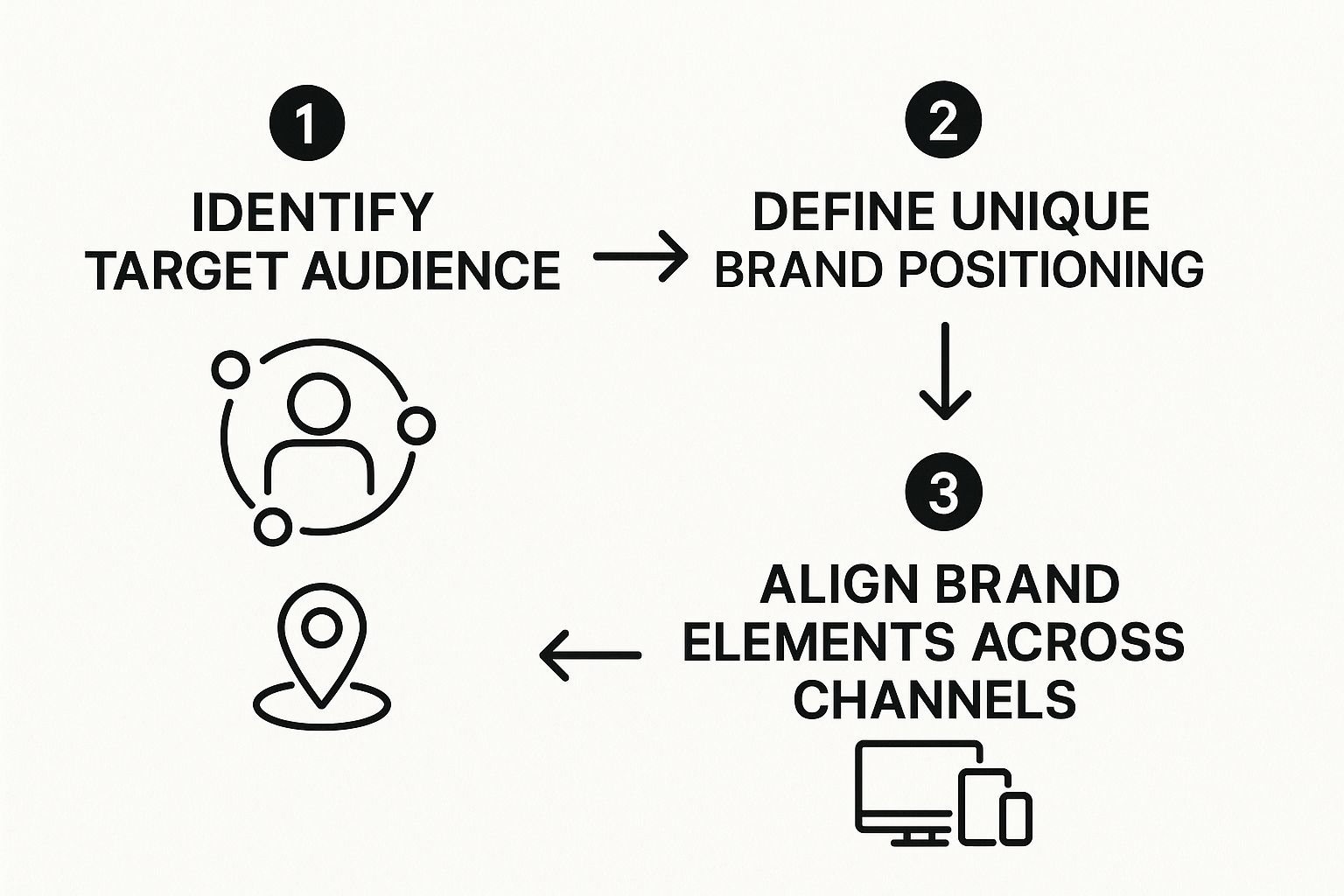 This process highlights a simple truth: a successful funnel starts long before the first lead comes in. It begins with a rock-solid understanding of who you're trying to attract and what makes your brand different.
The Consideration Stage: Building Trust
Once someone knows your brand exists, they slide into the consideration stage. Now, they're actively comparing you to other franchises. Your job is to build trust by giving them the nitty-gritty details they need to truly see themselves as a successful owner in your system. This is where you shift from broadcasting a message to building a relationship. You have to back up your initial claims with real substance and proof.
The Consideration Stage is where you transition from a "billboard" to a "blueprint." Candidates need to see the inner workings of your system—the support, the financials, and the real-world success of your current partners.
To nurture leads effectively in the middle of the funnel, focus on these tactics:
- In-Depth Webinars: Host live or on-demand webinars that pull back the curtain on your franchise model, training, and support systems. It’s a great format for a deeper dive and a live Q&A.
- Compelling Franchisee Testimonials: Video testimonials are gold. Get your real franchisees to share their honest stories—from their initial fears to their current wins. This kind of social proof is invaluable.
- Transparent Financial Disclosures: Make your Franchise Disclosure Document (FDD) and other investment details clear and easy to access. Being transparent here is non-negotiable for building credibility and weeding out unqualified candidates early.
The Decision Stage: Driving Conversion
Finally, the most qualified candidates reach the decision stage. These are serious people. They’ve probably reviewed your FDD and are on the verge of making a life-changing commitment. At this point, the process becomes highly personal. Your goal is to give them that last bit of confidence they need to sign on the dotted line. This is the moment of truth where all your earlier work pays off, so a smooth, well-run process is critical. If you're looking to really dial in this crucial part of your process, getting a handle on sales funnel optimization can give you a major edge. Key activities in the decision stage include:
- Discovery Days: Invite candidates to your headquarters for an immersive experience. Let them meet the corporate team, see the operation up close, and get a real feel for the company culture.
- Validation Calls: This is huge. Connect prospective franchisees with existing owners. That peer-to-peer validation is often the single most influential factor in their final decision.
- Personalized Follow-Up: Your franchise development team needs to maintain direct, one-on-one communication to answer any lingering questions and walk them through the final steps.
To help visualize how these pieces fit together, here's a quick breakdown of the funnel stages and the tactics that align with each one. Franchise Recruitment Funnel Stages and Tactics
| Funnel Stage | Objective | Key Marketing Tactics |
|---|---|---|
| Awareness | Capture attention and generate initial interest. | Content marketing (blogs, articles), SEO for "franchise opportunity" keywords, PR, targeted social media ads (e.g., LinkedIn). |
| Consideration | Build trust and provide detailed information. | In-depth webinars, franchisee video testimonials, transparent FDD access, detailed email nurture campaigns, case studies. |
| Decision | Validate the opportunity and drive commitment. | Discovery Days, validation calls with existing franchisees, one-on-one meetings with the development team, personalized follow-up. |
By systematically guiding candidates through these three stages, your franchise development marketing stops being a simple lead-gen machine. It becomes a powerful recruitment engine that consistently brings high-quality, fully committed franchise partners into your system.
Mastering Digital Channels for Franchise Leads
 If you want to win at franchise development, you have to fight on the right digital battlegrounds. Today's best prospects live online, doing their homework—researching, comparing, and sizing up opportunities long before they ever think about picking up the phone. A scattered approach just won't cut it. You need a focused, multi-channel strategy that grabs their attention and doesn't let go.
The shift to digital isn't a trend; it's the reality. A massive 65% of franchise leads now come from digital channels like Google searches and social media. That number tells a critical story for any growing brand: if you're not visible online, you're practically invisible to the best candidates out there.
This is where a tactical plan for key digital channels becomes non-negotiable for finding high-quality franchise partners.
If you want to win at franchise development, you have to fight on the right digital battlegrounds. Today's best prospects live online, doing their homework—researching, comparing, and sizing up opportunities long before they ever think about picking up the phone. A scattered approach just won't cut it. You need a focused, multi-channel strategy that grabs their attention and doesn't let go.
The shift to digital isn't a trend; it's the reality. A massive 65% of franchise leads now come from digital channels like Google searches and social media. That number tells a critical story for any growing brand: if you're not visible online, you're practically invisible to the best candidates out there.
This is where a tactical plan for key digital channels becomes non-negotiable for finding high-quality franchise partners.
Search Engine Optimization: The Long Game
Think of Search Engine Optimization (SEO) as building your digital headquarters on prime real estate. This isn't about quick wins or flashy campaigns. It's a long-term investment in becoming the go-to resource for anyone even thinking about opportunities in your industry. Your franchise development website should be the rock-solid cornerstone of your entire marketing effort. And that site needs to do more than just list facts and figures. It has to answer the tough, burning questions that keep potential investors up at night.
- Create Pillar Content: Develop deep-dive guides on topics like "How to Finance a Restaurant Franchise" or "What to Expect in Your First Year as a Franchisee." Become the expert.
- Optimize for High-Intent Keywords: Go after phrases that signal serious interest, like "best home service franchise" or "low-cost franchise opportunities," to attract people who are actively looking to invest.
- Showcase Franchisee Success: Nothing builds trust like proof. Feature detailed case studies and video testimonials from your top-performing partners. Let them tell your story for you.
A smart SEO strategy ensures that when a qualified candidate starts their search, your brand is the first and most credible answer they find. It's the foundational piece for building a pipeline of inbound leads that keeps on giving.
Pay-Per-Click Advertising: The Precision Strike
While SEO builds your foundation brick by brick, Pay-Per-Click (PPC) advertising is your special forces unit—sent in for precision strikes. PPC puts you directly in front of high-intent prospects at the exact moment they're searching for an opportunity like yours. It gives you speed, control, and immediate feedback on what messaging works. The real magic of a great PPC campaign is hyper-targeting. You can target people based on specific keywords they search, where they live, and even their professional backgrounds on platforms like LinkedIn. For example, you could run a campaign targeting individuals with "operations management" experience in a specific high-growth city.
PPC isn't just about buying traffic; it's about buying the right traffic. Every click should come from a user profile that closely matches your ideal franchisee, maximizing your return on ad spend.
The Strategic Value of Franchise Portals
Franchise portals are the established marketplaces of our industry. Think of them as specialized online hubs where serious candidates go to browse and compare opportunities side-by-side. They can be a fantastic source of leads, but only if you approach them with a real strategy. Just listing your brand and hoping for the best is a recipe for failure. To actually stand out, you need to get aggressive.
- A Compelling Profile: Treat your listing like a high-stakes landing page. It needs strong visuals, crystal-clear investment details, and powerful testimonials from your franchisees.
- Rapid Lead Response: This is huge. Leads from portals are often window shopping, submitting inquiries to multiple brands at once. Speed is everything. The first brand to make meaningful contact almost always wins.
- Performance Tracking: Don't just pay for a listing—track its ROI. You need to know which portals are delivering not just leads, but qualified candidates who actually move through your sales process. Many franchisors can learn more about effective franchise lead generation strategies to optimize their portal spend.
By treating portals as an active marketing channel rather than a passive directory, you can turn them into a reliable source of qualified prospects for your franchise development marketing pipeline.
How to Measure Franchise Marketing Success
You can pour a fortune into franchise development marketing, but without the right metrics, you’re just flying blind. It's easy to get distracted by vanity metrics like social media likes or a jump in website traffic, but those numbers won't tell you if your efforts are actually selling franchises. To really know what's working, you have to focus on the key performance indicators (KPIs) that connect directly to your bottom line. Measuring success isn't just about collecting data; it's about turning that data into smart decisions. Think of it like a ship's navigation system. It doesn’t just show you your current speed—it gives you the critical info needed to chart a course, avoid obstacles, and get to your destination. In this case, that destination is signing qualified franchisees.
Differentiating Your Metrics
Not all metrics are created equal. In the world of franchise development, it’s crucial to know the difference between leading and lagging indicators. This distinction is what separates reactive teams from proactive ones, helping you understand past performance while predicting future success.
- Leading Indicators: These are your forward-looking metrics, the ones that predict future outcomes. Think of them as the early warning signs of a successful (or failing) campaign. Things like the number of qualified leads you're generating or your lead-to-application ratio fall into this category.
- Lagging Indicators: These metrics measure what's already happened. They're easier to track but much harder to influence in the short term because they represent the final result of all your efforts. The most important lagging indicator? Your final number of signed franchise agreements.
A healthy marketing dashboard tracks both. Leading indicators give you a chance to adjust your strategy in real-time, while lagging indicators confirm whether those adjustments paid off.
The KPIs That Truly Matter
To get a clear picture of your marketing engine's health, you need to zero in on the metrics that trace a candidate's journey from initial interest all the way to a signed deal. These KPIs tell the full story of your efficiency, costs, and overall effectiveness. Here are the non-negotiable metrics every franchise development team should be obsessed with:
- Cost Per Lead (CPL): This is straightforward—how much are you spending to generate one new lead? You calculate it by dividing your total marketing spend on a campaign by the number of leads it produced. A low CPL is great, but only if the leads are actually good.
- Cost Per Application (CPA): This takes it a step further. It tells you exactly how much it costs to get a qualified candidate to submit a formal application. This metric shines a light on how well your lead nurturing process is working.
- Cost Per Acquisition (CPA): This is the ultimate benchmark, the real bottom line. It measures the total cost to sign one new franchisee. A healthy CPA is what ensures your growth is both profitable and sustainable.
By tracking these core KPIs, you move beyond guesswork and start making data-driven decisions. You can pinpoint which marketing channels deliver the most cost-effective candidates and confidently double down on what works.
To make sure your efforts are actually yielding a return, mastering marketing ROI measurement is non-negotiable. It’s how you connect your marketing spend directly to revenue and prove the value of your strategy. To tie this all together, let's break down these essential metrics in a simple table. Tracking these KPIs consistently is what allows you to optimize your budget, justify your marketing spend, and ultimately build a predictable engine for franchise growth.
Key Franchise Development Marketing Metrics
| Metric (KPI) | What It Measures | Why It's Important |
|---|---|---|
| Cost Per Lead (CPL) | The average cost to generate a single prospective franchisee lead. | Helps evaluate the cost-efficiency of top-of-funnel channels like PPC, SEO, and portals. |
| Cost Per Application | The expense required to get a qualified lead to submit an application. | Indicates the effectiveness of your mid-funnel nurturing and initial qualification process. |
| Cost Per Acquisition (CPA) | The total marketing and sales cost to sign one new franchisee. | The ultimate measure of ROI, determining if your growth strategy is financially sustainable. |
Focusing on these three core metrics gives you a powerful, at-a-glance view of your entire development pipeline. It turns a complex process into a clear, manageable system for growth.
What's Next for Franchise Development?
The game of franchise development is always in motion, and technology is setting the pace. Staying on top of what’s coming isn’t just about getting an edge—it’s about survival. The future belongs to franchisors who get comfortable with smart automation, genuine connection, and data to build a more personal and frankly, more efficient, recruiting machine. We're long past the days of manual follow-ups and one-size-fits-all email blasts. The next wave is all about intelligent systems that handle the grunt work, freeing up your development team to do what they do best: build real relationships. It’s about working smarter to find the people who are a perfect fit for your brand.
The Rise of Intelligent Automation
Automation is getting a serious upgrade. It’s moving beyond simple schedulers and into the realm of AI-driven engagement. Think of AI chatbots not as robotic replacements, but as the world's most dedicated digital assistant. They can qualify leads 24/7, answer the common questions from your FDD, and get a call scheduled with the right person on your team. No more prospects falling through the cracks. That first touchpoint is critical. From there, specialized CRMs built for the winding road of the franchise sales process take over. These aren't your standard sales trackers; they're packed with features designed for the unique franchisee journey:
- Automated Nurture Sequences: Sending the right content to the right person at the right time, based on where they are in their decision-making process.
- Predictive Lead Scoring: Using data to flag the leads most likely to sign on the dotted line, so your team knows exactly where to focus their energy.
- Integrated Communication: Every text, email, and call is logged automatically. You get the full picture of every conversation, without lifting a finger.
The goal isn’t to replace people with technology. It's to empower your people with technology, so they can build stronger, more authentic connections at a scale you never thought possible.
Authenticity Through Technology
Here’s the interesting part: as automation handles the tedious stuff, the human touch becomes even more valuable. Technology is actually making it easier to show off your brand’s true personality and build trust with candidates, no matter where they are. Authentic video isn't a "nice-to-have" anymore; it's a must. Think unscripted franchisee testimonials, behind-the-scenes glimpses of your operations, and live Q&A sessions with your leadership team. This is how you create transparency that candidates can feel. This idea now extends all the way to your big finale: Discovery Day. Virtual discovery days, powered by high-quality streaming and interactive tech, are here to stay. They give candidates a flexible, low-cost way to meet the team and experience your culture without the hassle of travel, which opens up your pool to a much wider audience. And make no mistake, finding the right partners is about to get even more competitive. In 2025, franchising is on track to contribute a staggering $578 billion to the global economy. Personal services franchises are leading the charge, with an expected expansion of 4.3%. To grab your share of the best candidates in this booming market, you need to be thinking ahead. You can learn more about this growth in the 2025 franchising economic outlook and its market trends. Adopting forward-thinking tech isn’t just an option—it’s how you’ll win.
Franchise Development Marketing FAQs
Diving into franchise development marketing always kicks up a few questions. It’s a totally different ballgame than what most people think of as "marketing," with its own rules, timelines, and ways to measure success. We get these questions all the time from franchisors, so let's clear up some of the most common ones.
What’s the Real Difference Between Franchise and Consumer Marketing?
The biggest difference is who you're talking to and what you're "selling." It's not even close. Consumer marketing is all about getting lots of people to buy a product or service. Think features, benefits, brand vibes. You're selling a hamburger, a haircut, a fitness class. But franchise development marketing is about finding a very small, specific group of people: entrepreneurs. You aren't selling them a hamburger; you're selling them the entire hamburger business. It's a massive, life-changing investment. So, the conversation shifts completely to ROI, support systems, and the long-term health of the business model.
How Much Should We Really Budget for Franchisee Recruitment?
There’s no magic number here. Your budget has to be tied directly to your growth goals. The smartest way to figure this out is to work backward from your target Cost Per Acquisition (CPA)—what you're willing to spend to sign one new franchisee. Let's say your franchise fee is $50,000. If you decide you can stomach a CPA of $10,000 for each new franchisee, the math gets simple. Want to sell five new units? You'll need a $50,000 marketing budget. One thing to remember: new franchisors should always plan to invest more heavily at the start. You have to build that initial brand awareness and get the flywheel spinning.
How Long Does It Take to See Results from a Campaign?
Patience is everything in this game. A good digital campaign can start generating leads in just a few weeks, but the full franchise sales cycle is a marathon, not a sprint. The journey from a simple "tell me more" inquiry to a signed franchise agreement can take anywhere from 60 days to over a year.
Why so long? Because it’s a serious process with a lot of steps: lead nurturing, FDD review, validation calls with other franchisees, and sorting out financing. A successful campaign should be giving you a steady flow of qualified leads within 3-6 months, but you might not see the first signed deals until the 6-12 month mark.
Ready to stop losing leads and start closing more deals? FranFunnel automates the first 60 seconds of lead engagement, ensuring every prospect gets an instant, personalized response. See how our platform can boost your response rates and maximize your marketing ROI. Visit https://www.franfunnel.com to learn more.