Expanding a successful franchise requires more than just replicating a winning formula. It demands a deliberate and strategic approach to growth. The path from a handful of locations to a dominant market presence is paved with critical decisions that can either accelerate your brand's ascent or stall it indefinitely. Making the right choice between different expansion models is fundamental to achieving sustainable scale, attracting qualified franchisees, and maximizing brand equity. This guide moves beyond generic advice to provide a comprehensive breakdown of nine powerful and distinct franchise growth strategies. Each strategy is designed to help franchisors navigate the complexities of expansion with clarity and confidence. We will explore actionable frameworks, real-world examples, and step-by-step implementation tips for each model, ensuring you can identify the best fit for your brand's unique goals and market position. Whether you're exploring master franchise agreements for international reach, targeting existing businesses for conversion, or leveraging area representative programs to accelerate regional development, understanding these strategic options is the first step toward building a scalable and enduring franchise empire. This article provides the detailed insights you need to evaluate, select, and execute the most effective franchise growth strategies for your organization. From multi-unit development deals to innovative digital-first models, the following sections will equip you with the knowledge to make informed decisions that drive significant and lasting expansion.
- Master Franchise Development
Master franchising is one of the most powerful franchise growth strategies for rapid, large-scale expansion, particularly into new international markets. Instead of selling individual units one by one, a franchisor grants exclusive rights to a "master franchisee" to develop an entire territory, such as a state, region, or even an entire country. This master franchisee essentially becomes the franchisor for that designated area. The master franchisee pays a significant upfront fee for these rights and then takes on the responsibility of recruiting, training, and supporting individual sub-franchisees within their territory. They collect franchise fees and ongoing royalties from their sub-franchisees, a portion of which is then paid to the original parent franchisor. This model allows the parent company to leverage the master franchisee's local market knowledge, capital, and operational infrastructure, dramatically accelerating growth while minimizing direct investment and risk.
How to Implement Master Franchising
Successful execution hinges on a meticulous selection process and a robust legal framework.
*Identify High-Potential Territories: Analyze markets with strong consumer demand for your product or service, a favorable business climate, and a stable legal system. Focus on areas where your brand has the potential for significant penetration. *Vet Master Franchisee Candidates Rigorously: The ideal partner is not just a well-capitalized investor. They must possess deep local market expertise, a proven track record in business operations (preferably in a related industry), and the infrastructure to manage a network of sub-franchisees. *Create an Ironclad Master Franchise Agreement: This legal document is critical. It must clearly define the territory, performance quotas (e.g., the number of units to be opened by specific deadlines), fee structures, training protocols, and brand standards. It should also outline the support the parent company will provide.
Key Insight: The success of a master franchising strategy is almost entirely dependent on the quality of the master franchisee. A poor choice can damage your brand's reputation in an entire country, while the right partner can unlock exponential growth.
A prime example is McDonald's, which has successfully used master franchising to expand into over 100 countries. By partnering with local entrepreneurs who understand the culture, supply chain, and real estate landscapes, McDonald's has adapted its model globally while maintaining core brand consistency. This approach is best suited for established brands with proven systems ready for large-scale replication.
- Multi-Unit Development Agreements
Multi-unit development agreements are a core component of many successful franchise growth strategies, designed to accelerate expansion by partnering with proven operators. Instead of selling single units to different individuals, a franchisor grants a qualified franchisee the right to open multiple locations within a defined territory over a set period. This approach capitalizes on the momentum of high-performing franchisees, empowering them to replicate their success across a broader area. The franchisee pays an upfront development fee for these exclusive rights and commits to a specific development schedule, such as opening five units in three years. This model allows the franchisor to secure market penetration quickly, lock out competitors, and build brand density with a trusted partner who already understands the operational system. It streamlines support and communication, as the franchisor deals with one sophisticated operator instead of several new single-unit owners.
How to Implement Multi-Unit Development
Effective execution relies on identifying the right partners and structuring a mutually beneficial agreement.
*Establish Clear Qualification Criteria: Not every successful single-unit owner is suited for multi-unit ownership. Define clear criteria based on financial strength, operational excellence, management capabilities, and a demonstrated passion for the brand. Prioritize existing franchisees with a strong performance history. *Create a Scalable Development Schedule: The agreement must include a realistic yet ambitious timeline for unit openings. This schedule holds the franchisee accountable and ensures the territory is developed as planned. Include milestones and performance benchmarks to track progress. *Offer Incentives and Enhanced Support: Motivate multi-unit growth by offering reduced franchise fees for subsequent units, royalty rebates for hitting development targets, or access to preferred financing partners. Provide dedicated support resources to assist with site selection, construction, and grand openings for multiple locations.
Key Insight: The true power of multi-unit agreements lies in leveraging proven talent. By empowering your best-performing franchisees to expand, you minimize risk and accelerate growth with operators who have already mastered your system.
Franchises like Jersey Mike's Subs and Domino's have excelled with this strategy. They identify successful owner-operators and provide them with the framework to build a local empire, leading to rapid, consistent, and high-quality expansion. This approach is ideal for brands looking to saturate a market methodically with experienced, dedicated partners.
- Conversion Franchise Programs
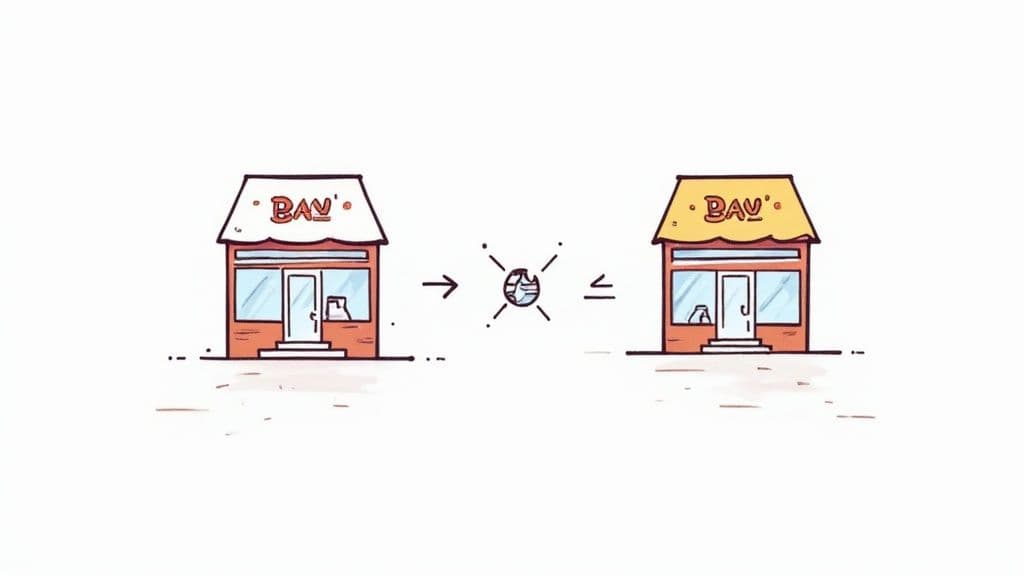
Conversion franchising is a unique and highly effective franchise growth strategy focused on converting existing, independent businesses in the same industry into franchise units. Instead of building a new location from scratch, a franchisor absorbs an established operation, leveraging its existing location, customer base, and operational infrastructure. The independent business owner benefits by gaining access to a powerful brand name, proven systems, and extensive marketing support.
This approach offers an instant boost in market presence and revenue streams for the franchisor, bypassing the lengthy and costly processes of site selection, construction, and initial customer acquisition. It essentially fast-tracks expansion by tapping into a pool of experienced operators who are already embedded in their local communities.
How to Implement a Conversion Program
A successful conversion strategy requires a delicate balance of attractive incentives, clear communication, and robust support systems to ensure a smooth transition.
*Develop a Compelling Value Proposition: Independent owners are often proud of their business. Your offer must be compelling, highlighting clear benefits like increased profitability through group purchasing power, access to sophisticated technology, and comprehensive marketing campaigns they could not afford on their own. *Offer Financial and Operational Incentives: Create a tiered incentive structure. This might include reduced initial franchise fees, flexible royalty rates for the first year, or financial assistance for rebranding costs like signage and interior updates. Provide extensive hands-on support during the transition period. *Create a Streamlined Conversion Process: Design a dedicated onboarding and training program specifically for converting owners. This program should respect their existing experience while thoroughly integrating them into your brand standards, operational procedures, and reporting systems.
Key Insight: The most successful conversion programs target business owners who are facing a specific challenge, such as succession planning, marketing fatigue, or an inability to compete with larger chains. Your franchise system should be positioned as the direct solution to these pain points.
The hotel and real estate industries provide classic examples of this strategy. Brands like Comfort Inn (part of Choice Hotels) and RE/MAX have grown exponentially by converting independent hotels and real estate brokerages. They offer these established businesses the power of a national brand and a global reservation or referral system, instantly elevating their competitive position. This strategy is ideal for mature industries where numerous independent operators already exist.
- Area Representative/Development Agent Programs
The Area Representative or Development Agent model is one of the more nuanced franchise growth strategies, offering a balance between direct franchisor control and rapid market penetration. In this structure, a franchisor appoints an experienced professional to act as a regional manager or local extension of the corporate team. This agent is responsible for recruiting new franchisees, providing initial and ongoing training, and offering local operational support within a defined territory. Unlike master franchisees, area representatives typically do not own the franchise agreements of the units in their territory. Instead, they earn a commission on the initial franchise fees and a percentage of the ongoing royalties collected from the franchisees they support. This model allows the franchisor to maintain direct legal relationships with each franchisee while leveraging the local expertise and sales acumen of the area representative to fuel expansion.
How to Implement an Area Representative Program
A successful program requires a strong partnership built on clear expectations and aligned incentives.
*Define the Role and Territory Clearly: Create a detailed profile of the ideal area representative, focusing on sales, management, and industry-specific experience. Assign exclusive, well-defined territories that are large enough to be profitable but manageable for a single representative. *Develop a Compelling Compensation Structure: The financial model must be attractive enough to attract top talent. This usually involves a significant split of the initial franchise fee (often 40-60%) and a recurring percentage of the royalty stream from the units in their territory. *Establish Rigorous Support and Accountability Systems: Provide comprehensive training on your brand, sales processes, and operational standards. Implement regular communication protocols, performance reviews, and clear key performance indicators (KPIs) to ensure representatives are meeting development targets and upholding brand quality. You can learn more about how this impacts your overall franchise recruitment strategy.
Key Insight: The Area Representative model is an "asset-light" way to build a local support infrastructure. It allows franchisors to scale their sales and support functions without the high fixed costs of establishing corporate regional offices and hiring full-time employees.
Jackson Hewitt Tax Service has famously used this model to build a massive national footprint. Their area representatives are deeply embedded in their local business communities, enabling them to recruit qualified franchisees and provide hands-on support during the critical tax season. This approach is ideal for brands that require strong local sales and operational coaching but want to retain ultimate control over the franchise relationship.
- Joint Venture and Partnership Growth
Joint venture and partnership growth is a highly effective franchise growth strategy that involves collaborating with other established businesses to accelerate expansion. Instead of going it alone, a franchisor forms a strategic alliance with a complementary brand, investor, or established company. This approach allows both parties to leverage shared resources, existing customer bases, and combined market presence to fuel mutual growth. This strategy significantly reduces the capital investment and risk typically associated with opening new locations. By partnering with a host business that already has prime real estate and high foot traffic, a franchise can access new markets quickly and cost-effectively. The partner benefits by adding a popular brand and new revenue stream to their existing operation, enhancing their customer experience and value proposition.
How to Implement Joint Ventures and Partnerships
A successful partnership relies on strategic alignment, clear agreements, and seamless operational integration.
*Identify Synergistic Partners: Look for non-competing businesses that share a similar target demographic. Think of brands whose customers would naturally appreciate your product or service. Examples include coffee shops inside bookstores, QSRs in gas stations, or fitness concepts within larger retail centers. *Establish Clear Partnership Agreements: The legal agreement is paramount. It must explicitly define financial arrangements (revenue sharing, fees), operational responsibilities, marketing contributions, brand usage guidelines, and performance metrics. Crucially, it must include a clear exit strategy for both parties. *Ensure Brand and Operational Compatibility: The partnership must feel natural to the consumer. Align on customer service standards, operational hours, and marketing messages. The integration should be seamless, so the customer experience remains consistent and positive across both brands.
Key Insight: The most successful partnerships are built on mutual benefit and brand fit. The goal is to create a combined offering that is more valuable to the customer than either brand standing alone, creating a powerful competitive advantage.
This strategy is famously executed by Starbucks, which established a strong presence inside retailers like Target and Barnes & Noble. Similarly, Yum! Brands often co-brands locations, housing a Taco Bell and a KFC under one roof to capture a broader customer base with shared operational costs. This approach is ideal for brands seeking rapid, low-capital expansion into high-traffic areas where standalone real estate is scarce or expensive.
- Digital-First Franchise Models
A digital-first franchise model is one of the most modern franchise growth strategies, built around technology to reduce overhead and streamline operations. Unlike traditional brick-and-mortar concepts, these franchises leverage digital platforms for everything from service delivery and marketing to customer support and back-end management. This approach significantly lowers startup costs for franchisees, removes geographical constraints, and allows for rapid scalability with a smaller physical footprint.
 These models cater to a new generation of entrepreneurs seeking flexibility and lower barriers to entry. By centralizing key functions through technology, the franchisor can provide robust support remotely, ensuring brand consistency while empowering franchisees to operate from virtually anywhere. The reliance on data analytics also enables more informed, real-time business decisions for both the franchisee and the franchisor.
How to Implement a Digital-First Model
Success with a digital-first model depends on building a powerful and user-friendly technology ecosystem.
*Invest in a Robust Tech Stack: Your core platform is your foundation. This includes a comprehensive CRM, project management software, digital marketing automation tools, and a centralized communication portal. The system must be scalable, secure, and intuitive for franchisees. *Develop Comprehensive Virtual Training: Create a dynamic online training program using video modules, live webinars, and knowledge bases. This ensures franchisees are proficient with your digital tools and operational standards without the need for extensive in-person sessions. You can learn more about the best franchise technology solutions on franfunnel.com. *Prioritize Digital Marketing Support: Franchisees will rely heavily on online lead generation. Provide them with proven digital marketing playbooks, assets for social media and search engine marketing, and performance dashboards to track their ROI.
Key Insight: In a digital-first model, your technology is your most valuable asset. Continuous investment in your tech stack and virtual support systems is not an expense, it is the core driver of franchisee success and system-wide growth.
Brands like Dream Vacations, a home-based travel agency franchise, exemplify this model's power. They provide franchisees with a comprehensive suite of web-based marketing, booking, and business management tools, enabling them to run a full-service agency from home. This strategy is ideal for service-based businesses in sectors like IT support, digital marketing, and professional consulting where physical presence is not a primary requirement.
- Non-Traditional Location Development
Non-traditional location development is a creative franchise growth strategy that involves placing units in unconventional, high-traffic venues outside of typical retail spaces. This approach targets captive audiences in locations like airports, universities, hospitals, military bases, sports stadiums, and even inside larger retail stores. By operating in these specialized environments, a franchise can tap into a constant stream of customers with limited direct competition, boosting brand visibility and generating significant incremental revenue. This model is effective because it brings the product or service directly to where consumers already are for other reasons. A Subway inside a convenience store or a Dunkin’ at a travel plaza captures customers who might not have made a separate trip. This strategy allows franchisors to access valuable real estate and new demographics, expanding their market footprint into areas that a traditional standalone location could not service. It is a powerful way to maximize brand exposure and convenience.
How to Implement Non-Traditional Location Development
Success in this area requires flexibility, strong partnerships, and operational adaptability.
*Identify High-Traffic Host Venues: Research potential partners like airport authorities, university administrators, hospital management, or major retailers (e.g., Walmart, Target). Analyze foot traffic, demographic fit, and the potential for long-term partnership. *Develop a Flexible Operational Model: Non-traditional locations often have space constraints, unique operating hours, or specific security requirements. Create a streamlined store model, potentially with a limited menu and specialized equipment, to fit these unique environments. *Negotiate Mutually Beneficial Agreements: Lease or licensing agreements are key. They must clearly define revenue-sharing or rent structures, operational guidelines, and marketing responsibilities. Build strong relationships with the host venue’s management to ensure smooth operations. *Adapt Marketing to the Environment: Your marketing efforts should be tailored to the specific audience. For example, promotions at a university location could target students and faculty, while airport marketing might focus on travelers needing quick service.
Key Insight: The primary advantage of non-traditional locations is access to a captive audience. Your success depends on adapting your operations and offerings to meet the specific needs and constraints of that unique environment and its customer base.
A classic example is Starbucks’ strategic partnership to open locations inside Target stores. This symbiotic relationship drives foot traffic for both brands; shoppers can grab a coffee while they shop, enhancing the overall customer experience and increasing the sales potential for both the host and the franchise. This approach is ideal for brands with high name recognition and a product that fits seamlessly into the customer's daily routine.
- Micro-Franchise and Low-Investment Models
Micro-franchising is a strategic approach that opens the door to franchise ownership for a much broader audience by significantly lowering the initial investment. This model involves creating a low-cost, simplified version of the business that can be operated with minimal overhead, often from home or as a mobile service. The core idea is to distill the business into its most essential, repeatable components, making it accessible to individuals who may not have the substantial capital required for traditional franchise opportunities. By reducing financial barriers, this strategy dramatically expands the pool of potential franchisees. Franchisors benefit from faster growth, deeper market penetration into niche communities, and the ability to tap into a highly motivated and diverse group of entrepreneurs. These models typically feature streamlined operations, turnkey systems, and robust support, ensuring that even first-time business owners can succeed while upholding brand standards. This approach is a powerful tool in any arsenal of franchise growth strategies.
How to Implement a Micro-Franchise Model
Executing a low-investment model requires a focus on simplicity, scalability, and support. The goal is to create an opportunity that is both affordable and sustainable for the franchisee.
*Simplify the Business Model: Strip the operation down to its core revenue-generating activities. This could mean focusing on a limited menu of services, creating a mobile-only concept instead of a brick-and-mortar location, or leveraging technology to reduce administrative tasks. *Develop Efficient, Turnkey Training: Since franchisees may have less business experience, training must be comprehensive yet easy to digest. Create modules that cover every aspect of the simplified operation, from service delivery to marketing and customer service, allowing for a quick ramp-up period. *Provide Robust Ongoing Support: A strong support system is critical for franchisee success and brand consistency. Offer centralized marketing resources, a dedicated support hotline, and regular check-ins to help new owners navigate challenges and grow their business.
Key Insight: A low-investment model isn't just about being cheaper; it's about being smarter and more accessible. Success comes from creating a highly efficient, replicable system that empowers individuals with passion and drive, not just those with deep pockets.
A classic example is Jazzercise, which allows fitness instructors to launch their own classes with a very low initial franchise fee. Similarly, home-based models like Cruise Planners and Dream Vacations empower individuals to become travel agents without the high cost of a retail storefront. These brands prove that lowering the barrier to entry can unlock rapid, widespread growth by attracting a passionate and diverse network of owner-operators.
- Franchise Broker Network Development
Developing a franchise broker network is a highly effective growth strategy that outsources a significant portion of the lead generation and qualification process. This approach involves partnering with independent franchise brokers or consulting groups who act as third-party matchmakers. These professionals work with aspiring entrepreneurs to understand their goals, financial capabilities, and skills, then recommend franchise opportunities that align with their profile. For a franchisor, this creates a pipeline of pre-qualified, educated, and motivated candidates. Instead of casting a wide net with franchise development marketing, you tap into the trusted relationships and extensive networks that brokers have already cultivated. Brokers are paid a commission, typically a significant percentage of the initial franchise fee, only upon the successful signing of a new franchisee. This performance-based model makes it a cost-effective method for accelerating franchise sales and reaching candidates who may not have discovered your brand through traditional channels.
How to Implement a Franchise Broker Network
Building a successful network requires strategic selection, robust support, and strong relationship management.
*Select and Vet Broker Partners: Not all brokers are a fit. Partner with reputable networks like FranNet or The Franchise Consulting Company, or individual brokers with experience in your specific industry. Ensure they understand your ideal franchisee profile and brand values. *Provide Comprehensive Support and Training: Equip your brokers with a detailed toolkit, including your Franchise Disclosure Document (FDD), marketing collateral, clear discovery day processes, and direct access to your development team. Regular training sessions keep them updated on your brand’s evolution. *Establish a Competitive Commission Structure: To attract and retain top-performing brokers, your commission structure must be competitive within the industry. A clear, fair, and promptly paid commission system is crucial for building trust and motivating brokers to present your brand favorably.
Key Insight: A franchise broker network is not a "set it and forget it" strategy. The most successful franchisors treat their brokers as true partners, investing time in communication, providing ongoing support, and ensuring the relationship is mutually beneficial.
Many emerging and established brands utilize groups like the International Franchise Professionals Group (IFPG) to connect with hundreds of qualified consultants. When recruiting, whether through brokers or at trade shows, leveraging impactful exhibition display ideas can dramatically increase visibility and attract higher-quality candidates. This strategy is ideal for brands looking to scale their recruitment efforts efficiently without a massive in-house sales team.
Franchise Growth Strategies Comparison Matrix
| Model | Implementation Complexity | Resource Requirements | Expected Outcomes | Ideal Use Cases | Key Advantages ★ |
|---|---|---|---|---|---|
| Master Franchise Development | High: legal agreements, oversight, vetting | High initial setup, lower ongoing capital | Accelerated international expansion, local market penetration | Large territories, international markets | Rapid growth with reduced capital, local expertise |
| Multi-Unit Development Agreements | Moderate to High: scheduled openings, territory mgmt | Experienced, well-capitalized franchisees | Faster market saturation, economies of scale | Experienced franchisees scaling multiple units | Competitive protection, reduced recruitment costs |
| Conversion Franchise Programs | Moderate: brand transition, staff retraining | Lower initial investment than new start-ups | Immediate market presence and revenue | Existing independent businesses or competing franchises | Fast ROI, leverage established locations/customers |
| Area Representative Programs | Moderate: selecting reps, training, coordination | Regional reps with industry experience | Scalable regional growth, improved franchisee satisfaction | Geographic territories needing local market support | Reduced corporate overhead, faster franchisee response |
| Joint Venture and Partnership | High: legal/financial complexity, shared control | Shared investment and resources | Accelerated growth, shared risks and resources | Collaborative growth with complementary partners | Reduced risk, expanded market access, shared expertise |
| Digital-First Franchise Models | Moderate to High: tech platform build and support | Lower startup costs, strong IT infrastructure | Rapid scalability, data-driven optimization | Tech-enabled or virtual franchises | Lower costs, greater flexibility, enhanced data insights |
| Non-Traditional Location Dev. | Moderate: complex leases, specialized ops | High rent and specialized staffing | Consistent captive audience, premium pricing | Airports, hospitals, universities, transportation hubs | Exclusive locations, reduced competition |
| Micro-Franchise / Low-Investment | Low to Moderate: simplified setup and training | Low initial investment ($10K-$50K) | Easier market penetration, broader franchisee demographic | First-time owners, low-capital entrepreneurs | Accessibility, faster ROI, expanded candidate pool |
| Franchise Broker Network | Low to Moderate: managing brokers and communications | Commission fees (25-50% of franchise fee) | Qualified leads, accelerated franchise sales | Franchise sales acceleration via third-party specialists | Reduced sales staffing, access to broader market |
Choosing Your Path to Sustainable Franchise Growth
The journey from a promising concept to a national or global franchise powerhouse is not paved with a single, universal blueprint. As we've explored, the landscape of franchise growth strategies is rich and varied, offering a spectrum of options that cater to different brand identities, capital structures, and market ambitions. Your brand's ascent is not about finding a magic bullet; it's about architectural precision. It requires building a growth engine from a combination of meticulously chosen, well-executed components. The nine strategies detailed in this article, from leveraging Master Franchisees for international expansion to pioneering Micro-Franchise models for market accessibility, represent the core toolkit for the modern franchisor. They are not mutually exclusive pathways but rather interconnected gears. You might find that a Multi-Unit Development Agreement in one region pairs perfectly with a Conversion Franchise Program in another, or that a network of Area Representatives is the ideal vehicle to support Non-Traditional Location development.
Synthesizing Strategy into Action
The critical takeaway is that sustainable growth is intentional. It moves beyond simply selling more units and evolves into a strategic placement of brand assets, human capital, and financial resources. The most successful franchisors are those who can zoom out to see the big picture and then zoom in to manage the granular details of implementation. Reflect on the following key questions as you plot your next steps:
*Brand Alignment: Which growth model best reflects your brand's core mission and operational complexity? A high-touch, service-based franchise may thrive under an Area Representative model, while a simple, product-focused concept might scale rapidly through Multi-Unit operators. *Capital Efficiency: How can you maximize growth without overextending your financial and human resources? Models like Master Franchising or Conversion Programs can shift a significant portion of the capital and operational burden to your partners. *Market Penetration: What is the most effective way to enter and dominate your target markets? A joint venture could be the key to unlocking a challenging international market, whereas developing a strong broker network might be the fastest way to saturate a domestic region. *Support Scalability: Can your corporate team effectively support the growth model you choose? The infrastructure needed to support 100 single-unit franchisees is vastly different from that required to manage 10 multi-unit developers who own 10 units each.
The Unifying Factor: Speed and Execution
Regardless of which combination of franchise growth strategies you deploy, one element remains constant: the critical importance of speed and professionalism in your franchise development process. Every lead generated from your marketing efforts, every inquiry from a potential broker, and every conversation with a prospective multi-unit owner represents a significant investment. Failing to respond instantly and effectively squanders that investment and cedes ground to your competition. In today's fast-paced digital environment, a lead's interest is fleeting. A delay of even a few hours can mean the difference between a signed franchise agreement and a lost opportunity. This is where operational excellence in your lead management process becomes the ultimate competitive advantage. It’s the final, crucial step that turns a well-designed growth strategy into tangible, revenue-generating reality. Your path forward is about making informed choices and executing them with precision. The strategies are available, the markets are waiting, and the potential for exponential growth is real. By carefully aligning your chosen growth model with your brand's unique strengths and reinforcing it with a flawless execution process, you can build not just a larger franchise system, but a more resilient, profitable, and enduring brand legacy.
As you implement these sophisticated franchise growth strategies, ensuring no lead goes cold is paramount. FranFunnel automates the initial contact and qualification process, engaging every potential franchisee within moments of their inquiry. See how our platform can become the engine that powers your expansion by visiting FranFunnel today.
Further reading: franchise development marketing and franchise lead engagement.