
So, you’re thinking about franchising.
It’s a huge step, and before you get lost in the weeds of FDDs and royalty structures, there's a much more important question you need to ask yourself: Is my business actually ready for this?
This is where you have to be brutally honest. Many profitable businesses have tried to franchise and failed spectacularly. Why? Because their success was tied too tightly to the founder’s magic touch or a unique local market that can’t be bottled up and sold.
The real question isn't, "Am I making money?" It's, "Can someone else make money with my system, in a totally different city, with me guiding them?"
This means checking your ego at the door and looking at the hard proof. A cool logo doesn't make a strong brand. A strong brand has a clear identity and a loyal following that isn't just about one specific location. Your concept has to be special enough to stand out, but simple enough that you can teach it to someone else.
Do You Have a Business or Just a Job?
The real test of a "franchise-able" business is its systems. Is every single part of your day-to-day operation documented, standardized, and repeatable?
I'm talking about a crystal-clear playbook. A franchisee needs a guide that covers everything from how to order supplies and run local marketing campaigns to the exact script for greeting a customer.
Key Takeaway: If your business operations exist mostly in your head, you are not ready to franchise. The entire model must be transferable through clear, comprehensive documentation and training.
A critical piece of this foundation is creating a robust business plan that maps out your concept and financial picture. This isn't just for getting a loan; it's the blueprint for your entire franchise strategy.
Are Your Pockets (and Your Mindset) Deep Enough?
Finally, let’s talk money and mentality. You’re going to need a significant amount of capital just to get this off the ground—think $50,000 to over $200,000 for legal fees, marketing, and building your support team before you ever see a dime in royalties.
And are you ready? Being a franchisor means shifting from being a hands-on owner to a leader, coach, and mentor for other owners. It’s a completely different job.
Here’s a quick gut-check to see if you’re on the right track:
- Proven Profitability: Do you have at least one—ideally more—corporate-owned location that is consistently profitable and shows a strong ROI?
- Brand Strength: Does your brand have a good reputation that extends beyond your immediate neighborhood?
- System Replicability: Could you hand a complete operations manual to a stranger and have them replicate your success?
- Leadership Capacity: Are you ready to stop doing the work and start leading, training, and supporting other people who are doing the work?
This self-assessment is non-negotiable. Answering these questions honestly is the only way to ensure you're building a franchise on a rock-solid foundation, not just on a dream.
Pinpointing Your Ideal Franchise Markets
Expanding your franchise without a solid, data-backed plan is like driving blind. Just picking a city because it's trendy or has a huge population is a recipe for a very expensive mistake. Real franchise strategy is about digging into the data to find territories that are genuinely ripe for growth—putting your brand and your future partners in a position to win from day one.
This isn't about guesswork. It's about a methodical analysis of regional economies, the competitive landscape, and the exact consumer demographics that match your ideal customer.

Analyzing Regional Economic Health
Before you look at anything else, you have to get a feel for the economic pulse of a potential market. A booming national economy doesn't mean every city is thriving. You need to get granular and look at local indicators that signal long-term stability and growth.
A few key metrics to dig into include:
- Local GDP Growth: Is the area’s economy actually expanding or is it shrinking? A growing GDP is a strong sign of a healthy business environment.
- Unemployment Rates: Lower unemployment usually means more disposable income, which is obviously critical for most consumer-facing businesses.
- New Business Formations: Are new businesses opening up and sticking around? This points to a supportive ecosystem for entrepreneurs.
For instance, high-level trends already point to massive geographic opportunities. Projections show that the Southeast and Southwest U.S. will likely outperform other regions, thanks to business-friendly policies and a lower cost of living. In these areas, franchise output is expected to jump by 6.2% and 8.5%, respectively. You can discover more about the key insights in the 2025 franchising economic outlook. This is the kind of data that helps you narrow your focus to the most promising states from the start.
Evaluating Competitor Density
Okay, so you've found an economically sound region. Now it's time to zoom in on the competition. It’s a common mistake to think a market with zero competitors is a golden ticket. More often than not, a total lack of competition means there's simply no demand for what you're selling. On the flip side, an oversaturated market can make it nearly impossible to get a foothold.
The goal is to find that sweet spot. Use tools like Google Maps and industry directories to map out every direct and indirect competitor in a territory. Don't just count them—analyze them. What are their prices? What do their customer reviews say? Finding a competitor's weakness, like terrible service or an outdated product, is where you'll find your opening.
A market with a few moderately successful competitors is a good thing—it proves customer demand exists. Your job is to figure out if you can step into that market and do it better, stealing a significant chunk of their customers.
Building Your Ideal Franchisee Profile
Finding the right market is only half the battle; you also need to find the right partner for that market. Your ideal franchisee isn't just someone with a checkbook. They need to be a perfect cultural and operational fit for your brand.
Think about the traits of your most successful managers, or even yourself. What makes them tick?
- Experience Level: Do they need a deep background in your specific industry, or is general business savvy enough?
- Personality Traits: Are they hands-on, in-the-weeds operators or more strategic, big-picture thinkers? Do they need to be killer salespeople or masters of operational discipline?
- Community Ties: Is it important for them to be well-connected locally?
Creating a detailed avatar of your ideal franchisee makes your recruitment marketing incredibly effective. You'll know exactly who you're looking for, which lets you tailor your messaging to attract high-quality leads who are a natural fit for your system.
Modeling Financial Feasibility
Finally, every potential market has to pass a financial stress test. This isn't about throwing vague numbers at a wall. It's about building a realistic financial model based on the specific costs and revenue potential of that territory. Your model needs to project potential royalty streams and initial franchise fees against the market’s unique conditions.
| Financial Feasibility Factor | Key Questions to Answer | Example Scenario (Quick-Service Restaurant) |
|---|---|---|
| Real Estate Costs | What are the commercial lease rates per square foot in target neighborhoods? | A suburban strip mall in Dallas might be $35/sq ft, while a downtown Austin location is $70/sq ft. |
| Labor Market | What is the average wage for the required staff in this city? | Minimum wage laws and market demand could mean paying staff 25% more in Denver than in Omaha. |
| Revenue Projections | What is the average household income and discretionary spending in the area? | A territory with a median household income of $95,000 has a higher revenue ceiling than one at $55,000. |
By running these numbers, you get a crystal-clear picture of a market's viability before you spend a single dollar on expansion. This data-driven approach pulls emotion out of the decision-making process, ensuring every new location is set up for profitability right from the start.
Crafting Your Franchise Operations Blueprint
So, you've nailed down your markets. Great. Now comes the real work: turning your one-location success story into a system anyone can copy and paste. This is where you bottle up the magic of your business into a blueprint that's easy to follow.
Getting this right hinges on two critical pieces: a rock-solid legal framework and an operations manual so detailed it leaves nothing to chance. These aren't just documents; they're the foundation of your entire franchise offering. They build trust, ensure consistency, and protect everyone involved.
The Franchise Disclosure Document Isn't Just Legal Mumbo Jumbo
The Franchise Disclosure Document (FDD) is the first big piece of that legal puzzle. It’s a beast of a document, required by law, that gives potential franchisees the full scoop on your business. Too many founders see it as just another legal hurdle, but that's the wrong way to look at it.
Think of it as your first real trust-building exercise.
Transparency is everything here. The FDD has to lay out all the details a franchisee needs to make a smart decision. This includes:
- The history of your company and who's running the show.
- Any past legal battles or bankruptcies (don't hide them).
- A full breakdown of all the fees: initial fee, royalties, marketing costs, everything.
- The total estimated initial investment, line by line.
- A clear outline of what you're responsible for and what they're responsible for.
It's basically a pre-nup for your business relationship. Getting everything on the table from day one is how you attract serious, high-quality partners who value honesty over hype.
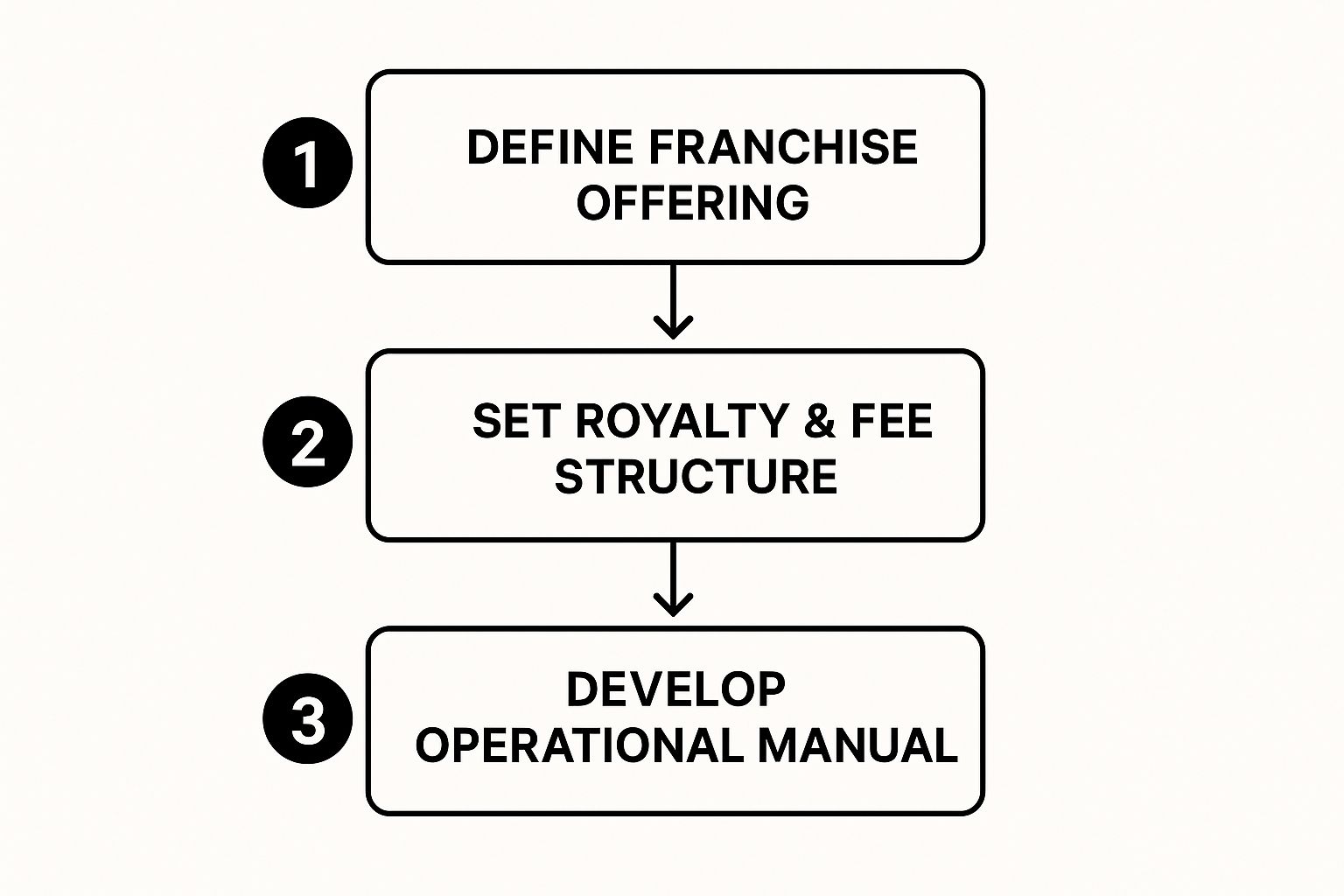
This image gives you a bird's-eye view of the whole process. It shows how you move from defining what you're selling, to sorting out the money, and finally, documenting exactly how everything gets done.
Structuring Fees for a Win-Win
One of the biggest sticking points I see with new franchisors is figuring out the fees. You need a model that makes you money, obviously, but it absolutely has to let your franchisees run a profitable business. If they aren't winning, the whole system crumbles. It's that simple.
Finding that sweet spot is part art, part science. Here are the two main financial levers you'll be pulling:
- Initial Franchise Fee: This is the one-time payment a franchisee makes to get in the door. It usually covers their training, help with site selection, and your initial support. We typically see this fall somewhere between $20,000 to $50,000, though it can swing wildly depending on the industry.
- Ongoing Royalties: This is your main revenue stream as a franchisor. It's a recurring fee, usually a percentage of their gross sales (often 4% to 8%), that covers your ongoing support, brand development, and system improvements.
A great fee structure should feel like a partnership. Franchisees should feel like their royalty checks are a direct investment in the support and brand power that helps them succeed, not just a tax on their revenue.
To help you think through the options, let's compare a few common structures.
Franchise Fee and Royalty Structure Comparison
Deciding on your fee model is a foundational decision. Here’s a breakdown of the most common approaches, highlighting their benefits and drawbacks to help you see which might be the best fit.
| Structure Type | Description | Pros | Cons |
|---|---|---|---|
| Percentage of Gross Revenue | Franchisees pay a fixed percentage of their total sales. | Simple to calculate and scales with franchisee success. Aligns franchisor and franchisee goals. | Can be a burden during slow periods. Requires transparent and accurate sales reporting. |
| Fixed Fee (Flat Rate) | Franchisees pay a set, recurring amount regardless of revenue. | Predictable revenue for the franchisor. Motivates high-performing franchisees since they keep more profit. | Doesn't scale with franchisee growth. Can be punishing for struggling locations. |
| Tiered Percentage | The royalty percentage changes based on revenue milestones. | Encourages growth by rewarding higher sales with a lower percentage. | More complex to track and manage. Can create confusion if not clearly defined. |
| Minimum Fee | Franchisees pay either a percentage of revenue or a minimum flat fee, whichever is greater. | Provides a stable revenue floor for the franchisor, even with underperforming units. | Can put significant pressure on new or struggling franchisees. |
Ultimately, the best structure reflects the value you provide. If your ongoing support is intensive, a percentage-based model makes sense. If your system is more hands-off, a fixed fee could be more attractive to potential partners.
The Operations Manual: Your Ultimate Playbook
If the FDD is the legal contract, the operations manual is the "how-to" guide for actually running the business. I'd argue this is the single most important document for keeping your brand consistent from one location to the next. A vague or lazy manual is a one-way ticket to brand chaos and franchisee failure.
Your ops manual needs to be painfully detailed. Seriously, leave no stone unturned. It is the bible for replicating your success. For a deeper dive into this, check out our guide on building a complete franchise development plan, which covers this in detail.
A killer manual breaks down every single part of the business:
- Customer Service: Greeting scripts, how to handle complaints, refund policies.
- Product/Service Delivery: Specific recipes, step-by-step service procedures, quality checklists.
- Marketing & Sales: Pre-approved local marketing tactics, social media dos and don'ts.
- Daily Routines: Opening/closing checklists, inventory counts, staff scheduling.
- Financials: How to handle cash, daily reporting requirements, bookkeeping standards.
Let's put this in perspective. A fast-food franchise manual wouldn't just list "turkey sandwich" on the menu. It would specify the brand of turkey, the exact weight of the meat, the number of pickles, the precise toasting time for the bun, and show a diagram of how to wrap it.
That's the level of detail that separates the great franchise systems from the mediocre ones. It’s the playbook that gives your franchisees the confidence to go out and win.
Recruiting and Training Your First Franchisees
Your franchise strategy is just a document until you bring people into the system. And make no mistake, the people you bring in—your first franchisees—will define your brand's future. They are your proof of concept, your front-line ambassadors, and the foundation for all future growth.
Getting this part right isn’t a passive process. It demands a deliberate, thoughtful approach to finding and preparing the right partners.
Attracting the Right Candidates
Before you can pick the perfect franchisee, you have to get them in the door. This means you need to move past generic "franchise with us" ads and build a funnel that speaks directly to the person you want to partner with.
Your best tool for this? Compelling content.
Think about creating videos, blog posts, and testimonials that don't just sell a business opportunity but showcase your brand's why. A detailed case study on a successful corporate store, complete with real numbers and operational insights, is infinitely more powerful than a glossy brochure. To build a robust pipeline of candidates, you have to master your franchise recruitment strategy from day one.
A few powerful channels to get you started:
- Digital Lead Generation: Use targeted ads on platforms like LinkedIn and the big franchise portals to reach people who are actively looking for their next move.
- Content Marketing: Start a blog or a webinar series. Position yourself as an expert and give candidates a genuine taste of your company culture and what it takes to succeed.
- Franchise Expos: They can be expensive, but there's no substitute for face-to-face interaction. Expos allow you to make a personal connection that digital channels just can't replicate.
Designing a Rigorous Vetting Process
Once leads start trickling in, you need a multi-stage vetting process that goes way beyond a credit check. You're not just assessing financial stability; you're looking for cultural fit, operational aptitude, and a real passion for what you do. A weak vetting process is a recipe for future disaster—from brand standard violations to constant support headaches.
Your process should feel less like an interrogation and more like a mutual discovery.
Key Insight: The best selection processes are two-way streets. While you're interviewing them, they are absolutely interviewing you. Total transparency and a focus on mutual success are what build the strongest long-term partnerships.
Think about a multi-step journey:
- Initial Application & Financial Review: This is the first gate. Does the candidate meet the basic financial requirements? Is their background clean?
- Discovery Call: This is your first real conversation. Your goal is to understand their "why." Why this brand? What are their personal and professional goals? This is your first gut check for cultural alignment.
- FDD Review & Q&A: Hand over the Franchise Disclosure Document and give them plenty of time to review it with their lawyer. Then, host a dedicated call to answer every single question they have. No holding back.
- Discovery Day: Invite your top candidates to headquarters. Let them meet the support team, see a location in action, and truly get a feel for the business. This is the ultimate test of fit for both sides.
Building a World-Class Onboarding Program
The moment a franchisee signs on the dotted line, the real work begins. Your onboarding and training program is your first and best chance to set your new partner up for success. A rushed or incomplete training program is a direct path to an underperforming location.
The goal is simple: turn an enthusiastic entrepreneur into a confident, capable operator of your system.
To make sure your franchisees are truly ready, look into modern training frameworks like a Competency-Based Training Approach. This model shifts the focus from simply "checking the box" on training hours to demonstrating true mastery of essential skills.
Your program should blend different learning styles and cover every part of the business.
| Training Module | Format | Key Topics Covered |
|---|---|---|
| Foundational Training | Classroom & Virtual | Brand history, mission, culture, FDD review, business planning, key performance indicators (KPIs). |
| Operational Training | In-Store (Corporate Location) | Day-to-day procedures, inventory management, POS system, customer service scripts, quality control. |
| Pre-Opening Support | On-Site & Remote | Site selection assistance, lease negotiation guidance, construction management, vendor setup. |
| Launch Week Support | On-Site | Hands-on support from a corporate trainer during the grand opening week to ensure a smooth launch. |
A comprehensive approach like this ensures that when your franchisees open their doors, they aren't just hopeful—they're prepared. They have the tools, the knowledge, and the confidence to execute your vision and build a thriving business from day one.
Building Technology And Support Systems That Scale
When you're managing just a handful of locations, a few spreadsheets and a smartphone can get the job done. But as you start to scale, that manual approach stops being just inefficient—it becomes a direct threat to your brand's consistency and your ability to grow.
A real franchise strategy isn't about reacting to growth; it's about building an infrastructure that fuels it. You need a centralized nervous system that connects you, your franchisees, and your customers without the chaos.

Constructing Your Core Tech Stack
Your tech stack is more than just software. It’s the single source of truth for your entire operation. The right tools bring clarity, make communication seamless, and give you the data you need to make smart decisions. Without this backbone, you’re flying blind.
These are the non-negotiables for any franchise system built to last:
- Customer Relationship Management (CRM): Think of this as your franchise development command center. A solid CRM tracks every lead, conversation, and document from the first inquiry all the way to a signed franchise agreement. Nothing falls through the cracks.
- Point of Sale (POS) System: A standardized, integrated POS is absolutely critical. It guarantees consistent pricing and promotions across every location, but more importantly, it feeds real-time sales data back to corporate. That data is gold for tracking performance and spotting trends.
- Central Communication Hub: Whether it’s an intranet portal, a dedicated Slack channel, or your own platform, you need one spot for all official communications. This is where you'll share operations updates, new marketing materials, and training resources. It cuts through the noise and helps build a connected community.
A strong technological backbone is what allows a franchise to scale without breaking. Understanding the bigger picture, like a comprehensive Data Center Overview, helps you appreciate what it takes to support a national brand's data load.
Designing a Proactive Support Structure
Technology is only half the battle. World-class support is what keeps your franchisees engaged, profitable, and true to the brand vision. A reactive, ticket-based system just won’t cut it. You need to be proactive, providing guidance before problems pop up.
Your support should be tiered, so franchisees have clear points of contact for different needs. This avoids the classic "who do I even call for this?" dilemma and gets issues resolved fast.
A dedicated franchise business consultant (FBC) model is a proven winner here. Each FBC gets a portfolio of franchisees and acts as their primary coach and guide. They're on the ground conducting site visits, reviewing performance data, and helping owners tackle local marketing and operational hurdles.
The goal of your support system isn't just to solve problems. It's to empower your franchisees to become more successful business owners, which in turn strengthens the entire network.
The franchise industry is booming. Forecasts predict the total number of franchised establishments will grow by 2.5%, hitting nearly 851,402 units. That growth means a whole lot more owners will be relying on their franchisor's infrastructure to succeed.
Integrating Systems For Maximum Impact
The real magic happens when your systems talk to each other. Your POS should feed data into your accounting software, and your CRM should be hooked directly into your lead generation tools. When systems are siloed, you just create more manual work and miss out on valuable insights.
For example, integrating your lead capture forms with a communication platform lets you automate the first touchpoint with prospective franchisees. This ensures every single inquiry gets an immediate, personalized response, which dramatically boosts engagement. Our deep dive into modern franchise tech shows just how powerful these integrations can be.
Think about this workflow: A potential franchisee fills out a form on your website.
- The lead data instantly hits your CRM.
- An automated system immediately sends a personalized SMS and email to the prospect.
- The lead is automatically assigned to the right development rep based on their territory.
This seamless process, all powered by integrated tech, means you never miss an opportunity. It turns your franchise development from a series of manual chores into an efficient, scalable growth engine.
Driving Long-Term Network Health and Growth
Getting your first few franchises launched isn't the finish line—it's the starting gun for a much longer race. A truly effective franchise strategy has to look beyond just selling units. The real goal is to build an ecosystem where every single franchisee can thrive for years.
This is where the focus shifts from sales to support.

This long-term mindset is all about proactive, data-driven coaching. You can't just wait for a franchisee to send up a flare for help. You need to establish and track the key performance indicators (KPIs) that act as an early warning system.
Forget about just looking at top-line revenue. You need to dig deeper into the metrics that reveal the true health of a location. These are the numbers that matter:
- Unit-Level Profitability: Are your owners actually making money after paying all their bills? This is the ultimate stress test for your entire business model.
- Customer Satisfaction Scores (CSAT): Happy customers are repeat customers. If these scores start to dip, it’s a huge red flag that something is off with their operations.
- Cost of Goods Sold (COGS): Keeping a close eye on COGS helps you spot problems with waste, theft, or even supplier pricing issues before they spiral out of control.
Fostering a Collaborative Community
A franchise network is only as strong as its weakest link, but it’s most powerful when everyone feels connected and heard. When you create real channels for communication, you turn a group of individual owners into a collective force that drives the brand forward.
This isn’t just about warm-and-fuzzy feelings; it's a core strategic move.
Here are a couple of proven ways to build that community:
- Establish a Franchisee Advisory Council (FAC): An FAC gives owners a real seat at the table. It’s a structured way for them to share ideas, voice concerns, and have a genuine impact on brand-wide decisions. It gives them true skin in the game.
- Host Annual Conventions: Nothing beats getting everyone in the same room. An annual convention is the perfect place to celebrate wins, roll out new initiatives, and remind everyone they’re part of something much bigger than their four walls. The energy is contagious.
When you invest in the long-term success of your franchisees, you kickstart a powerful, self-sustaining cycle of growth. Profitable, engaged owners become your best brand ambassadors. They validate your concept for new candidates and provide the royalty stream that funds your next big innovation.
This commitment to mutual success is the final, crucial piece of the puzzle. It’s what transforms a simple collection of businesses into a resilient, unified brand that’s built for sustainable growth.
Even after you’ve hammered out a detailed franchise strategy, some big questions always pop up. Let's tackle them head-on, so you know exactly what to expect on this complex but rewarding journey.
How Much Does It Really Cost To Franchise My Business?
There's no single price tag, but you should budget somewhere between $50,000 and $200,000 for the initial setup.
Just to be clear, this isn't for opening another location. This is the one-time investment to build the franchise system itself—the entire infrastructure.
The bulk of that cost goes toward a few key areas:
- Legal Fees: This is the big one. Drafting the Franchise Disclosure Document (FDD) is non-negotiable and requires expert legal help.
- Operations Manual Development: Think of this as your business's bible. It’s the detailed playbook your franchisees will live by.
- Trademark Registration: Protecting your brand is critical as you expand nationally.
- Initial Marketing: You need a solid campaign to find and attract your very first franchisee candidates.
How Long Does The Development Process Take?
Be realistic. It typically takes between four and six months to get your franchise system built and legally ready to sell. For more complex businesses, it can stretch to a year.
Rushing this foundational work is one of the most common—and costly—mistakes I see. Get it right the first time, or you’ll pay for it later.
What Is The Most Important Part Of A Franchise System?
Legal compliance is mandatory, of course. But ask any seasoned franchisor, and they’ll tell you the real secret sauce is a highly detailed and replicable operating system.
This system is your operations manual. It's the blueprint for success.
Without a proven, easy-to-follow system, franchisees will struggle to replicate your original success, leading to brand damage and potential failures. A strong operational foundation is the core of any healthy franchise network. It ensures consistency and gives your partners the best possible chance to thrive.
Ready to turn more qualified leads into successful franchisees? FranFunnel automates the first 60 seconds of lead engagement, ensuring you connect with every prospect instantly. See how our platform can boost your response rates and help you win more deals.