A lead qualification framework is really just a structured filter. It’s the system that separates the real opportunities from the time-wasters, acting like a seasoned guide for your sales team, pointing them straight to the treasure and helping them sidestep the dead ends.
Why Your Sales Team Is Chasing Ghosts
Let’s be honest for a second. Far too many sales teams spend their days chasing leads that simply vanish into thin air. This isn't a problem of effort—it's a problem of strategy. Without a clear system in place, reps are left guessing which prospects are serious and which are just kicking tires. The result? Wasted time, frustration, and missed revenue targets.
A lead qualification framework changes that frustrating guessing game into a predictable, efficient process. It sets up a standard set of criteria that every single lead has to meet before ever landing on a sales rep's desk. This simple step ensures that only prospects with a genuine interest, a real need, and the ability to buy actually make it through.
The Power of a Structured Approach
Putting this kind of structure in place does a lot more than just save time. It systematically pulls your marketing and sales efforts into alignment, creating one unified definition of what a "good lead" actually looks like. That alignment is absolutely critical for any kind of sustainable growth.
The impact on your bottom line can be huge. Companies with a structured qualification process see much higher conversion rates—some research shows an increase of up to 73% compared to those flying blind. You can dig into the full findings on lead qualification process improvements at callin.io.
By filtering out all the noise, a lead qualification framework gives your sales team the freedom to focus their energy where it actually counts: building relationships with people who are ready to have a conversation.
This strategic focus doesn't just boost morale; it dramatically shortens the sales cycle. When reps start their day with well-qualified leads, the conversations are instantly more productive. They can skip the basic, repetitive discovery questions and get right into solving specific pain points and showing real value.
This shift turns your sales process from a leaky bucket into a well-oiled machine, driving consistent results and maximizing the return on every single dollar you spend on marketing.
Before we dive into how to build your own framework, it helps to understand the core pieces that make it work. These are the essential pillars that support any effective qualification strategy.
Core Components of a Modern Lead Qualification Framework
| Component | Primary Function |
|---|---|
| Ideal Customer Profile (ICP) | Defines the perfect-fit company (industry, size, revenue) you should be targeting. |
| Buyer Personas | Describes the specific individuals (job titles, roles, pain points) you need to engage within those companies. |
| Scoring Criteria | Assigns points to leads based on their demographic data, firmographic details, and behaviors (e.g., website visits, content downloads). |
| Disqualification Triggers | Sets clear, non-negotiable rules for automatically filtering out leads that are a poor fit (e.g., competitors, students). |
| Lead Stages | Outlines the specific journey a lead takes from initial contact (MQL) to a sales-ready opportunity (SQL). |
Having these components clearly defined is what allows marketing and sales to finally speak the same language, ensuring a smooth and efficient handoff every single time.
Choosing Your Qualification Model
Picking the right lead qualification framework is a lot like choosing the right tool for a job. You wouldn't use a sledgehammer to hang a picture, and you definitely wouldn't use a tiny tack hammer to break up concrete. The model you choose has to fit your business reality—your sales cycle, the complexity of your product, and who you’re trying to sell to.
There’s no magic, one-size-fits-all solution here. Instead, think of it as a toolbox filled with proven models, each built for a different kind of job. Once you understand what each one is designed for, you can pick the framework that snaps perfectly into your sales process and helps your team qualify leads with real precision.
The right framework isn't just about organizing your pipeline; it's a strategic move that pays off in a big way, as you can see below.
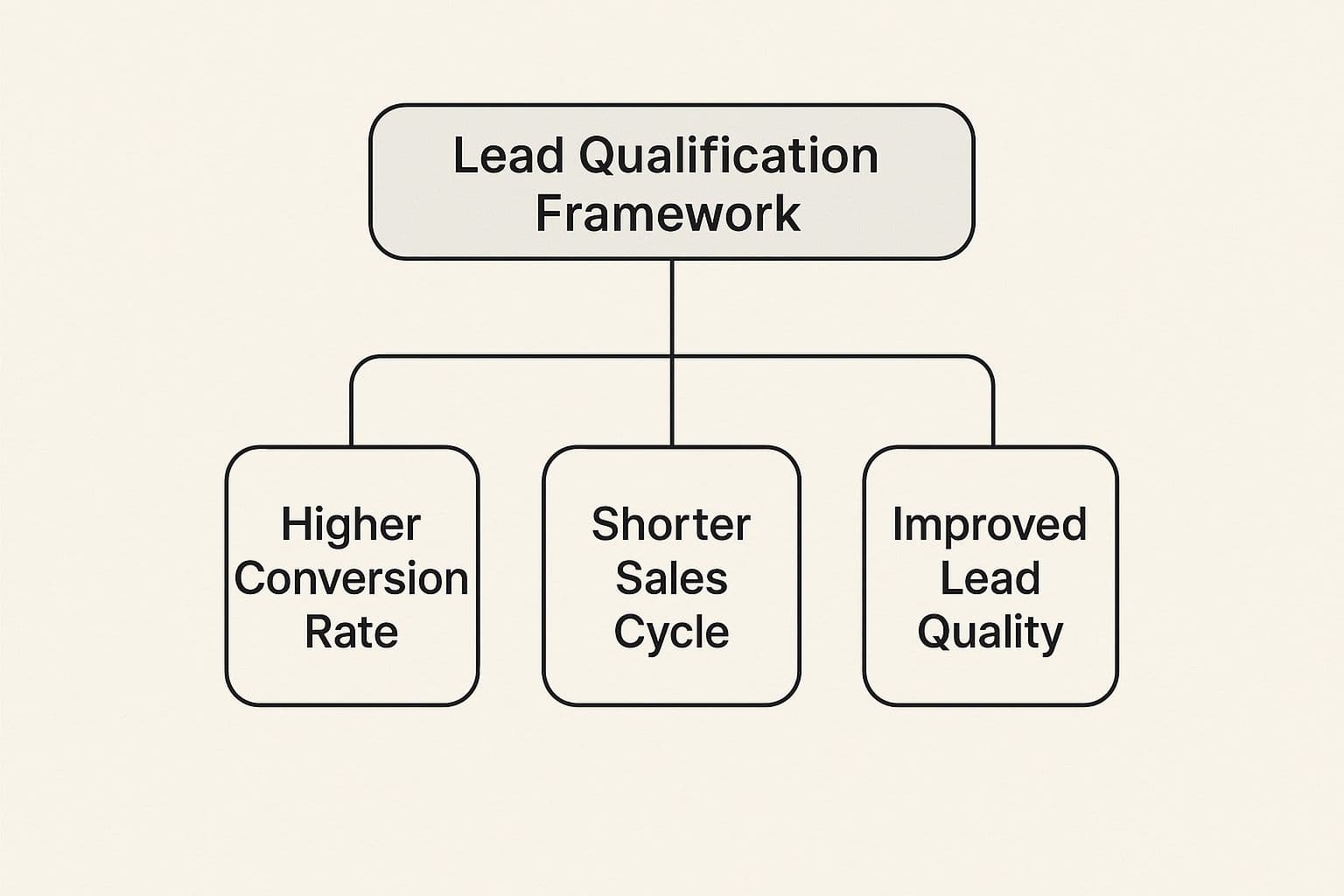
As the numbers show, this isn't just a busywork task. A solid framework directly boosts conversion rates, shrinks your sales cycle, and improves the overall quality of your leads.
BANT For Speed And Simplicity
The BANT model is a classic for a reason. It's clean, simple, and gets straight to the point by focusing on four key pieces of information: Budget, Authority, Need, and Timeline. This framework is a workhorse for businesses with shorter sales cycles and more straightforward products.
Let's say a SaaS company sells a mid-priced marketing tool. When a new lead signs up for a demo, the sales rep can use BANT to quickly figure out if they're a good fit:
- Budget: Does their company actually have money set aside for new marketing software?
- Authority: Is this person the decision-maker, or do they need to get a sign-off from their VP?
- Need: What specific problem are they trying to solve? Why now?
- Timeline: Are they looking to buy this quarter, or are they just kicking tires for next year's budget?
In just a few questions, BANT acts as a quick, effective filter. It ensures your sales team only invests time in demos with people who can realistically become customers.
MEDDIC For Complex Enterprise Sales
When you're dealing with high-value, complex deals that have long sales cycles, you need something more powerful. That's where MEDDIC comes in. It stands for Metrics, Economic Buyer, Decision Criteria, Decision Process, Identify Pain, and Champion.
Imagine you're selling enterprise-grade cybersecurity software to a major bank. The deal is worth six figures and has to go through multiple departments. MEDDIC gives your sales rep a roadmap for a much deeper discovery process.
MEDDIC forces a salesperson to go beyond surface-level qualification. It requires them to understand the customer’s business case, navigate internal politics, and quantify the value of their solution.
This detailed approach helps you uncover the critical stuff, like the specific ROI the buyer is aiming for (Metrics) and finding an internal advocate who will champion your solution when you're not in the room (Champion).
CHAMP: A Customer-Centric Alternative
The CHAMP model is a more modern, customer-first spin on qualification. It stands for Challenges, Authority, Money, and Prioritization. By putting Challenges at the very beginning, it forces the conversation to start with the prospect's pain points.
This model is especially useful when prospects might not even realize they have a problem or understand how your product could solve it. It encourages your reps to act more like consultants, helping the lead define their own needs before you ever start talking about budget or who signs the contract. It’s a more empathetic approach that builds trust from the get-go.
Ultimately, the best lead qualification framework is the one your team will actually use. Pick one of these models as a starting point, but don't be afraid to tweak it to fit your needs. Many companies take these frameworks a step further by layering on a numerical score. To see how that works, you can check out our complete guide on how the best lead scoring software can automate and sharpen this entire process.
Mastering the Art of Lead Scoring
If your qualification framework is the rulebook, then lead scoring is how you keep score. Think of it as a system that translates a lead’s profile and actions into a simple number, giving you a clear, data-backed signal of how ready they are to buy. It’s where the art of understanding your customer meets the science of data.
Without scoring, your sales team ends up treating every lead the same. Lead scoring fixes that by creating a pecking order, automatically pushing the hottest, most engaged prospects to the front of the line. It just makes sense—a lead who visited your pricing page three times is a lot more interested than someone who just downloaded a top-of-funnel ebook. Scoring makes that distinction for you.
This system works by gathering two different types of intel to build a complete picture of each prospect.
Explicit vs. Implicit Scoring
To build a really effective model, you have to understand the two sides of the lead scoring coin. Each one gives you a different piece of the puzzle.
Explicit scoring is all about the hard data a lead gives you directly. It’s their professional resume—the stuff they put in your forms. This includes things like:
- Demographics: Their job title, seniority, and location.
- Firmographics: The industry, size, and annual revenue of their company.
Implicit scoring, on the other hand, is about the digital breadcrumbs they leave behind. This is all about tracking their behavior and how they engage with your brand—from opening an email to watching a webinar.
This behavioral data is a huge deal. Recent surveys show that nearly 75% of companies say how often a lead interacts with their content is the most critical factor in scoring, way more important than company size or industry. You can dig into more of this data with these key lead generation statistics at uplead.com.
A great lead scoring model doesn’t choose between explicit and implicit data; it blends them. A Vice President (explicit) from a target account (explicit) who requests a demo (implicit) is the textbook definition of a hot lead.
Building a Simple Scoring Model
Let's make this practical. To get started, you just need a basic scoring system. The key is to assign points that reflect a lead's potential value and how serious their intent is.
Here’s a sample breakdown:
- High-Value Actions (15-20 points): These are strong buying signals.
- Requests a demo or a quote
- Visits the pricing page
- Medium-Value Actions (5-10 points): This shows they're actively researching.
- Downloads a case study
- Subscribes to your newsletter
- Low-Value Actions (1-3 points): This is just initial, top-of-funnel curiosity.
- Reads a blog post
- Follows you on social media
Then, you set a threshold—let's say 50 points. Once a lead hits that score, you can create an automated trigger that flags them as an SQL and routes them straight to sales.
This kind of automation is a lifesaver, especially in industries like franchising where you’re drowning in inquiries. Managing a high volume of leads is a massive challenge, and this is how you solve it. You can learn more about how AI is fueling a franchise boom and managing the lead surge in our other article.
Automating Your Qualification Process
A solid lead qualification framework is a great start, but it’s when you pair it with automation that things really take off. This is how you scale your efforts and get wildly efficient.
Let’s be honest, manually scoring every lead, digging up their data, and routing them to the right sales rep is a massive time sink. It’s also where human error creeps in and good leads get lost. Automation tools, like your CRM or marketing automation platform, become the engine that runs your entire framework on autopilot.
Think about it this way: a prospect fills out a form on your site. Instantly, your system scores them based on their job title and company size. In the same breath, it enriches their profile with more details and, because they hit a certain score, immediately assigns them to the right sales rep with a task to follow up. This all happens in seconds, without anyone lifting a finger.
Building Automated Workflows
The heart of this automation is the "if/then" workflow. These are simple but incredibly powerful rules you set up to manage leads as they move through your pipeline. The goal is to wipe out the tedious administrative tasks so your team can do what they do best: build relationships and close deals.
Here are a few common workflows you can set up right away:
- Instant Lead Scoring: The moment a new lead enters your system, the platform automatically applies points based on the criteria you’ve already defined. No more spreadsheets.
- Data Enrichment: Workflows can trigger other tools to automatically fill in the blanks on a lead's profile, like company revenue or employee count. This gives your reps a much richer picture to work with.
- Smart Lead Routing: Once a lead hits a specific score and becomes an SQL (Sales Qualified Lead), the system can automatically send them to a sales rep based on territory, industry, or even who has the most bandwidth.
Below is an example of what this looks like inside a marketing automation tool like HubSpot.
This kind of visual builder lets you map out complex, multi-step journeys that guide leads from their very first click all the way to being sales-ready.
The Gains in Efficiency and Accuracy
Automating your lead qualification isn't just a small improvement; it's a game-changer. Companies that get good at lead nurturing generate 50% more sales-ready leads at a much lower cost. Automation is what makes this possible at scale.
By taking manual data entry and decision-making off your team's plate, you don't just speed up response times—you slash the risk of valuable leads falling through the cracks because someone got busy or forgot.
This shift allows your sales and marketing teams to stop chasing paperwork and start thinking strategically. To get a better sense of what’s possible, check out some advanced marketing automation workflow examples. They can spark some great ideas for building more sophisticated sequences for your own business.
Ultimately, your framework provides the rulebook, but automation is what flawlessly executes the plays, every single time.
How to Measure and Refine Your Framework

Putting your lead qualification framework into action isn't the finish line; it’s just the starting block. Think of it less like a rigid rulebook and more like a living system. To stay effective, it has to adapt as your business and your market change.
Continuous measurement and refinement are what keep this system sharp. Without a regular cycle of review, even the most brilliantly designed framework will slowly lose its edge. Your real job is to listen to the data, see what it's telling you, and make smart, targeted adjustments. This is how you turn a simple filter into a strategic engine for growth.
Key Metrics to Track
To get a real handle on performance, you need to watch a handful of critical metrics. These numbers tell the story of your framework's health and point directly to where you need to focus your attention.
Here are the key performance indicators (KPIs) that matter most:
- Lead-to-Opportunity Rate: This is the big one. What percentage of your leads are actually turning into legitimate sales opportunities? It's the ultimate test of whether your qualification criteria are working.
- Sales Cycle Duration: How long does it take to close a deal, from the first touch to a signed contract? A well-tuned framework should shorten this timeline by handing off better-qualified leads from the start.
- Win Rate by Lead Source: Are leads from your webinar closing at a higher rate than those from organic search? This helps you figure out which channels are goldmines and where to double down on your efforts.
- Lead Score Accuracy: This requires a conversation. Talk to your sales team regularly. Are the leads with high scores consistently leading to great conversations and demos?
Once your framework is up and running, this kind of ongoing measurement is essential. Beyond just your qualification process, understanding how to be measuring marketing effectiveness in general will give you a much more complete picture of your growth engine.
Analyzing and Adjusting Your Framework
Data is only useful if you do something with it. The goal here is to spot bottlenecks and inefficiencies before they grow into major problems. For instance, if your lead-to-opportunity rate is disappointingly low, your scoring thresholds might be too high, or maybe your MQL definition is just a bit too fuzzy.
On the flip side, if the sales team is constantly complaining that the leads are underqualified, your criteria are probably too loose. This feedback loop—powered by both hard data and human insight—is what makes the whole system work.
The greatest challenge in qualification isn't just setting rules, but ensuring the data feeding those rules is clean. Dirty data can quietly sabotage even the most sophisticated framework.
This isn't a small problem. While 70% of marketers rate their leads as 'high quality,' a massive 64% also admit that outdated or decaying data is their single biggest obstacle to keeping things accurate. That bad data directly undermines the entire qualification process. You can dive deeper into these important lead generation statistics from Databox to see the full picture.
Set a recurring date on the calendar to review your framework—a quarterly check-in is a great place to start. In these meetings, dig into your KPIs, discuss what the sales team is seeing on the ground, and make deliberate tweaks to your scoring rules and criteria. This discipline is what ensures your lead qualification framework remains a precise, powerful tool for your sales pipeline.
Common Mistakes and How to Avoid Them
Even the sharpest lead qualification framework can fall apart if you trip over a few common pitfalls. Building a system that actually works means knowing what these traps are from the get-go. Spot them early, and you’ll create a framework that your entire organization trusts and, more importantly, uses.
One of the biggest blunders we see is when marketing builds the framework in a silo. When the sales team has no say in what makes a lead “qualified,” they have zero reason to trust the output. This almost always ends in low adoption, finger-pointing, and missed targets.
The fix? Collaboration. Get sales and marketing in a room—virtual or otherwise—and build the thing together. When reps help define the scoring criteria and the triggers that make a lead an SQL, they feel a sense of ownership. That makes them far more likely to jump on the leads you send their way.
Overlooking Data Hygiene
Here’s another classic mistake: building your framework on a mountain of dirty or incomplete data. Your qualification system is only as good as the information you feed it. Inaccurate contact details, old company info, or missing data points can throw your scoring completely off track. You’ll end up chasing bad leads and ignoring great ones.
A framework built on a foundation of bad data isn't a filter; it's a game of chance. You might as well be guessing which leads to pursue.
Clean, consistent data hygiene isn't optional; it's essential. This means:
- Regularly verifying and updating contact information.
- Standardizing data entry to keep everything consistent.
- Using data enrichment tools to automatically fill in the blanks.
Setting the Wrong Thresholds
Finally, a surprisingly common problem is getting your lead scoring thresholds wrong. If you set the bar too high, your sales team will starve for leads because almost no one will hit the SQL mark. You’ll create a bottleneck and a very frustrated sales team.
Set it too low, and you’ll drown your reps in underqualified leads, wasting their time and destroying their trust in marketing. The best approach is to start with a conservative baseline and adjust it based on real-world feedback and performance data. Getting these details right is a key part of effective lead management, which we dive into in our guide to lead follow-up best practices.
Your Lead Qualification Questions, Answered
Even with a great system, questions will pop up. Building a solid lead qualification framework is one thing, but knowing how to tweak and maintain it is where the real magic happens.
Here are some of the most common questions we hear—and our straight-up answers.
How Often Should I Review My Framework?
Think quarterly. That’s the sweet spot for most businesses.
A quarterly review gives you enough time to collect real performance data, hear what your sales team is experiencing on the ground, and make smart adjustments. Markets shift, customer needs change, and your framework has to keep up.
But don't be rigid. If you launch a new product or break into a new market, don't wait for the calendar. Review it immediately.
The goal isn't to set your framework in stone. The goal is to keep it sharp, and regular reviews are the whetstone that maintains its edge.
What Is the Difference Between an MQL and an SQL?
Getting this right is the core of the whole process. It’s the handshake between marketing and sales.
- MQL (Marketing Qualified Lead): This is a lead your marketing team has flagged as promising. They fit your ideal customer profile and have shown interest, like downloading a whitepaper or attending a webinar. They're warm, but not quite ready for a sales pitch.
- SQL (Sales Qualified Lead): This is an MQL that sales has personally reviewed and accepted. They’ve confirmed this person has a real, pressing need and is ready to talk business. This is the green light for a sales call.
Your framework's job is to create a crystal-clear, agreed-upon definition that turns an MQL into an SQL. No confusion, no dropped balls.
Can a Small Business Use This Framework?
Absolutely. In fact, small businesses might need it more.
The principles are the same whether you're a global enterprise or a two-person shop. The only thing that changes is the scale of your tools—maybe you’re using a smart spreadsheet instead of a massive CRM.
A lead qualification framework helps any business, regardless of size, stop wasting precious time and money on leads that are going nowhere. It’s about focusing your energy where it counts most.
Stop letting valuable franchise leads slip through the cracks. FranFunnel automates your outreach with instant SMS, email, and phone touchpoints, so you can respond faster, get noticed, and win more franchise deals. See how it works.
Further reading: franchise development marketing and franchise lead engagement.