
Think of effective franchise management like conducting an orchestra. You have a room full of talented musicians—your franchisees—each playing their part. As the conductor, your job is to make sure they all play in harmony, creating a powerful and consistent brand experience for every single customer.
The Blueprint for Successful Franchise Management
At its heart, managing a franchise system is a delicate balancing act. You have to enforce brand standards to keep things consistent across the board, but you also need to empower your franchisees to thrive in their own local markets. It’s less about a rigid, top-down rulebook and more about creating a real partnership built on solid support, clear communication, and goals you both share.
This means you can't just see franchisees as operators running a location. They're your strategic partners on the ground. When they feel valued, supported, and genuinely heard, they transform into your most powerful brand ambassadors. The real goal is to build a scalable, resilient system where every single franchisee is motivated to drive the success of the entire network.
Building a Framework for Growth
A strong management framework isn't built on one thing, but on several key pillars that hold the whole system up. These pillars give both you and your franchisees a clear roadmap to follow.
- Brand Consistency: This is the non-negotiable promise you make to your customers. It's delivered through detailed operational manuals, consistent training, and solid quality control. No exceptions.
- Franchisee Support: This is way more than just a help desk. It means active field support, coaching, performance reviews, and giving franchisees the tools they need to win locally.
- Open Communication: You need to build channels for feedback to flow both ways. Things like franchisee advisory councils and regular town-hall meetings build trust and make everyone feel like they're on the same team.
Of course, a huge part of local success comes down to marketing. To give your franchisees a real edge, it's worth exploring the top marketing strategies for small businesses that can help them capture that crucial local market share.
The ultimate measure of successful franchise management is a network where individual units thrive, contributing to a brand that is stronger than the sum of its parts. It creates a win-win scenario where franchisee profitability and brand equity grow hand-in-hand.
To truly understand how these pieces fit together, it helps to see them side-by-side.
Key Pillars of Effective Franchise Management
| Pillar | Description | Primary Goal |
|---|---|---|
| Brand Consistency | Maintaining uniform standards in operations, branding, and customer experience across all locations. | To protect brand equity and ensure a predictable, high-quality customer experience everywhere. |
| Franchisee Support | Providing ongoing training, operational guidance, marketing resources, and performance coaching. | To empower franchisees to run their businesses profitably and overcome local challenges. |
| Open Communication | Establishing systems for regular, two-way dialogue between the franchisor and franchisees. | To foster trust, gather valuable feedback from the field, and ensure strategic alignment. |
These pillars aren't just corporate jargon; they are the active ingredients for a healthy, growing franchise system where everyone wins.
The economic impact of getting this right is massive. In the United States alone, franchising is expected to add around 210,000 new jobs, pushing total franchise employment to over 9 million jobs. That growth is actually outpacing the rest of the economy, which just goes to show how powerful a well-managed franchise system can be. You can find more details on this trend in the full franchising economic outlook.
Guiding the Franchisee Journey from Day One

Great franchise management doesn't kick in after someone signs on the dotted line. It starts the moment you begin looking for new partners.
Think of recruitment less like filling a vacancy and more like casting the lead role in your brand's next chapter. You aren't just looking for someone with a healthy bank account; you need people whose personal drive and professional goals genuinely click with your company's mission.
This is where everything begins. Get the right person, and you have a partner who drives growth. Get the wrong one, and you’re stuck with someone who needs constant hand-holding and never quite "gets it." A solid recruitment process looks beyond the financials to find the right mindset and a real passion for what you do. To sharpen your process, you need to understand https://www.franfunnel.com/blog/how-to-sell-franchises and attract the best-fit candidates from the get-go.
Onboarding and Brand Immersion
Once you've found that perfect partner, the real work begins. The next step is a deep, immersive onboarding program—and no, that's not just handing them a 300-page operations manual. Your training needs to be an experience that creates brand champions, not just operators who can follow a checklist.
The goal here is to go beyond the "how-to" of daily operations. A truly effective onboarding program shares the why—the brand's history, its core promise to customers, and its vision for the future. This builds an emotional connection that fuels the kind of motivation and commitment that manuals alone can't create.
An outstanding training program ensures that when a franchisee faces a tough decision, their first thought isn't "What does the manual say?" but "What is the right thing to do for the brand?" This mindset is the bedrock of operational excellence.
Part of this initial guidance is also setting them up for a killer launch. Helping new franchisees plan and execute successful grand openings creates instant momentum and boosts their confidence, putting them on the right track from day one.
From Launch to Long-Term Success
The journey is far from over after the grand opening ribbon is cut. In fact, this is where the strongest franchisor-franchisee relationships are built. Ongoing support should feel like coaching, not policing.
Effective long-term management boils down to a few key things:
- Constructive Field Visits: These shouldn't be dreaded compliance audits. Instead, use these visits to team up on challenges, spot new opportunities, and solve problems together.
- Performance Data as a Tool: Don't just send reports. Share data and insights that help franchisees see how they stack up against the rest of the network and where they can improve. It’s a roadmap for growth.
- Managing Renewals and Exits: Handle the end of a contract term—whether it’s a renewal or an exit—with total transparency and professionalism. A well-managed exit protects your brand's reputation and often provides valuable lessons for the whole system.
By actively guiding your franchisees through every single stage, from their first curious email to their final day of operation, you build a network that's not just profitable but resilient and loyal. This holistic approach to the management of franchise partnerships is what truly separates the good franchise systems from the great ones.
Achieving Operational Excellence Across Your Network

Brand consistency is everything. It’s the silent promise you make to a customer, guaranteeing that the experience they have in one location will be the same in any other. How do you keep that promise? Through operational excellence.
This is where you build the systems that empower every single franchisee to replicate the brand experience flawlessly. We're not talking about generic checklists that get stuffed in a drawer. True operational excellence comes from developing practical Standard Operating Procedures (SOPs) that your franchisees actually want to use because they make their lives easier and their businesses more profitable.
Think of your SOPs not as a restrictive rulebook, but as a playbook for success. When your systems are clear, repeatable, and genuinely helpful, your franchisees can stop worrying about the small stuff and focus on what really matters: serving customers and growing their local business.
Building Resilient Systems
A huge piece of the operational puzzle is a rock-solid supply chain. Your franchisees are counting on you to source high-quality products, ingredients, and materials at a fair price. A well-run supply chain doesn't just control costs; it prevents disruptions and ensures the final product is perfect every single time.
Let's not forget the money involved. The financial and operational sides of a franchise are deeply connected. The sheer capital required to open a location highlights why these systems are so critical. For instance, opening a major brand like Burger King can require an investment of around $4.52 million, which includes a hefty $50,000 franchise fee and $1.6 million just for construction. With that much on the line, you need operational frameworks that protect that investment.
Quality control, when done right, is a supportive tool, not a punitive measure. It should feel like coaching. From mystery shoppers to performance audits, the goal is to provide actionable feedback that helps franchisees improve and succeed.
To protect the brand’s image, reputation management is non-negotiable. This practical guide to small business reputation management is a great resource for safeguarding the brand at both the national and local levels.
Balancing National and Local Marketing
Operational excellence even extends to marketing. The real challenge is finding the sweet spot between powerful national campaigns that build brand awareness and empowering franchisees with the tools they need to win locally.
This means you have to equip them with:
- Customizable templates for local ads, social media, and mailers.
- Clear guidelines for local events and community partnerships.
- Training on local digital marketing, like managing online reviews and local SEO.
Of course, your teams need the skills to pull this off. Our guide on franchise sales training can help you better prepare your people for both growth and operational support. By getting national brand-building and local activation to work together, you create a powerful synergy that drives traffic and boosts sales across the entire network.
Using Technology To Streamline Franchise Operations
In today’s world of franchising, technology isn’t just a nice-to-have—it’s the central nervous system of your entire network. A smart tech stack is your command center, bringing clarity and efficiency to both your team and your franchisees. Frankly, a successful management of franchise system is impossible without getting this part right.
Think about it. Can you imagine trying to manually track royalty payments, marketing fund contributions, and operational compliance across dozens, or even hundreds, of locations? It would be a total nightmare of spreadsheets, missed details, and constant headaches. This is precisely where dedicated software stops being a luxury and becomes a necessity.
The Core Of Your Tech Ecosystem
At the heart of it all is your Franchise Management Software (FMS). Consider it the digital headquarters for your brand. An FMS automates the most critical—and often tedious—administrative tasks, freeing you up to focus on what really matters: strategy and franchisee support.
If you’re wondering where to start, we have a complete guide on choosing the right franchise management software for your brand's unique needs.
But a great FMS is just one piece of the puzzle. To build a truly effective system, you need a few more tools working together. Here's a look at the essential software that makes up a modern franchise tech stack:
Franchise Management Technology Stack
A well-rounded tech stack ensures every part of your franchise system has the tools it needs to succeed. Each piece of software serves a distinct purpose, from processing sales to training new hires.
| Technology Type | Core Function | Example Benefit |
|---|---|---|
| Point-of-Sale (POS) | Processes sales and tracks inventory | Gathers real-time data on best-selling products to spot local and national trends. |
| CRM | Manages customer data and interactions | Supports national brand loyalty programs and enables targeted local marketing. |
| Learning Management System (LMS) | Delivers standardized training content | Ensures every franchisee gets consistent, on-demand training on new products or procedures. |
| Franchise Management Software (FMS) | Automates back-office operations | Automates royalty collection and compliance tracking, saving you countless hours. |
The real magic happens when these systems talk to each other. When your POS, CRM, and FMS are integrated, you get a clear, actionable picture of your entire network's health. You're no longer just collecting data; you're gaining intelligence.
Measuring What Matters for Franchise Growth

When it comes to management of franchise systems, there’s a simple truth: you can't improve what you don't measure. Trying to steer your brand’s growth based on gut feelings or just top-line revenue is like trying to navigate a ship in a storm without a compass. It just doesn’t work.
To make smart, strategic decisions, you have to track the right Key Performance Indicators (KPIs). These numbers give you a balanced, honest look at your network's health. Think of them as a report card showing you what’s working, what’s broken, and where your biggest opportunities are hiding. This data-driven approach is what separates reactive managers from proactive leaders.
Financial Health Indicators
Sure, overall revenue is important, but the real story is always in the unit-level economics. These are the metrics that tell you if the business model is actually working for your franchisees—the ultimate test of a sustainable brand.
- Average Unit Volume (AUV): This is the average annual sales across all your locations. Tracking AUV helps you set realistic performance goals and quickly spot which units are flying high and which ones are struggling to get off the ground.
- Royalty Collection Efficiency: Are you getting 100% of the royalties you're owed? This isn't just an administrative metric; it's a direct signal of your franchisees' financial stability. If this number starts to dip, it’s often an early warning sign of deeper issues.
- Unit-Level Profitability: This is the big one. It looks past sales and focuses on the franchisee's actual bottom line. Healthy franchisee profits are the single best indicator of a successful and attractive franchise opportunity.
A rising AUV is great, but if franchisee profitability is shrinking due to rising costs, your system is on shaky ground. True financial health means both the franchisor and franchisee are winning.
Operational and Growth Metrics
Financials only tell half the story. You also need to measure how well your operational systems are running and if your brand is growing in a healthy, sustainable way. These metrics reveal the real strength of your support systems and your brand’s momentum in the market.
Operational KPIs to Watch:
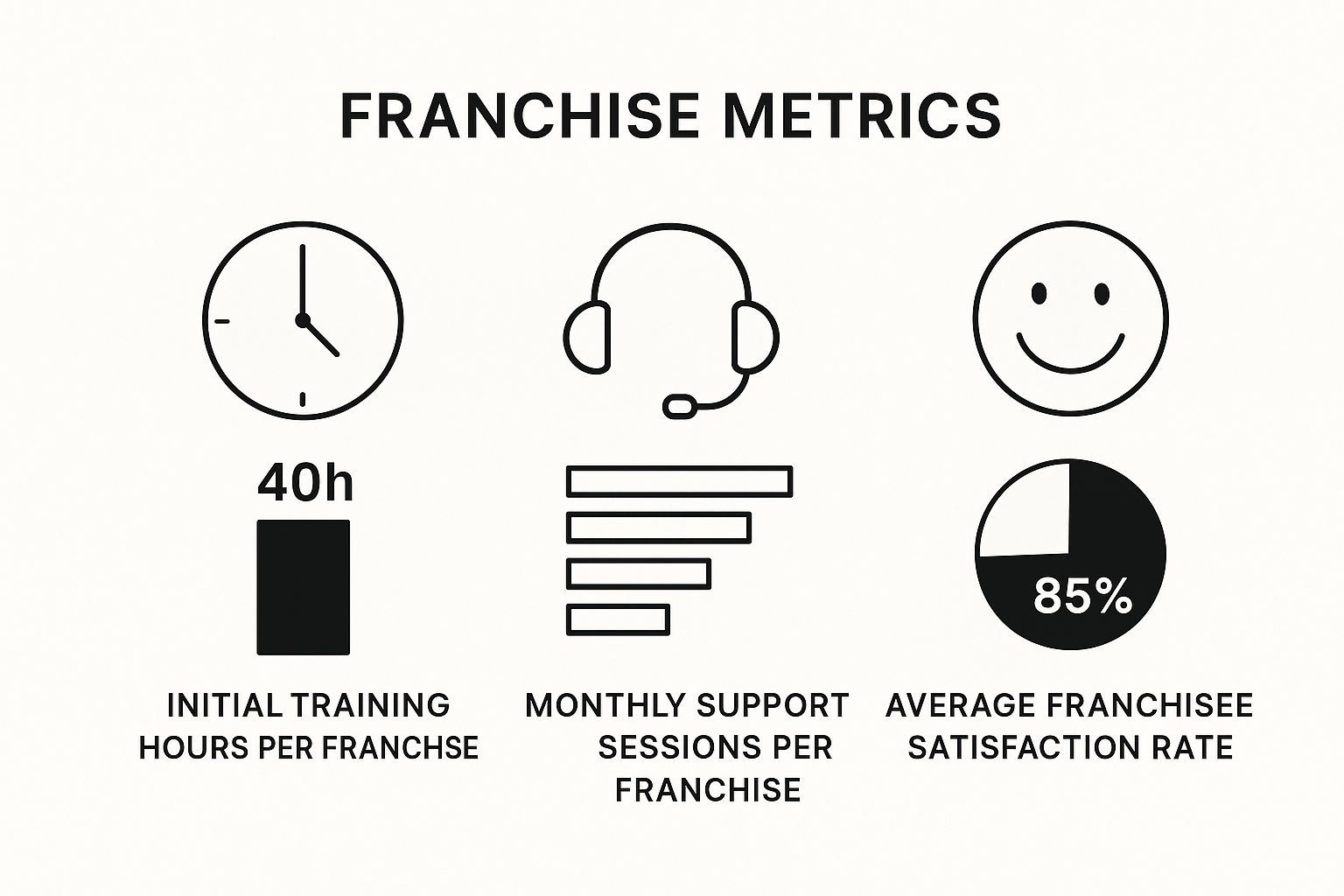
- Franchisee Satisfaction Scores: You have to ask them! Regularly survey your franchisees to get a pulse on their morale. High satisfaction is directly linked to better performance and compliance. Unhappy franchisees are a massive risk to your brand.
- Brand Standard Compliance Rates: Use data from field audits and visits to track how consistently your standards are being met. This is a direct measure of how effective your training and support really are.
Growth Metrics to Track:
- New Unit Velocity: This is the speed at which you're opening new franchise locations. It’s a straightforward measure of your sales team's effectiveness and the market's demand for your brand.
- Franchisee Turnover Rate: How many franchisees are leaving the system? A high turnover rate is a major red flag. It’s a flashing neon sign pointing to potential problems with profitability, support, or the business model itself.
By combining these financial, operational, and growth KPIs, you build a complete dashboard for your franchise system. This is how you stop guessing and start making the informed, strategic decisions that drive long-term, profitable growth for everyone involved.
Building Unbreakable Franchisor-Franchisee Relationships
Let’s get one thing straight: the most critical part of franchise management isn’t buried in an operations manual or a P&L statement. It’s the human connection you build with your franchisees.
This relationship is the real engine of your brand. When it’s strong, the whole network fires on all cylinders. But when it starts to sputter, everything else will eventually grind to a halt.
Think of it like a high-stakes expedition. Both you and your franchisee are depending on each other for survival and success out in the wild. Trust isn't just a nice-to-have; it's the lifeline that keeps everyone moving forward. This means you have to build a foundation of transparency and mutual respect from the moment they sign the FDD.
Fostering Open and Honest Communication
Trust is built on one thing: communication. You can't expect your franchisees to feel like valued partners if they feel like they’re shouting into a void or just getting directives from on high.
Establishing clear, consistent, and—most importantly—two-way channels for dialogue is non-negotiable. This goes way beyond sending out a monthly corporate newsletter. It’s about creating forums where franchisees feel safe enough to share what’s really happening on the ground.
- Franchisee Advisory Councils (FACs): These elected groups are a game-changer. They give franchisees a formal, representative voice, providing structured feedback on everything from marketing campaigns to new product rollouts.
- Regular One-on-One Meetings: Your field consultants need to be more than just compliance cops. Scheduled, productive check-ins are crucial for personalized coaching and collaborative problem-solving.
A healthy franchise system operates on a simple principle: listen more than you talk. Your best ideas for improving the brand will almost always come directly from the people serving your customers every single day.
Turning Conflict into Collaboration
Look, disagreements are going to happen. It's a natural part of any business relationship. The difference between a thriving system and a dysfunctional one is how you handle that conflict.
A proactive approach can actually strengthen your partnership. It shows you’re committed to finding fair solutions, not just winning arguments. The key is having a framework in place before things get heated. This process should always prioritize direct conversation, mediation, and finding common ground.
When you build a culture where franchisees not only trust you but also trust and support each other, you create a powerful force. Your network stops being a simple corporate hierarchy and becomes a true community, all pulling in the same direction.
Common Questions About Franchise Management
Franchisors, new and old, often wrestle with the same tough questions. It’s natural. Getting straight answers is key to leading your network with confidence.
Let's cut through the noise and tackle the questions we hear most often.
What Is the Biggest Challenge in Franchise Management?
Hands down, the biggest challenge is balancing brand consistency with franchisee autonomy.
Think of it like walking a tightrope. On one side, you have the absolute need for every customer to get the same fantastic brand experience, no matter which location they visit. On the other, you need to give your franchisees enough breathing room to be true local owners and adapt to their specific market.
The best systems master this balancing act. How? Through relentless support, crystal-clear communication, and building a foundation of trust.
The most important part of the franchisor-franchisee relationship is trust built on transparent communication. When your franchisees feel heard—and truly believe you’re making decisions for the good of the whole system—that’s when the magic happens. Trust is the bedrock of high performance.
How Does Technology Improve Franchise Operations?
Technology is the ultimate force multiplier for franchise operations. It’s not about flashy gadgets; it’s about smart efficiency.
A good Franchise Management Software (FMS) is a game-changer. It automates the soul-crushing, tedious work—think royalty calculations, compliance tracking, and reporting. It gives both you and your franchisees real-time dashboards to see what's working and what isn't.
This isn't just about saving a few hours. When you free your team from administrative quicksand, they can focus on what actually moves the needle: strategic growth and world-class franchisee support. The result is a sharper, more profitable network for everyone.
Ready to supercharge your franchisee recruitment and stop losing valuable leads? FranFunnel automates your outreach with instant SMS and email, ensuring every prospect is engaged immediately. See how our platform can boost your response rates and help you win more franchise deals.