When you’re looking into buying a franchise, it’s easy to fixate on the ongoing royalty payments. They can feel like just another cost, a constant drain on your revenue.
But that’s the wrong way to look at it.
Franchise royalties are the lifeblood of the entire system. They aren't just a fee you pay to use the brand name; they're your investment into a massive, built-in support network designed to help you win.
Why Franchise Royalties Are More Than Just a Fee

Think of it this way: your initial franchise fee is what gets you in the door. The ongoing royalties are what give you the keys to the entire building. They're what power the engine that drives both the brand's success and your own.
Without that consistent flow of funds from franchisees, the very support systems that make franchising so appealing would crumble. Things like national advertising, cutting-edge technology, and on-the-ground operational help would simply disappear.
The Power of Pooling Resources
Your royalty payments are a direct investment back into the brand, which in turn is an investment into the long-term health of your own business. It’s a collective funding model.
This system pools resources from every franchisee, creating a much stronger, more visible, and more resilient brand than any single small business could ever build on its own.
Key Takeaway: Franchise royalties aren't just a "cost of doing business." They are your stake in a comprehensive support ecosystem that gives you access to marketing, technology, and operational guidance—all critical for helping your location thrive.
What Exactly Are Your Royalties Paying For?
So where does all that money go? While every franchise is a bit different, the funds from royalties typically fuel a few key areas that keep the brand valuable and give you the tools you need to operate effectively.
Your contributions directly support things like:
- Brand-Wide Marketing & Advertising: Those slick national TV commercials or massive online ad campaigns? Royalties make them happen, building brand recognition that drives customers straight to you.
- Ongoing Operational Support: This is your direct line to the experts. It includes field consultants who visit your location, constantly updated playbooks, and a corporate team ready to help you solve problems.
- Technology and Innovation: Royalties ensure the brand’s tech—from point-of-sale (POS) systems to custom booking software and the franchisor software that manages leads and locations—stays modern and competitive.
- Continuous Training and Development: The business world never stands still. Royalties fund ongoing training programs for you and your team to keep everyone’s skills sharp.
Across most industries, the structure is pretty standard. Franchise royalties usually fall somewhere between 4% and 12% of gross sales. This percentage-based model is the main way franchisors make money, which means they are deeply invested in your success. When you make more, they make more.
Once you understand this dynamic, you start to see royalties not as a burden, but as a shared investment in mutual growth. You can learn more about the different ways franchise royalty fees are calculated and applied to see how this plays out in practice.
How Your Franchise Royalties Are Calculated

When it comes to setting royalty rates, franchisors don’t just pull a number out of thin air. The method for calculating what you owe is a strategic decision, and it’s all laid out in your Franchise Disclosure Document (FDD). Getting your head around this is non-negotiable for forecasting your business’s financial future.
These methods dictate how much you pay and when, which directly hits your cash flow and, ultimately, your bottom line. While there are a few different flavors out there, most franchise systems lean on one of a handful of core models for calculating ongoing royalties for franchises. Let's break down the most common structures you'll run into.
The Percentage of Gross Sales Model
This is, by far, the most common approach you'll see in the franchising world. It’s pretty straightforward: you pay a set percentage of your total revenue, or gross sales, before you deduct any of your business expenses. For example, if your royalty rate is 6% and you bring in $50,000 in revenue one month, you’ll owe the franchisor $3,000.
What’s great about this model is that it aligns everyone’s interests. The franchisor only makes more money when you make more money. This gives them a powerful reason to provide top-notch support, effective marketing, and solid systems to help you boost your sales.
For you, the franchisee, it means your payments scale with your performance. In a slow month, your royalty bill shrinks, which can be a lifesaver for your cash flow. On the flip side, as your business takes off, your payments will grow right along with it.
The Fixed Fee Model
Some franchise systems go a different route, opting for a predictable, flat-rate royalty. Instead of a percentage, you pay a fixed dollar amount every week or month, no matter how much you sell. You might, for instance, owe a flat $2,000 per month.
This model gives you consistency, which makes budgeting for your royalty payments incredibly simple. But it can be a double-edged sword.
- When business is booming, a fixed fee feels like a great deal. If you have a record-breaking month, that royalty payment stays the same, letting you pocket a larger chunk of the profit.
- During the critical startup phase or a slow season, that same fixed fee can put a serious strain on your finances, since you owe it even if sales are low.
Understanding your revenue streams and implementing effective pricing strategies for businesses is key to managing royalties, regardless of the model.
Alternative and Hybrid Royalty Structures
Beyond the two main models, some franchisors get creative with hybrid structures to fit their specific industry or business cycle.
Tiered or Sliding Scale Royalties This hybrid approach adjusts your royalty percentage based on how much you sell. It might look something like this:
- 7% on the first $25,000 in monthly sales
- 6% on sales between $25,001 and $50,000
- 5% on all sales above $50,000
This structure is designed to reward high-performers with a lower effective royalty rate, giving you a strong incentive to keep growing.
Minimum Royalty Payments It’s also common to see a minimum payment clause baked into a percentage-based agreement. For instance, your royalty might be 5% of gross sales, but with a minimum floor of $1,500 per month. If 5% of your sales in a slow month only adds up to $1,200, you’d still have to pay the $1,500 minimum. This just protects the franchisor’s baseline revenue.
To make these different models easier to understand, we've broken them down in a simple table.
Comparing Franchise Royalty Calculation Methods
Here’s a quick look at the most common royalty structures, how they work, and what they mean for you as the franchisee.
| Royalty Method | How It Works | Pros for Franchisee | Cons for Franchisee |
|---|---|---|---|
| Percentage of Gross Sales | A set percentage of your total revenue is paid to the franchisor (e.g., 6% of sales). | Payments are lower during slow periods, aligning franchisor and franchisee goals. | Payments increase as revenue grows, meaning you share more of your success. |
| Fixed Fee | A flat, recurring payment (e.g., $2,000/month) regardless of sales volume. | Predictable and easy to budget. You keep all extra profit in high-sales months. | Can be a heavy burden during the startup phase or in slow seasons when sales are low. |
| Tiered / Sliding Scale | The royalty percentage changes as your sales reach certain thresholds. | Rewards growth with a lower effective royalty rate as you sell more. | Can be more complex to calculate and forecast accurately. |
| Minimum Royalty | A baseline payment is required, even if your percentage-based royalty is lower. | No direct pro for the franchisee; it primarily protects the franchisor. | Ensures a minimum payment is due even during your worst sales months. |
Each method has its trade-offs, so it's vital to model out how each would impact your specific business plan before you sign on the dotted line.
How Royalties Are Collected
The actual process of paying your royalties is usually streamlined and not up for debate. With potentially hundreds or thousands of locations, franchisors need a consistent and reliable way to collect these funds.
Here are the most common collection methods:
- Automated Clearing House (ACH) Debit: This is the go-to for most systems. The franchisor automatically pulls the royalty amount directly from your business bank account on a set schedule.
- POS System Integration: Many modern point-of-sale (POS) systems are set up to automatically calculate and report sales data to corporate, which then triggers the payment.
- Manual Reporting: Less common now, but some systems may require you to manually submit your sales reports. The franchisor will then send you an invoice for the royalty payment.
Getting a firm grasp on these calculation and collection methods is a fundamental part of your due diligence. It ensures you have a crystal-clear picture of your financial obligations from day one.
What Your Royalties Actually Fund
When you see that royalty payment leave your account every month, it’s only natural to ask, "Where is this money really going?" It’s a fair question, and one every potential franchisee should ask.
The good news is that royalties for franchises aren't just a fee you pay into a black hole. Think of them as the fuel that powers the entire support system designed to help you succeed. They're what turn a collection of individual businesses into a powerful, unified brand.
You're pooling your resources with every other franchisee in the system. Your royalty payment is your contribution to fund services and initiatives that no single location could ever afford on its own.
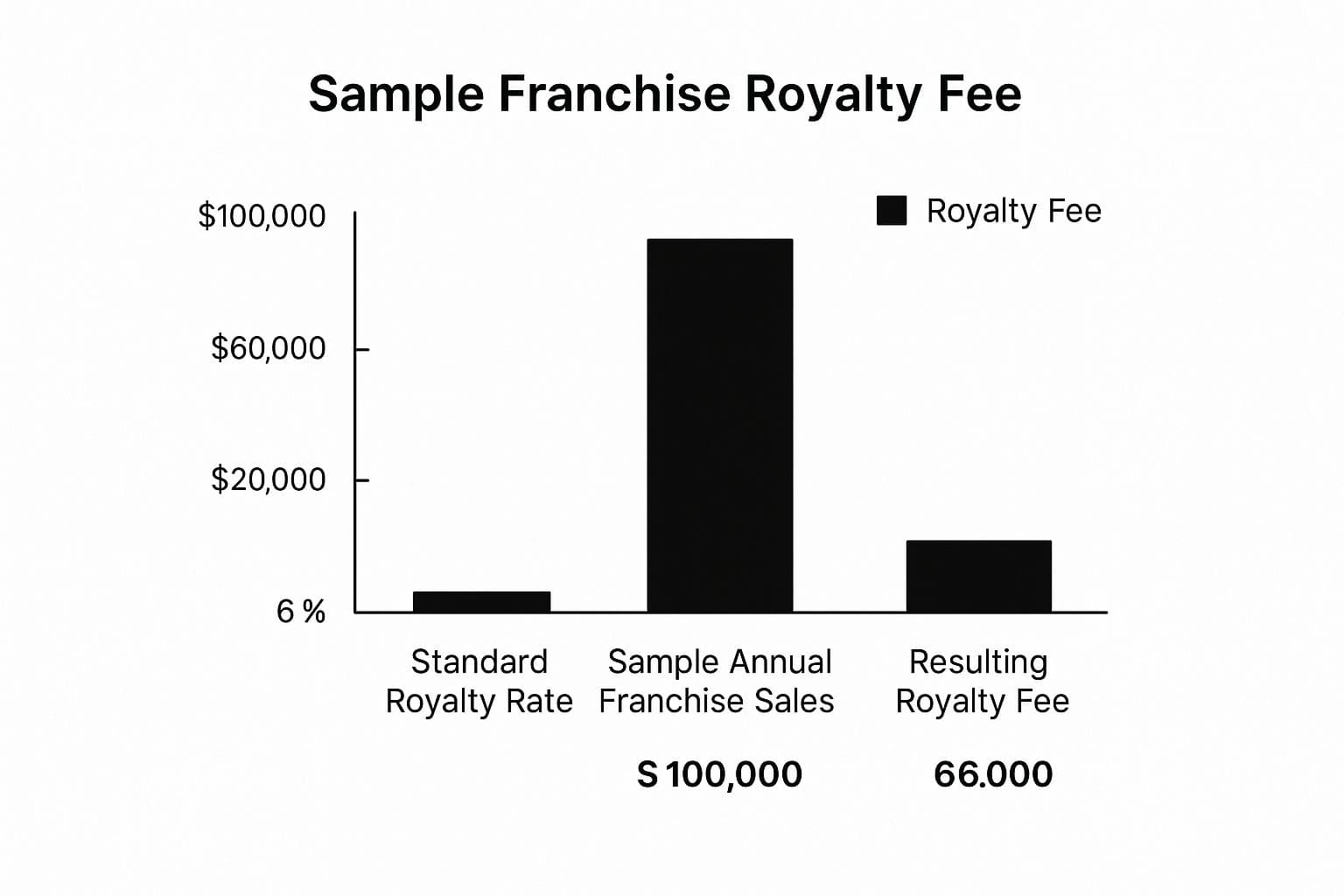
As you can see, a pretty standard 6% royalty on $100,000 in sales equals a $6,000 fee. This shows the direct link between your revenue and your contribution back into the brand that helps generate that revenue.
The Pillars Of Franchisee Support
So what do those fees specifically pay for? Imagine your total royalty contribution as a pie. Each slice represents a critical service that builds brand value and supports your day-to-day operations.
These services usually fall into three core buckets:
- Operational Guidance and Support: This is your direct line to corporate. It pays the salaries of the field consultants who visit your location, offer hands-on coaching, and help you solve real-world problems. It also funds the ongoing development of the operational playbook—the brand’s secret sauce.
- Brand-Building and Marketing: This slice is what gets customers in the door. It covers national ad campaigns, social media management, PR, and the creation of professional marketing materials you can use locally. You get the benefit of a big-brand marketing budget without having to foot the entire bill yourself.
- Technology and Innovation: In today's market, you can't afford to fall behind. A portion of your royalties funds the development and maintenance of essential tech, like proprietary point-of-sale (POS) systems, online booking platforms, mobile apps, or customer relationship management (CRM) software.
Fueling System-Wide Growth And Innovation
Beyond the day-to-day, royalties are the engine for long-term growth. Franchisors use these funds to invest in research and development, explore new product or service lines, and legally protect the brand’s trademarks. This is what keeps the entire brand relevant and competitive, which directly benefits every single franchisee.
By pooling resources through royalties, the franchise can undertake large-scale initiatives that create a significant competitive advantage—one that would be impossible for an independent business to achieve.
Ultimately, these payments are a shared investment. Understanding this value exchange is crucial for seeing the full picture of what you're buying into. It helps you grasp the bigger financial picture and how it relates to your own bottom line. To learn more, check out our guide on calculating your potential franchise ROI.
When you see it this way, you realize your royalty payments are actively working for you, every single day.
When you're looking into buying a franchise, it’s easy to get fixated on the ongoing royalty fees. But to truly understand the financial commitment you're making, you need to see the bigger picture. Royalties are a huge part of it, for sure, but they're just one piece of the puzzle.
Think of it like this: to budget correctly and avoid nasty surprises down the road, you have to know the difference between all the fees you'll be paying.

This breakdown from Forbes Advisor nails the core concept: there’s a big difference between the one-time franchise fee and the ongoing royalties. While that initial check you write is a major hurdle, it's the recurring royalties that define your long-term financial relationship with the franchisor.
The most critical distinction to get right is between the initial franchise fee and your royalty payments.
The initial fee is your ticket to the show. It's a one-time, upfront payment that grants you the license to operate under the brand, use their trademarks, and tap into their proven business model. This fee typically covers your initial training, help with finding the right location, and the keys to the operational playbook. It's what gets your foot in the door.
Royalties: The Ongoing Subscription
Royalties, on the other hand, are like your monthly subscription. These are the recurring payments you’ll make—usually a percentage of your gross sales—every week or month for the entire life of your franchise agreement.
If the initial fee gets you in the system, the royalties are what keep you in the system and give you access to all the ongoing support that comes with it. That’s the fundamental difference. One is a one-time entry cost; the other is a continuous operational cost that reflects the value you get over time.
Key Distinction: The Initial Franchise Fee is a one-time cost to join. Royalties are recurring payments for the ongoing right to use the brand and receive continuous support, from marketing to tech development.
Getting this part straight is step one. But your financial obligations don't stop there. Most franchise systems have a few other fees you need to be ready for.
Other Common Fees You Can Expect
Beyond the big two, your Franchise Disclosure Document (FDD) will list out several other required payments. These aren't hidden costs, but they are separate line items you absolutely must budget for.
Here are a few you'll almost always see:
- Marketing or Advertising Fund Fee: This is another recurring fee, often 1-3% of gross sales, that gets pooled into a national or regional ad fund. That money is used for the big-picture marketing campaigns that build brand awareness for every franchisee.
- Technology Fee: Many franchisors charge a fixed monthly fee for access to required technology. This might cover their proprietary software, point-of-sale (POS) systems, online booking tools, or a central customer relationship management (CRM) platform.
- Training Fees: Your first round of training is usually covered by the initial fee. But if you or a new manager needs specialized or ongoing training later on, you'll likely have to pay for it. This can include travel and lodging to attend sessions at corporate headquarters.
- Renewal Fee: Franchise agreements don't last forever. When your initial term is up (often after 10 or 20 years), you’ll probably need to pay a renewal fee to sign on for another term.
By mapping out all these different costs, you can build a realistic budget from the start. Understanding that royalties are just one part of your ongoing financial commitment is the key to accurately projecting your cash flow and setting your new business up for long-term success.
How to Analyze and Approach Royalty Negotiations
Let’s be honest: talking about franchise royalties can be nerve-wracking. Most prospective franchisees walk into the conversation thinking the numbers are set in stone. And for big, established brands, they often are. But your power isn't in haggling over a percentage point—it's in deeply understanding what you’re paying for.
Your best tool here is knowledge. Start by treating the Franchise Disclosure Document (FDD), specifically Item 6, as your roadmap. This is where the franchisor lays out all the fees, including the royalty structure. Don't just skim it; dig in and analyze it.
Benchmarking the Royalty Rate
So, is that 5% royalty a great deal or a total rip-off? The answer completely depends on the industry and the support you’ll get. You need context.
Start by benchmarking the rate. A quick-service restaurant will have a totally different royalty range than a home services or fitness franchise. Look at direct competitors and see what you can find publicly about their fee structures.
Ask yourself these critical questions:
- What's the industry average? Is the rate they’re asking for way higher or lower than the norm?
- What’s included in the support package? A higher royalty might be a bargain if it buys you a world-class tech platform, tons of field support, and a massive national ad budget.
- How strong is the brand? A household name with legions of loyal customers can command a higher royalty because it delivers instant value the day you open your doors.
Identifying Potential Negotiation Points
Even when that headline royalty percentage is locked down, you might find some wiggle room elsewhere. It’s not common, but finding it can make a huge difference, especially when you're just starting out.
One of the most valuable (though rare) things to ask for is a royalty ramp-up period. This is where you negotiate a temporarily lower rate for your first 6-12 months. For instance, you might pay 2% for the first six months, 4% for the next six, and then hit the standard 6%. This can be an absolute lifesaver for your cash flow when you’re still building revenue.
Crucial Insight: Royalties are what fund a franchisor's brand strength and support systems. So, a franchisor’s willingness to negotiate is often a sign of how badly they want to attract top-notch candidates in a competitive market.
Leading franchise brands are in a fierce battle for the best franchisees. To win, they're pouring money into recruitment. In fact, for 2025, franchisors are expected to more than double their spend on brokers to an average of $157,741 per brand. It’s a clear signal that royalties are being reinvested to fuel system growth. You can see the full breakdown of how franchisors are investing to attract new talent on Franchising.com.
The Non-Negotiable Final Step
Beyond benchmarking and creative terms, you have to watch out for clauses about automatic rate increases. Does the agreement say the royalty will jump from 5% to 6% in year five? That's a huge detail you need for your long-term financial plans. Knowing how to build a strong team is also crucial, as great operations help justify the royalty costs. For a better handle on what franchisors look for, check out our guide on how to sell franchises.
Finally, there’s one step that is absolutely, 100% non-negotiable: have an experienced franchise attorney review the FDD and the final franchise agreement. They know exactly what to look for, can spot unfair clauses, and will advise you on every detail of the financial partnership you’re about to enter. This is not the place to cut corners. It’s a vital investment in your future.
Common Questions About Royalties for Franchises
When you start digging into the world of franchising, it's natural for a lot of practical questions to pop up around royalties. Even after you get the basics down, you're still left wondering about the day-to-day financial side of things. Let's tackle some of the most common questions head-on to give you more confidence as you move forward.
Are Franchise Royalty Fees Tax-Deductible?
Yes, absolutely. This is one of the first and most important financial questions franchisees ask, and for good reason. Your ongoing royalty payments are considered a necessary cost of doing business—just like your rent, payroll, or inventory.
Because they are a direct expense for operating under the franchise brand, they are fully tax-deductible. This is a huge deal for your financial planning. While the royalty fee does come out of your gross profit, its deductibility helps lower your overall taxable income. In short, the actual cost to your bottom line is less than the number you see on paper.
Just be sure to keep meticulous records of every royalty payment you make. Your accountant will need that paper trail to claim the proper deductions, which can make a real difference come tax time.
Key Financial Tip: Treat your royalty payments as a standard operating expense in your books. Solid documentation is your best friend here—it ensures you can deduct these costs and get a true picture of your business's profitability.
What Happens If I Miss a Royalty Payment?
Honestly, this is a situation you want to avoid at all costs. Missing a royalty payment is a serious problem because the franchise agreement you signed is a legally binding contract. Failing to pay is a direct breach of that contract, and the consequences can escalate quickly.
First, you'll likely get a formal notice from the franchisor, probably with some late fees and interest charges tacked on, just as outlined in your Franchise Disclosure Document (FDD). Think of this as your first and only warning shot—a chance to fix the mistake immediately.
If you keep missing payments, things get much worse:
- Loss of Support: The franchisor can cut you off from essential support, like marketing resources, operational help, and their software systems.
- Legal Action: They can sue you to get the money they're owed, which is a stressful and expensive nightmare you don't want.
- Default and Termination: Ultimately, if you continue to not pay, the franchisor can declare you in default. This can lead to them terminating your franchise rights, meaning you could lose your entire business.
If you know you're going to have trouble making a payment because of cash flow issues, be proactive. Call your franchisor before the payment is due. Explain what's going on and see if you can work out a temporary plan. It's not a guarantee they'll say yes, but it’s a thousand times better than just going silent.
Can a Franchisor Change My Royalty Rate?
Generally, no—at least not in the middle of your contract term without you agreeing to it. The royalty rate and how it's calculated are core parts of the franchise agreement you sign. That contract locks both you and the franchisor into those terms for the entire agreement, which is often 10 or 20 years.
A franchisor can't just wake up one day and decide to bump your 5% royalty up to 7%. Any change like that would require a formal amendment to the contract, which you would have to sign off on.
However, there are two key times when the rate can change:
- Built-In Increases: Your original agreement might already have a clause for scheduled increases, say, after five years. This isn't an unexpected change; it was a term you agreed to from the very beginning.
- Upon Renewal: When your initial term is up, you'll have to sign a new agreement to renew your franchise. The royalty rate in that new contract will reflect the franchisor's current terms, which could very well be higher than what you were paying before.
How Do Franchisors Decide on a Royalty Rate?
Setting the right royalty rate is a careful balancing act. The franchisor needs to charge enough to fund their support system, drive brand innovation, and make a profit. But they can't set it so high that it makes it impossible for their franchisees to be profitable.
Here’s what they typically look at when setting their royalty structure:
- Industry Benchmarks: They spend a lot of time researching what their competitors and other franchises in the same industry are charging.
- Support Services Provided: The more a franchisor offers, the more they need to charge. A brand with a sophisticated tech platform, a large field support team, and a national marketing fund will have higher royalties to cover those significant costs.
- Brand Strength and Recognition: A household name with legions of loyal customers can command a higher royalty because they offer instant credibility and a built-in customer base from day one.
- Franchisee Profitability Models: Smart franchisors run the numbers. They create detailed financial models to make sure a franchisee can still earn a healthy profit after paying royalties and all other fees. An unprofitable franchisee is a liability for the entire system.
The initial steps to becoming a franchisee are where you get clarity on all these details. Understanding the typical franchise sales process can give you a better feel for how these financial conversations play out. For anyone wanting to dig deeper, it’s worth it to explore franchise opportunities and financial aspects with a trusted resource. At the end of the day, the rate should reflect the value and support you get from the brand.
Are you ready to grow your franchise brand? FranFunnel is purpose-built to help you connect with more qualified franchisee leads faster. See how our automated communication platform can help you respond instantly, get noticed, and win more deals at franfunnel.com.