Franchise development teams live on speed. A candidate fills out a portal form, clicks a Meta ad, or requests information from your website, and the race starts immediately. The problem is that the same text message or call that helps you win the conversation can also create legal exposure if the consent trail is weak, the number was reassigned, or the lead should never have been contacted in the first place.
That’s why tcpa compliance software matters so much in franchise lead follow-up. In this part of the sales process, compliance isn’t a back-office legal checkbox. It’s part of the operating system for how your team texts, calls, routes, logs, and suppresses leads across every source. If your franchise recruitment stack moves fast but can’t prove consent, honor opt-outs instantly, and validate numbers before outreach, your speed-to-lead process is carrying more risk than most development teams realize.
The Million-Dollar Mistake in Franchise Lead Follow-Up
A single non-compliant outreach attempt under the TCPA can trigger statutory damages of $500 to $1,500 per violation for unsolicited calls or texts, according to Gryphon’s TCPA compliance recap. For franchise development teams that depend on fast text and phone follow-up, that changes the economics of lead response fast.
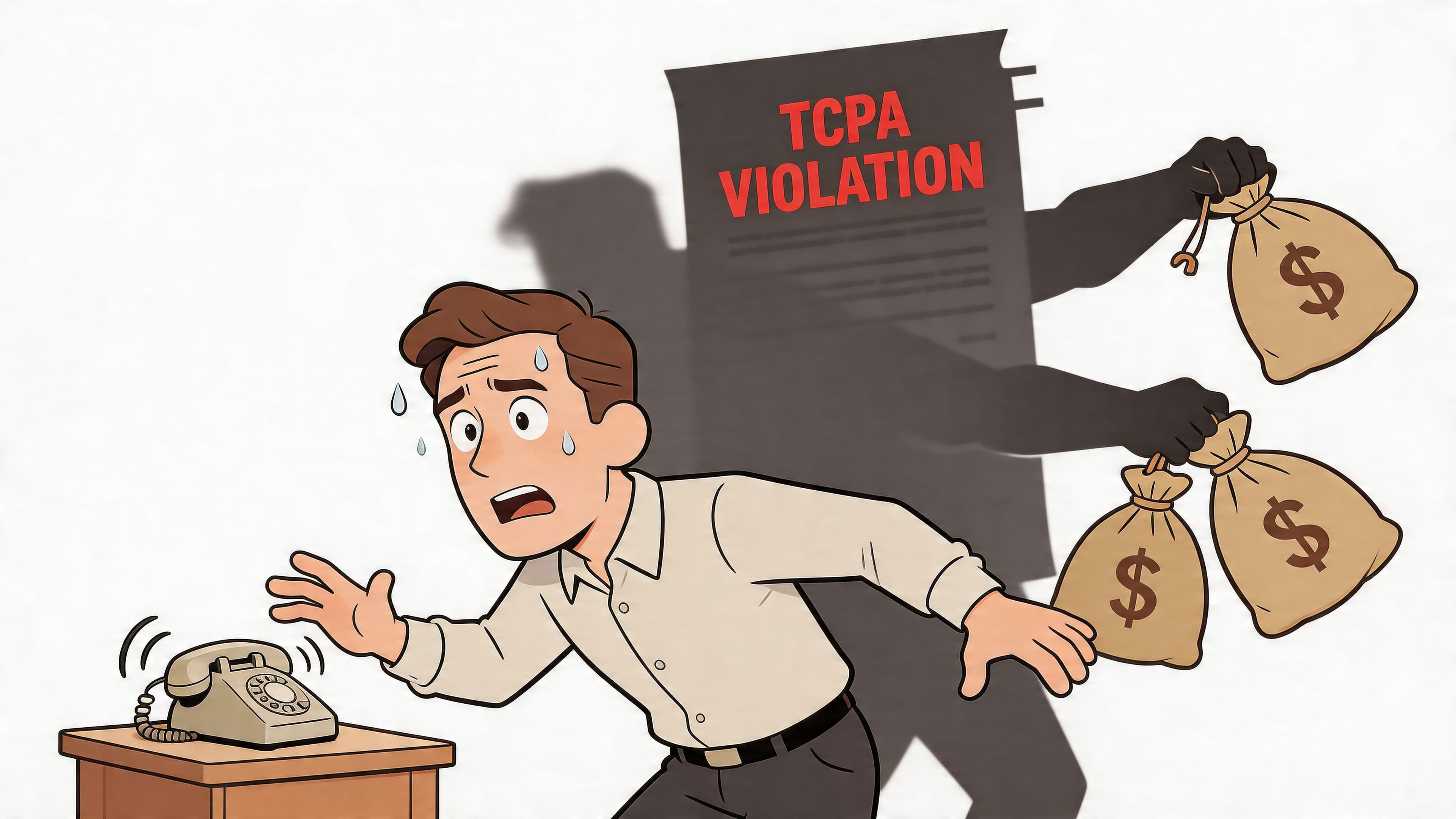
The scale is what catches people off guard. Gryphon notes that a company handling 18 million calls annually could face $22.5 million in exposure if just 0.25% of those calls, or 45,000 incidents, were non-compliant at $500 per violation. The same analysis reports that TCPA litigation filings rose 17.1% from 1,033 in 2022 to 1,210 in 2024. For a franchisor, that means compliance risk isn’t theoretical, and it isn’t getting quieter.
Why franchise teams are especially exposed
Franchise lead follow-up has a messy reality that generic TCPA advice often skips. Your team may be working leads from franchise portals, paid search, social ads, broker referrals, organic forms, and event lists in the same day. Some go straight into a CRM. Others route through middleware, spreadsheets, inbox rules, or outsourced follow-up.
That creates three common failure points:
- Consent gets separated from the lead record. A rep sees a phone number in the CRM but not the original opt-in context.
- Outreach happens too fast in the wrong way. Teams chase speed and assume every inbound lead is automatically safe to text or call.
- Suppression fails across systems. A candidate opts out in one channel, but another tool still pushes a message.
Practical rule: If your rep can send the message faster than your system can verify consent and suppression status, your process is upside down.
The pressure to respond instantly is real. Franchise leads are expensive, high-intent, and usually evaluating multiple brands at once. Nobody wants to lose a qualified candidate because the team waited too long. But speed without controls is not a growth strategy. It’s a liability engine.
The right way to think about tcpa compliance software
Most franchise teams don’t need slower outreach. They need safer speed. That’s the point of tcpa compliance software. It gives the team a framework to verify who can be contacted, how they can be contacted, and what proof exists if that outreach is challenged later.
That matters most in the first few minutes after a lead arrives. If your process for instant franchise lead follow-up depends on manual checks, disconnected tools, or rep memory, the risk sits inside your normal workflow. If compliance is automated before the message goes out, speed and legal discipline can work together.
Franchise development leaders should treat this the same way they treat territory control, FDD process discipline, or candidate qualification standards. It protects conversion economics, keeps your team operational, and reduces the chance that one broken workflow turns into a very expensive problem.
Understanding TCPA Requirements for Franchise Sales
In franchise sales, TCPA compliance starts long before the first discovery call. It begins at lead capture. The form language, the source of the lead, the phone number, the opt-in record, and the suppression logic all matter because they determine whether your team should text or call at all.
The broad rule is simple. If your franchise development team uses SMS or phone outreach, you need a process that can prove consent, honor opt-outs, and prevent outreach to restricted numbers. If you want a plain-English legal overview of what regulatory compliance entails, that resource is a useful starting point. In practice, franchise teams need to apply that discipline to a very specific lead journey.
What consent looks like in franchise recruitment
A lead from your brand website is not automatically the same as a lead from a portal. A lead from LinkedIn is not automatically the same as a referral from a broker. The source matters because your team needs to know what permission was granted and whether that permission is documented in a way you can defend.
For franchise sales, that usually means asking:
- Where did the lead originate. Brand form, portal, paid social, paid search, consultant, or broker.
- What disclosure did the lead see. The exact language matters when the team later relies on that opt-in.
- Was the phone field tied to clear permission for text and call outreach. Assumptions here are dangerous.
- Did the consent record stay attached to the lead as it moved into the CRM or engagement tool. Many teams often break the chain at this stage.
A rep doesn’t need to become a lawyer. But the rep should never be forced to guess whether a record is safe to contact.
Reassigned numbers are a hidden franchise problem
One of the least appreciated risks in franchise development is the reassigned number issue. Prior consent may not follow the number when that number changes hands. According to TCN’s discussion of TCPA compliance solutions, the FCC reported more than 748 million U.S. number reassignments in 2024. The same source notes that TCPA rules apply to B2B texts and calls without a valid opt-in, and that 2025 class actions rose 22% against sales automation vendors.
For franchise brands, this is especially relevant because the funnel is often long. A candidate may inquire, go quiet, return months later, then re-enter an automated follow-up sequence. If the number changed during that gap, your historical record may no longer protect you.
A phone number in the CRM is not proof that the current owner of that number consented to hear from you.
That’s why static assumptions fail. In franchise recruitment, lists age, leads recycle, and candidates revisit brands on their own timeline.
DNC and opt-out obligations are operational, not theoretical
The National Do Not Call Registry is only part of the issue. Internal suppression matters too. If a candidate says stop, opts out through SMS, or asks your team not to call again, your systems need to reflect that immediately. Not tomorrow. Not after a list cleanup. Immediately.
This becomes harder when the franchise sales stack is fragmented. A portal may route the lead one way, your CRM may log the contact another way, and a separate engagement tool may continue messaging because suppression status didn’t sync.
A franchise development leader should be able to answer these questions without hesitation:
| Compliance question | What your team should know |
|---|---|
| Can we prove this lead opted in? | The source, disclosure, timestamp, and record location |
| Can we verify the number is still safe to contact? | Whether reassigned number checks are part of the workflow |
| Can we stop outreach across every tool immediately? | Whether opt-outs sync in real time across systems |
If those answers are fuzzy, your outreach process is relying on hope. Hope doesn’t hold up when a complaint arrives.
Core Features of Effective TCPA Compliance Software
The job of tcpa compliance software is straightforward. It should reduce the chance of a bad outreach attempt, and if a complaint still happens, it should help your team prove what occurred. In franchise development, that requires more than a basic dialer and a checkbox field in the CRM.
The strongest systems combine prevention and documentation. Prevention stops outreach that shouldn’t happen. Documentation preserves the records you’ll need later if a lead, plaintiff’s lawyer, regulator, or internal counsel asks what happened and why.
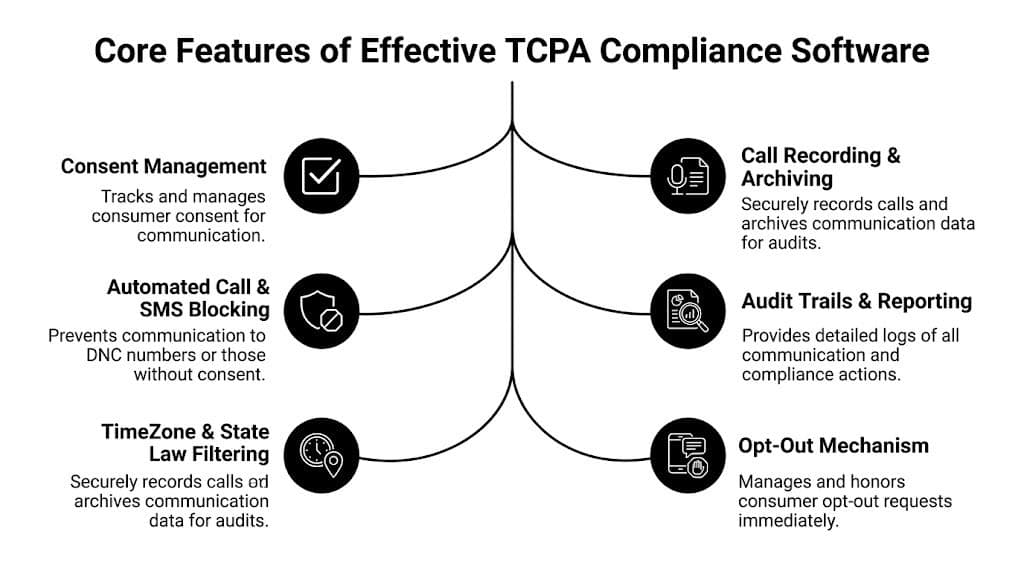
According to ActiveProspect’s overview of TCPA tools, the key categories include consent management platforms for audit trails, DNC scrubbers with reassigned number checks, lead filtering to block known litigators, and documentation tools that provide session replays. ActiveProspect also notes that FTC rules extended recordkeeping requirements to 5 years in 2024, while TCPA claims can remain viable for up to 6 years. That time horizon matters. Franchise brands need systems that keep records usable long after the lead first entered the funnel.
Consent records that hold up later
A contact record with a phone number is not enough. You need a record that shows how the lead entered, what consent language was presented, and when that action occurred.
Good software should preserve:
- Timestamped consent evidence tied to the specific lead
- Audit trails that show where the lead came from and how it moved through the system
- Session-level documentation such as form capture context or replay-based proof where available
- Tamper-resistant storage so the record looks credible later
What doesn’t work is loose operational memory. If your defense depends on someone saying, “I’m pretty sure that portal included the right disclosure,” you don’t have a real defense.
Real-time scrubbing beats batch processing
This is one of the biggest dividing lines between usable software and software that only sounds compliant in a demo. In high-velocity franchise lead follow-up, batch processing leaves a gap between lead arrival and validation. That gap is exactly where bad outreach happens.
The better model is pre-contact validation. Before the text or call is attempted, the system checks suppression and consent status in real time. That’s especially important when leads are coming from multiple portals and ad channels, then moving into one engagement layer.
Here’s the practical difference:
| Approach | What usually happens in franchise follow-up |
|---|---|
| Batch scrubbing | A lead may enter the queue before the latest suppression data is applied |
| Real-time validation | The system checks current status before the outreach attempt fires |
That’s why teams comparing texting tools should look beyond templates and automation. The more important question is whether the platform handles compliance checks before action is taken, not after. The contrast is similar to the difference between texting inside a CRM versus a dedicated engagement layer. The issue isn’t just convenience. It’s whether the workflow is built for fast, controlled execution.
What works: systems that block risky contact attempts automatically.
What fails: systems that log the problem after the rep already made the call or text.
Reassigned number checks and litigator filtering
Franchise development teams often revisit old opportunities. That makes reassigned number checks more important than many brands realize. If a lead from an older campaign re-enters your cadence, the system should verify that the number still aligns with the consent record before fresh outreach goes out.
The same goes for lead filtering. Some platforms screen for known litigators or other high-risk records before they get to reps. This doesn’t remove the need for compliant practices, but it does reduce unnecessary exposure in messy lead environments.
This is one of those areas where point solutions can help, but only if they’re wired into the actual outreach flow. A great compliance tool sitting outside the texting or dialing path won’t stop much.
Documentation that supports the legal team
If prevention fails, documentation becomes the second line of defense. That means logs, timestamps, suppression events, opt-out records, source history, and communication history must be easy to retrieve and understandable to someone outside sales operations.
The best systems produce records that answer practical questions quickly:
- How did this lead enter the system
- What permission existed at the time of outreach
- Was the number checked before contact
- Did the lead revoke consent or opt out
- Did every downstream system honor that status
If your team has to hunt across the CRM, SMS platform, form builder, agency spreadsheet, and portal export to answer those questions, your software stack isn’t compliance-ready.
In franchise recruitment, that’s the standard to use. Not whether the tool has a compliance tab. Whether it creates a reliable proof trail while your team still moves fast enough to engage serious candidates.
Integrating Compliance into Your Franchise Sales Tech Stack
Compliance breaks down most often at the handoff point. The portal sends the lead. The CRM creates the contact. The engagement platform launches the message. The rep replies from a shared inbox. A separate vendor handles voice. Another system stores form data. When those pieces don’t stay aligned, the legal risk doesn’t stay neatly assigned to one vendor. It lands on the brand.
That’s why compliance can’t sit in a silo. In franchise development, it has to live inside the same workflow that controls speed-to-lead, routing, texting, call attempts, and opt-out handling.
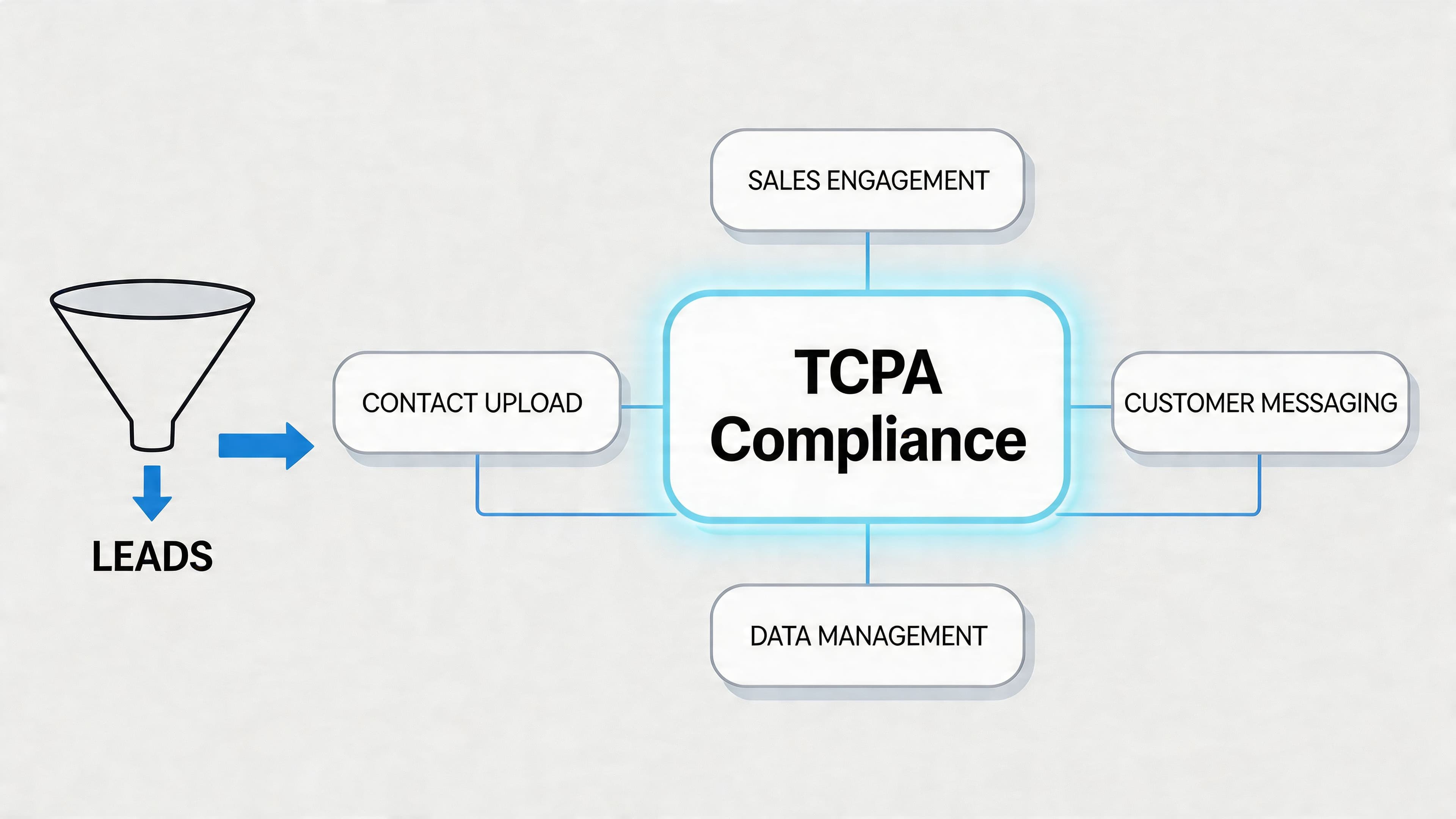
According to Husch Blackwell’s analysis of TCPA compliance risk, Q1 2026 FCC reports showed a 35% year-over-year increase in TCPA suits against integrated platforms due to unverified consent syncing. The same source states that an April 2025 FCC ruling expanded the definition of ATDS to include AI SMS workflows. For franchise teams using automation, that makes system-to-system audit trails much more important than they used to be.
The CRM cannot do this alone
A CRM is the system of record. It is not always the best system for real-time engagement control. Most franchise development leaders already know this operationally. The CRM stores the lead, tracks stages, and organizes the pipeline. But the outreach itself often happens faster and more reliably in a dedicated engagement layer.
That setup can work well, but only if the data flow is disciplined.
A compliant franchise sales stack should sync these elements across tools:
- Consent status
- Opt-out status
- Lead source
- Communication history
- Routing history
- Any compliance-related suppression flags
If one tool knows a candidate opted out and another tool doesn’t, the stack is broken. If the engagement layer can’t push activity back to the CRM, the proof trail is incomplete. If an agency uploads leads without validated consent fields, the risk entered the system before your reps even saw the record.
Vicarious liability is a franchise reality
Franchise brands often rely on third parties. Lead portals, agencies, consultants, brokers, and integration partners all touch candidate data. That creates a recurring misconception. Teams assume the source that captured the lead owns the compliance risk. That is a dangerous assumption.
In practice, if your brand sends the text or places the call, your brand needs confidence that the consent chain is intact. That means vendor oversight isn’t optional. A portal feed or agency lead source should not be treated as self-certifying.
The safest workflow is the one that verifies consent again when the lead enters your own environment, before your team reaches out.
What a strong integrated workflow looks like
A good setup usually follows this logic:
- Lead enters from a source such as a portal, website, or ad funnel.
- Validation runs immediately before outreach is attempted.
- The engagement layer sends the first compliant message or routes to a rep.
- All activity syncs back to the CRM so the contact record stays complete.
- Any opt-out or suppression event updates everywhere.
The practical advantage is that speed and control happen at the same time. Teams can still automate first-touch outreach, reminders, follow-up sequences, and rep assignment. They just aren’t doing it blindly.
For franchise brands exploring automated outreach, this is the standard to use when evaluating franchise sales automations. Not whether the workflow builder looks polished. Whether the automation layer can prove what it knew, when it knew it, and what it did before each message or call went out.
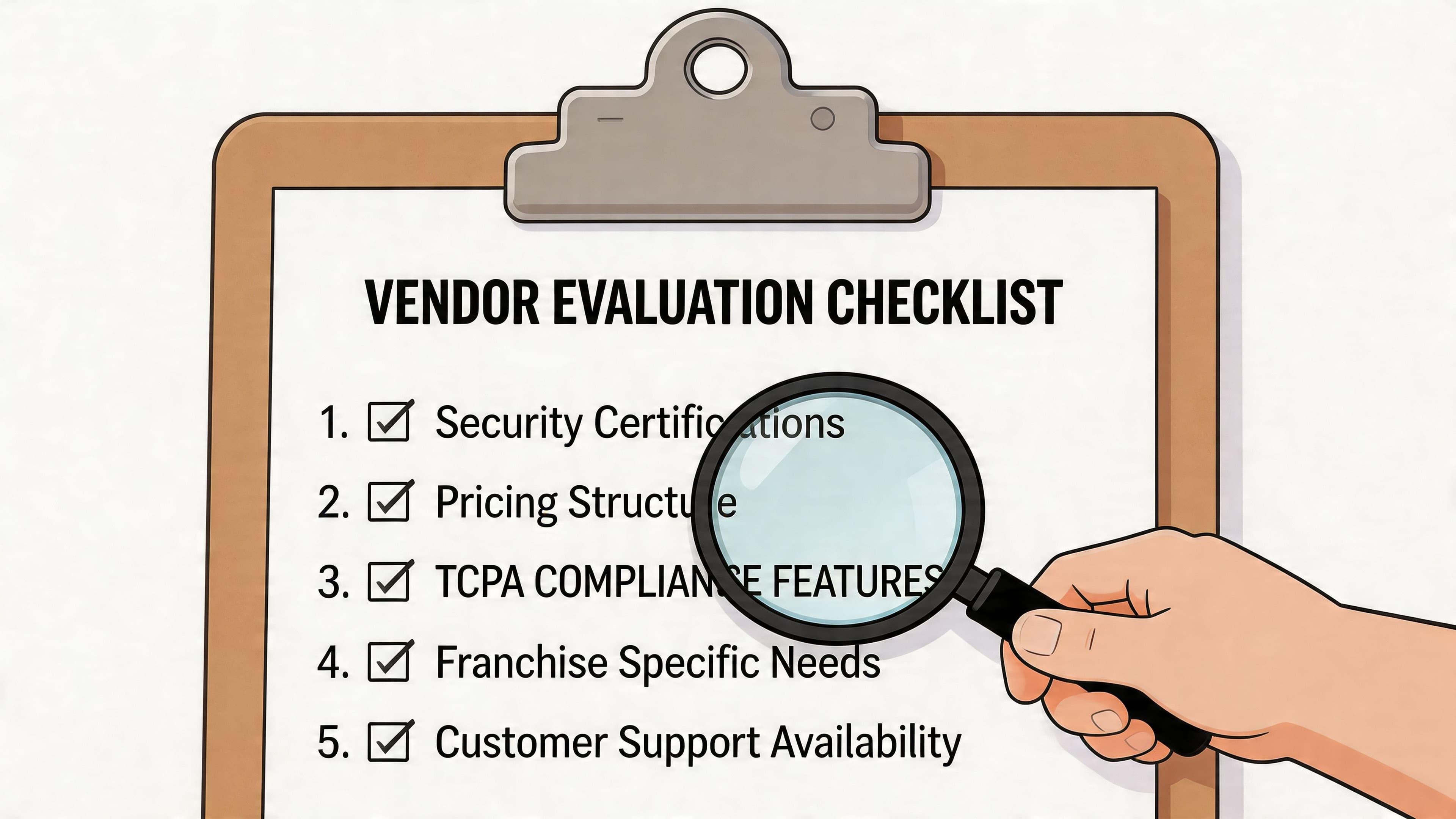
A Franchise-Focused Vendor Evaluation Checklist
Most TCPA software demos sound strong for the first fifteen minutes. Vendors show suppression logic, mention DNC compliance, and promise clean integrations. Then the questions get specific. Can the platform handle portal leads and brand-site leads differently? Does it preserve the original consent record when a lead is reassigned to another development manager? What happens when a candidate opts out in one channel but keeps talking in another?
That’s where franchise buyers need a tighter checklist.
Questions about lead capture and proof
Start at the top of the funnel. If the vendor can’t protect the first moment of lead creation, the rest of the stack won’t save you.
Ask questions like:
- How does the platform store consent evidence? Ask to see the actual record, not a slide about “auditability.”
- Can the system preserve source-level context? You need to distinguish a website lead from a portal lead or an uploaded list.
- What happens when the lead syncs into the CRM? The proof should travel with the record, not stay trapped in a separate system.
- Can users retrieve documentation quickly? If legal or leadership asks for proof, your team shouldn’t need a specialist to assemble it manually.
A practical test helps here. Ask the vendor to walk through a disputed lead from start to finish. If they can’t show the consent chain clearly, keep looking.
Questions about real-time controls
The second set of questions should focus on what the system does before outreach happens.
Look for clear answers on:
| Evaluation area | What you want to hear |
|---|---|
| DNC handling | The system checks before contact, not after |
| Reassigned number risk | The workflow includes number validation as part of outreach control |
| Opt-outs | Revocations update immediately across channels and users |
| Time-zone and state filtering | Outreach rules can be enforced automatically |
If the vendor leans on manual imports, periodic list scrubs, or rep training as the main safety layer, that’s a warning sign. Training matters, but software should remove obvious failure points before the rep has a chance to create one.
Questions about franchise-specific workflows
A lot of compliance vendors understand call centers. Fewer understand franchise recruitment. Those are not the same environment.
Ask directly:
- Can the platform ingest and normalize leads from franchise portals, paid media forms, website forms, brokers, and consultants?
- Can it route leads by brand, territory, or development manager without losing compliance metadata?
- How does it handle shared inboxes and team-based follow-up?
- Can it support text-first outreach while preserving the full communication trail?
Franchise sales teams often work a mix of centralized and distributed follow-up. The software must accommodate this without creating version conflicts or missing suppression updates.
Don’t buy based on feature count. Buy based on whether the workflow matches how franchise leads actually move inside your organization.
Questions about vendor liability and operational support
The final category is the one buyers often leave until procurement. It belongs in the demo conversation.
Ask:
- What contractual commitments does the vendor make around data handling and audit support?
- How do they support investigations or complaints when records need to be produced quickly?
- What happens if a third-party integration fails and consent fields stop syncing?
- How are customers alerted to workflow failures or suppression mismatches?
Also ask who helps with implementation. A technically capable product can still create risk if setup is left entirely to your internal team without process guidance. In franchise development, where speed-to-lead pressure is intense, sloppy implementation often becomes permanent process.
A strong vendor should show operational realism. They should acknowledge edge cases, explain trade-offs, and be clear about where customer responsibility begins. If the sales team promises perfect compliance without discussing integration risk, that’s not reassuring. It usually means they haven’t spent much time inside the kinds of lead environments franchise brands run.
Your Action Plan for Compliant Franchise Outreach
Most franchise teams don’t need a full rebuild to reduce TCPA exposure. They need a sharper operating discipline around lead intake, validation, and messaging. Start with the highest-risk moments in the funnel, then tighten the systems that control first contact.
The key standard is this. Real-time DNC scrubbing and consent verification should happen before outreach, not in delayed batch processes. As explained in LeadCompliant’s guidance on compliance technology stacks, for franchise teams handling 500+ daily inquiries, API-based real-time validation is the only proactive way to prevent violations because each lead is checked against current registries milliseconds before an outreach attempt.
Step 1 audit your intake points
Review every place your franchise leads originate. Website forms, portals, paid social forms, consultant feeds, broker referrals, and manual imports should all be mapped.
Focus on three questions:
- Can you identify the exact source of every lead?
- Does the consent record stay attached as the lead enters your CRM and engagement workflow?
- Would your team be able to produce that proof quickly if challenged?
If the answer is no for any major source, that’s your first priority.
Step 2 map the moments where errors happen
Most compliance failures don’t happen because the team is reckless. They happen because the workflow is fragmented. One tool stores consent. Another sends the text. A rep updates opt-out status in a note field that no automation reads.
Write down the full path from inquiry to first outreach and from opt-out to suppression. Then identify where a manual handoff, delay, or missing sync could create a bad contact attempt.
Immediate takeaway: The more your process depends on exports, spreadsheets, and rep memory, the more likely it is to break under speed-to-lead pressure.
Step 3 evaluate software based on prevention, not promises
When you look at tcpa compliance software, don’t stop at dashboards and feature lists. Ask whether the system validates before sending, stores evidence for years, syncs suppression status across tools, and supports how franchise teams route and follow up with candidates.
That’s how you protect both sides of the equation. You keep the speed that helps convert serious candidates, and you reduce the legal and operational risk that can come with rushed outreach.
A good action item for this week is simple. Pull one recent lead from each major source and trace its full compliance trail. If your team can’t verify consent, validation, suppression handling, and communication history without piecing together multiple systems by hand, your stack needs attention now.
FranFunnel helps franchise development teams move fast without letting compliance controls fall apart in the handoff between lead source, outreach, and CRM. It acts as a text-first engagement layer on top of systems like FranConnect, HubSpot, Salesforce, and Zoho, so your team can respond instantly, automate follow-up, and keep communication history organized in one workflow. If you want a cleaner way to engage franchise candidates at speed, see how FranFunnel fits into your current stack.