
In the competitive landscape of franchising, simply having a great concept isn't enough. Sustainable growth hinges on a sophisticated and multi-faceted franchise recruitment strategy. While many brands rely on a single channel, the most successful franchisors build a robust system that attracts, qualifies, and converts the right candidates from multiple angles. This guide moves beyond generic advice to provide a detailed roundup of eight essential recruitment models that can be combined to create a powerful, resilient growth engine for your brand.
We will explore the specific mechanics, real-world applications, and critical data points for each distinct approach, from digital lead generation and broker networks to targeted territory development plans. Whether you're aiming to expand into new regions, attract multi-unit operators, or simply improve the quality of your applicants, understanding these strategies is the first step toward building a franchise network that not only grows, but thrives. You'll learn how to implement these plans effectively, ensuring no qualified lead is ever left behind in your pursuit of scalable success.
- Digital Lead Generation Strategy
A robust digital lead generation strategy is the cornerstone of modern franchise recruitment, creating a predictable and scalable pipeline of qualified candidates. This approach involves leveraging a multi-channel digital presence to attract, engage, and convert prospective franchisees actively searching for opportunities online. By combining search engine optimization (SEO), pay-per-click (PPC) advertising, and social media marketing — the core channels of franchise development marketing — you can meet candidates exactly where they are.
For instance, The UPS Store has excelled by creating a dedicated, SEO-optimized franchise portal that consistently ranks high in organic search results, driving a steady stream of high-intent traffic. Similarly, Anytime Fitness effectively uses Facebook Lead Ads to target fitness enthusiasts in specific geographic markets, lowering acquisition costs.
Key Implementation Steps
To execute this franchise recruitment strategy effectively, focus on precision and measurement.
*Dedicated Landing Pages: Create unique, high-converting landing pages for each campaign (e.g., one for Google Ads, another for Facebook). This allows for tailored messaging and accurate performance tracking. *Targeted Content: Develop location-specific content, such as blog posts or videos, highlighting market potential in different cities or states. *Direct Outreach: For directly attracting high-caliber potential franchisees, implementing effective LinkedIn lead generation strategies is essential for leveraging its professional network. *Engagement Tools: Implement a live chat function on your franchise site to answer questions instantly and capture leads in real-time.
To visualize how these channels typically contribute to a digital strategy, the following summary shows a common breakdown of lead sources.
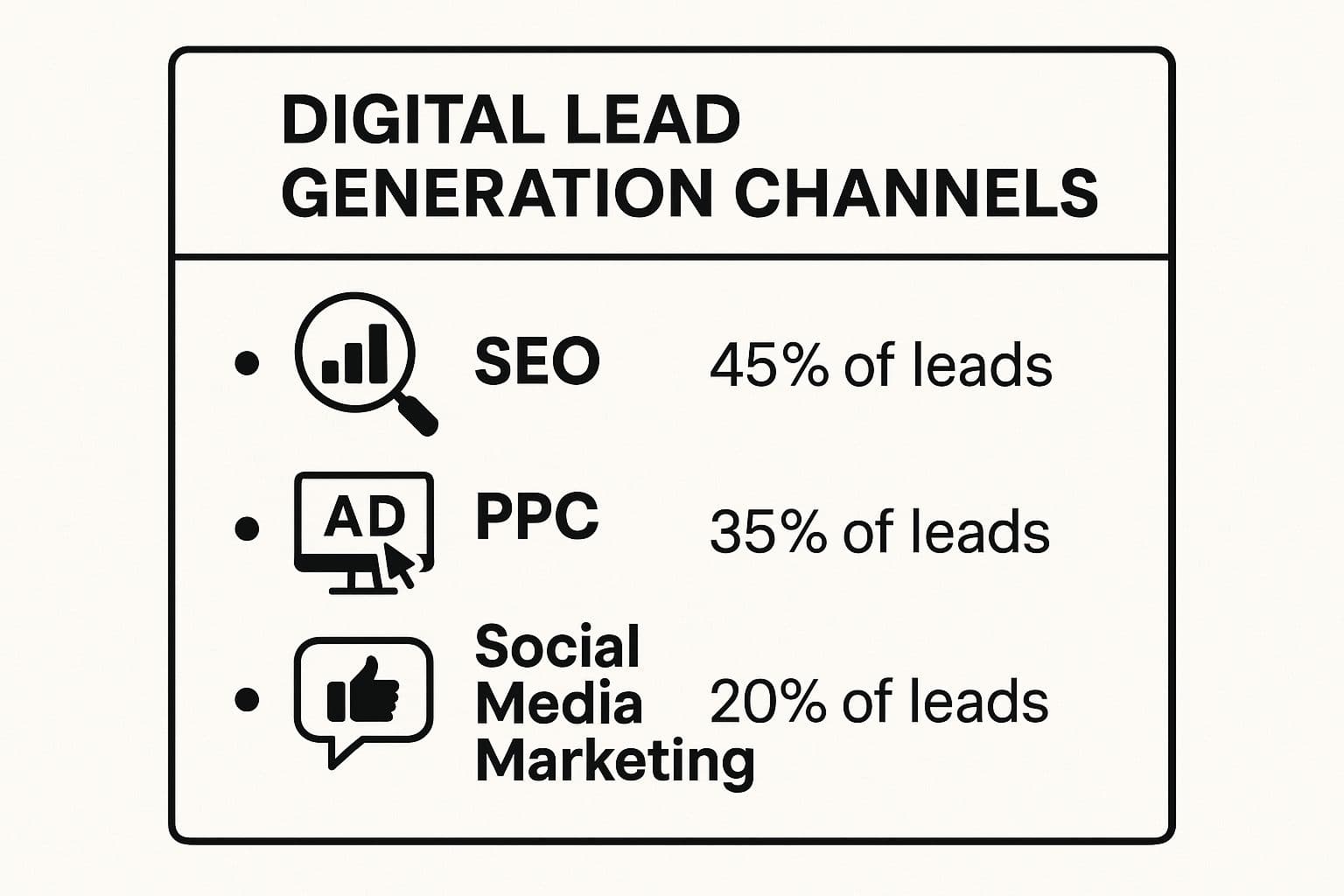
This data highlights the importance of a balanced approach, with organic search driving the most volume, supported by targeted paid and social campaigns. For a deeper dive, learn more about crafting a comprehensive digital lead generation plan.
- Broker Network Strategy
A strategic Broker Network Strategy involves building and nurturing relationships with independent franchise brokers and consultants. These intermediaries act as a powerful extension of your development team, pre-screening and connecting qualified, high-intent candidates directly with your brand. Leveraging a broker network is a highly effective franchise recruitment strategy because it taps into a pre-existing pool of vetted prospects who are actively seeking to invest.
For example, the FranChoice network has been instrumental in the rapid expansion of brands like Mosquito Squad by matching them with ideal owner-operators. Similarly, the International Franchise Professionals Group (IFPG) consistently delivers high-quality leads to its partner franchisors, particularly within the home services and B2B sectors, significantly shortening the sales cycle.
Key Implementation Steps
To maximize the return from this channel, a systematic and relationship-focused approach is essential.
*Vet Your Partners: Carefully select broker networks and individual consultants. Ensure their values align with your brand and that they have a proven track record of placing successful franchisees in your industry. *Provide Comprehensive Training: Equip brokers with a robust toolkit, including detailed brand guidelines, ideal candidate profiles, and unique selling propositions. This ensures they can represent your opportunity accurately and enthusiastically. *Establish Clear Metrics: Set clear expectations for lead quality and conversion rates. Implement a system to track performance by broker or network, allowing you to focus resources on your most productive partnerships. *Maintain Regular Communication: Treat brokers as true partners. Provide them with regular updates on brand performance, new initiatives, and success stories to keep your franchise top-of-mind.
This strategy is particularly effective for brands looking to accelerate growth without massively expanding their in-house sales team. The key is to view brokers not as a simple lead source, but as a strategic alliance built on mutual trust and shared goals. For more insights on working with these groups, you can explore the resources offered by organizations like the International Franchise Professionals Group (IFPG).
- Referral Program Strategy
A well-structured referral program is a powerful franchise recruitment strategy that leverages your most valuable assets: your existing network. This approach taps into the trusted relationships you have with current franchisees, employees, customers, and business partners, encouraging them to recommend qualified candidates. Because these leads come from a source that already understands your brand and culture, they often have higher conversion rates and a better long-term fit.

For instance, McDonald's has historically generated as much as 30% of its new franchisees through its internal referral program, demonstrating the immense potential of this channel. Similarly, brands like RE/MAX incentivize their real estate agents to refer new franchisee candidates, while Supercuts offers rewards to customers who bring in potential owners. These programs capitalize on inherent trust and pre-existing brand loyalty to attract high-caliber prospects.
Key Implementation Steps
To build a successful referral engine, your focus should be on simplicity, motivation, and clear communication.
*Meaningful Incentives: Offer rewards that truly motivate action, such as significant cash bonuses, royalty relief for a set period, or other high-value perks. Consider tiered rewards for multiple successful referrals to encourage ongoing participation. *Simple Submission Process: Make it incredibly easy for people to submit a referral. A simple online form or a dedicated email address is far more effective than a complex, multi-step process. *Consistent Communication: Provide regular updates to the referrer on the status of their candidate. Keeping them informed shows their contribution is valued and maintains engagement. For detailed guidance on setting up a robust program, consider reading this guide on how to create a referral program that actually works. *Public Recognition: Beyond financial rewards, publicly celebrate successful referrers in company newsletters, at annual conferences, or on internal communication platforms. This recognition can be a powerful motivator for others.
- Trade Show and Event Marketing Strategy
A well-executed trade show and event marketing strategy allows you to connect with prospective franchisees on a personal level, moving beyond digital interactions to build genuine rapport. This hands-on approach involves participating in franchise expos, industry conferences, and business exhibitions to meet qualified candidates face-to-face. It provides a unique platform to demonstrate your business concept, answer complex questions in real time, and cultivate relationships in a high-energy, focused environment.

For example, the annual International Franchise Association (IFA) Convention is a prime venue where emerging and established brands generate thousands of leads. Similarly, restaurant-focused events like the Multi-Unit Restaurant Show (MUSOExpo) offer direct access to experienced operators looking to diversify their portfolios, making it a highly effective franchise recruitment strategy for food and beverage concepts. Regional events like Franchise Expo West also provide concentrated access to candidates in specific high-growth markets.
Key Implementation Steps
Success in event marketing hinges on meticulous preparation and a systematic approach to engagement and follow-up.
*Strategic Event Selection: Choose events that attract your ideal franchisee profile. A concept targeting veterans might prioritize military-focused business expos, while a B2B service brand should attend professional industry conferences. *Compelling Booth Presence: Design a visually engaging booth with clear messaging and interactive elements. Offer live demonstrations, product samples, or a virtual reality tour of a model location to capture attention. *Lead Qualification Training: Equip your event staff with a clear set of qualifying questions and a process for capturing lead information efficiently. Not every conversation will yield a qualified prospect, so knowing how to identify serious candidates is crucial. *Systematic Follow-Up: Develop a multi-touch follow-up sequence that begins within 24 hours of the event. Combine personalized emails, phone calls, and tailored information packets to nurture the relationship and maintain momentum.
To see how top brands prepare their teams for these high-stakes events, watch this insightful video on maximizing your trade show investment.
By setting clear goals for lead generation and appointment setting, you can transform event participation from an expense into a powerful and predictable recruitment channel. Learn more about selecting the right shows at the International Franchise Association's event calendar.
- Territory Development Strategy
A sophisticated territory development strategy is a proactive franchise recruitment strategy that moves beyond simply reacting to inbound leads. It involves a methodical, data-driven approach to geographic expansion, analyzing specific markets to identify ideal locations and then recruiting franchisees to fill them. This ensures systematic growth, optimizes brand penetration, and prevents market oversaturation, creating a sustainable and profitable network.
For instance, Starbucks built its global empire not by chance but through meticulous market-by-market expansion, ensuring each new store supported the next. Similarly, Papa John's uses a territory development model that analyzes demographic data and competitor density to define prime territories, which they then actively market to potential franchisees. This strategic planning maximizes the success potential for each new unit.
Key Implementation Steps
To execute a successful territory development plan, your approach must be rooted in deep market intelligence and targeted outreach.
*Conduct Market Analysis: Use demographic, psychographic, and economic data from firms like SiteZeus or Buxton to identify and prioritize key markets with the highest potential return on investment. *Develop Market-Specific Messaging: Tailor your recruitment marketing materials to highlight the unique opportunities within a target territory, such as a growing population, lack of direct competition, or strong local economy. *Engage Local Partners: Collaborate with local business brokers, real estate agents, and chambers of commerce who have deep connections within the community and can introduce you to qualified candidates. *Define Clear Timelines: Create a detailed roadmap with milestones for entering each new market, from initial research and lead generation to franchisee signing and store opening.
This proactive method ensures you are not just selling a franchise but are offering a strategic business opportunity in a pre-vetted, high-potential area. For a comprehensive guide on building your growth map, you can learn more about crafting a strategic franchise development plan.
- Multi-Unit Development Strategy
A multi-unit development strategy is a powerful franchise recruitment strategy focused on accelerating brand growth by partnering with experienced operators capable of opening multiple units. Instead of pursuing a one-by-one franchisee model, this approach targets sophisticated investors and business leaders, offering them area development rights or multi-unit agreements. This secures rapid market penetration, ensures operational consistency, and reduces the franchisor's support burden over the long term.
For example, quick-service restaurant (QSR) giants like Taco Bell and Dunkin' have heavily relied on this model to scale quickly, prioritizing candidates with proven operational track records and significant financial backing. Similarly, 7-Eleven's area licensee development strategy allows seasoned partners to control entire regions, ensuring rapid and cohesive expansion. This approach is ideal for brands aiming to saturate a market efficiently.
Key Implementation Steps
Executing a multi-unit strategy requires a different level of due diligence and support compared to single-unit recruitment.
*Rigorous Vetting: Thoroughly vet potential developers for both financial capacity and proven multi-location management experience. This goes beyond simple capital checks to include leadership and operational history. *Structured Agreements: Create detailed development agreements with realistic timelines, performance milestones, and clear remedies for non-compliance. This protects both the brand and the developer. *Enhanced Support Systems: Provide specialized training and support tailored to multi-unit operations, covering topics like regional management, supply chain logistics, and consolidated marketing. For franchisors expanding their footprint, implementing robust local SEO for multiple locations is essential to support these partners digitally. *Relationship Management: Establish a dedicated point of contact or a specialized support team for multi-unit developers to foster a strong, collaborative partnership.
- Content Marketing and Thought Leadership Strategy
A forward-thinking content marketing and thought leadership strategy positions your brand as an industry authority, attracting high-quality candidates by providing value long before they ever fill out a form. This franchise recruitment strategy moves beyond direct advertising to build trust and credibility. By creating and distributing insightful content such as blogs, whitepapers, webinars, and case studies, you educate potential franchisees and guide them through their decision-making journey.
For example, many leading franchise development consultants build their entire business on this model, offering free educational resources that address the core concerns of prospective owners. Similarly, established brands like Orangetheory Fitness use their blog and social media to share business insights and success stories, establishing themselves as leaders not just in fitness but in franchising. This approach nurtures leads by answering their questions proactively.
Key Implementation Steps
To build authority, your content must be authentic, helpful, and consistently delivered.
*Address Key Pain Points: Create a content calendar focused on answering the biggest questions and fears potential franchisees have, such as "How much can I make?" or "What support will I get?" *Segment by Funnel Stage: Develop content for every stage of the buyer's journey. Use top-of-funnel blog posts for awareness (e.g., "5 Signs You're Ready to Own a Business") and bottom-of-funnel webinars for decision-making (e.g., "A Deep Dive into Our FDD"). *Leverage Data and Research: Back up your claims with industry data, internal performance metrics, and franchisee testimonials. This data-driven approach builds immense credibility. *Optimize and Repurpose: Ensure all content is optimized for search engines (SEO) to attract organic traffic. Repurpose major assets like a whitepaper into multiple blog posts, infographics, and social media updates to maximize reach.
This strategic investment in content marketing not only generates leads but also ensures they are better informed and more aligned with your brand's vision from the very first interaction. Educating candidates through content is a critical component of effective franchise sales training, as it pre-qualifies them and streamlines the sales process.
- Partnership and Strategic Alliance Strategy
A proactive partnership and strategic alliance strategy expands your recruitment network by leveraging trusted, third-party relationships. This approach involves formally collaborating with complementary businesses, financial institutions, and professional organizations to create a powerful ecosystem of mutual referrals. Instead of relying solely on direct outreach, you tap into existing networks of potential franchisees who already trust your partners.
For instance, many emerging fast-casual restaurant franchises build strong relationships with Small Business Administration (SBA) lenders. The lenders can then refer pre-qualified loan applicants directly to the franchise, streamlining the financing and recruitment process. Similarly, a home services franchise might partner with local real estate associations, gaining direct access to agents who can recommend the business to new homeowners.
Key Implementation Steps
To build a successful partnership-based franchise recruitment strategy, focus on creating clear, mutually beneficial agreements.
*Formalize Agreements: Develop written partnership agreements that clearly outline roles, responsibilities, referral processes, and any commission or fee structures. This prevents misunderstandings and sets expectations. *Target Complementary Verticals: Identify partners whose customer base aligns with your ideal franchisee profile but who are not direct competitors. Examples include industry suppliers, accounting firms, or business brokers. *Provide Partner Toolkits: Equip your allies with marketing collateral, key talking points, and a dedicated contact person. Make it easy for them to understand your value proposition and refer candidates effectively. *Establish Regular Communication: Nurture relationships through regular check-ins, performance reviews, and joint planning sessions. Strong relationships are the foundation of a productive partnership program.
Building these alliances allows you to access warm, pre-vetted leads, often at a lower acquisition cost than traditional advertising. This method is particularly effective for reaching candidates who may not be actively searching on franchise portals but possess the skills and capital to succeed. For more insights on building these types of business-to-business relationships, the U.S. Chamber of Commerce offers valuable resources on strategic partnership development.
Franchise Recruitment Strategy Comparison
| Strategy | Implementation Complexity | Resource Requirements | Expected Outcomes | Ideal Use Cases | Key Advantages ★ |
|---|---|---|---|---|---|
| Digital Lead Generation Strategy | High: requires tech, continuous optimization | High: digital tools, skilled marketers | Scalable, measurable leads; targeted and 24/7 generation | Brands seeking scalable, data-driven lead flow | Cost-effective; high targeting precision; data optimization |
| Broker Network Strategy | Medium: relationship management, training needed | Medium: broker commissions and support | Access to pre-qualified candidates; faster market entry | Franchisors needing vetted candidates quickly | Market expertise; reduced internal costs; vetted prospects |
| Referral Program Strategy | Low to Medium: requires tracking and incentives | Low to Medium: incentives and administrative support | High conversion rates; pre-qualified leads via trust | Networks with engaged franchisees/customers | Low acquisition cost; sustainable; authentic endorsements |
| Trade Show and Event Marketing | High: preparation, staffing, event presence | High: booth, travel, materials | Direct interaction; immediate feedback; brand credibility | Brands targeting concentrated qualified audiences | Face-to-face engagement; relationship building; visibility |
| Territory Development Strategy | High: requires research, planning, market analysis | High: research, local marketing | Strategic market coverage and optimized territorial growth | Franchisors focusing on geographic expansion planning | Data-driven decisions; reduced cannibalization; focused growth |
| Multi-Unit Development Strategy | High: legal, contractual complexity, vetting | Medium to High: developer support, agreements | Accelerated expansion; higher revenue from multi-units | Experienced operators or investors pursuing multi-unit growth | Faster expansion; reduced costs per unit; market dominance |
| Content Marketing & Thought Leadership | Medium to High: continuous content creation | Medium: skilled creators, sustained effort | Long-term trust and organic leads; expert brand positioning | Brands establishing authority and inbound leads | Builds credibility; cost-effective; educates prospects |
| Partnership & Strategic Alliance | Medium to High: agreement management, coordination | Medium: joint marketing, partner enablement | Expanded reach and referrals via trusted networks | Franchisors leveraging complementary business links | Access new markets; shared resources; credibility boost |
Integrating Your Strategies for Maximum Impact
Navigating the complex landscape of franchise development requires more than just a single, isolated tactic. As we've explored, a truly powerful franchise recruitment strategy is not a menu of options from which you select one or two favorites. Instead, it’s a dynamic, interconnected ecosystem where each component strengthens the others, creating a powerful engine for sustainable growth.
Imagine your robust digital lead generation funnel feeding highly qualified prospects directly into your trade show calendar. Picture your satisfied multi-unit owners becoming the most vocal champions for your franchisee referral program. This is the synergy you should aim for, where your content marketing establishes the thought leadership that attracts high-caliber candidates through broker networks and strategic alliances.
Weaving the Threads Together
The individual strategies, from hyper-targeted digital campaigns to relationship-driven broker networks, are the essential threads. However, the true strength lies in how you weave them together. The success of this integrated approach hinges on one critical factor: a centralized, responsive, and seamless communication process. Without it, even the highest quality leads generated from these diverse channels can fall through the cracks, growing cold from a lack of immediate engagement.
A lead from a trade show has a different context than one from a referral, yet both demand the same thing: speed. Your ability to connect instantly, regardless of the source, is what separates successful franchise systems from those that constantly struggle to fill their pipeline.
The Power of an Integrated System
A successful franchise recruitment strategy is built on a foundation of a few core principles:
*Diversification: Relying on a single lead source is a recipe for vulnerability. By combining digital efforts, broker relationships, events, and referral programs, you create a resilient and consistent flow of candidates. *Synergy: Your content marketing should provide the assets your brokers use. Your trade show appearances should be promoted through your digital channels. Each strategy should actively support and amplify the others. *Speed-to-Lead: In the competitive franchise sales environment, the first to respond often wins. Automating initial contact ensures no prospect is ever left waiting, dramatically increasing your chances of starting a meaningful conversation.
By thoughtfully combining these powerful recruitment methods and underpinning them with a robust, automated communication hub, you transform your recruitment efforts from a series of disconnected activities into a scalable, efficient, and highly effective growth machine. This integrated system doesn't just find candidates; it nurtures them, qualifies them, and converts them into the passionate franchise owners who will drive your brand forward for years to come.
Ready to unify your diverse lead sources and ensure every potential franchisee gets an immediate response? See how FranFunnel can automate your outreach and supercharge your franchise recruitment strategy. Visit FranFunnel to learn how our platform integrates with all your channels to turn more leads into owners.