In the competitive world of franchise sales, every lead represents a potential multi-year partnership worth hundreds of thousands of dollars. Yet, franchisors often lose significant revenue for every lead that goes stale due to slow response times. The critical gap between a prospect's inquiry and your first contact is where deals are won or lost. An optimized lead routing strategy is not just an administrative task; it's the engine of your franchise development pipeline, ensuring the right prospect connects with the right development representative at the perfect moment.
This guide moves beyond generic advice to provide a comprehensive look at the lead routing best practices that separate high-growth franchise systems from the rest. The effectiveness of your entire strategy, however, is directly tied to the quality of your incoming leads. This process starts with implementing essential email verification best practices to ensure your contact data is accurate and deliverable from the very beginning, preventing routing errors before they happen.
By mastering these techniques, you can build a more efficient, responsive, and ultimately more profitable franchise sales process. We will explore actionable, in-depth strategies tailored for the unique challenges of franchise development, including:
*Round-Robin and Geographic Routing: Fairly distributing leads across territories. *Lead Scoring and Priority Routing: Focusing your team's energy on the hottest prospects. *Speed-to-Lead Optimization: Minimizing response times to gain a competitive edge. *Skills-Based and Account-Based Routing: Aligning complex leads with specialized representatives. *Omnichannel Source and Capacity Management: Handling leads from various channels and managing team workload effectively.
These proven methods will help you convert more qualified applicants into successful franchisees.
- Master the Fundamentals with Balanced Round-Robin Lead Distribution
Round-robin distribution is the foundational model for fair and equitable lead allocation, making it an essential starting point for any franchise sales team. It systematically assigns incoming franchise leads to sales representatives in a cyclical, sequential order. Think of it as dealing a deck of cards one by one to each player at the table; this method ensures every franchise development representative (FDR) receives an equal volume of opportunities over time. This approach is a cornerstone of many successful lead routing best practices because it directly addresses team morale and fairness.

For a franchise system, this means a lead from Dallas is just as likely to go to Rep A as a lead from Miami, assuming it is Rep A's turn in the queue. This simple mechanism prevents lead hoarding and FDR burnout, fostering a collaborative environment where success is based on performance, not on who gets the 'best' leads. However, its simplicity is also its primary limitation; a basic round-robin setup does not account for a rep's specific experience, their current workload, or geographical expertise.
Why It's a Foundational Practice
Round-robin is the baseline for fairness and is incredibly easy to implement. It establishes a transparent process that your team can understand and trust. This is crucial for building a healthy sales culture, especially in a competitive environment like franchise development. It removes any perception of favoritism in lead assignment, allowing managers to evaluate performance based on skill and effort rather than the quality or quantity of assigned leads.
Actionable Implementation Tips
To get the most out of a round-robin system, go beyond the basic setup. Consider these specific actions:
*Implement Weighted Distribution: Instead of giving every rep one "slot" in the rotation, assign weights based on experience or performance. A senior FDR might receive three leads for every one lead a new trainee receives, ensuring your most capable reps handle more opportunities while new hires aren't overwhelmed. *Set “Out of Office” Rules: Your routing system must automatically skip reps who are on vacation or unavailable. This prevents leads from languishing in an inactive inbox, a critical step for maintaining speed-to-lead. Most CRMs, like HubSpot, allow you to set user availability. *Monitor and Adjust: Regularly review conversion rates for each representative. If a particular FDR is consistently underperforming with their assigned leads, it signals a need for targeted training, not just a flaw in the distribution. This turns your routing data into a powerful coaching tool.
- Leverage Local Expertise with Geographic Territory-Based Routing
Geographic territory-based routing assigns leads to sales representatives based on the prospect's physical location. This strategy is built on the principle that local knowledge matters. By connecting a potential franchisee with a representative who understands their specific market, you create a more personalized and effective sales experience. This is a crucial evolution from basic distribution and one of the most impactful lead routing best practices for franchises with a national or international footprint.
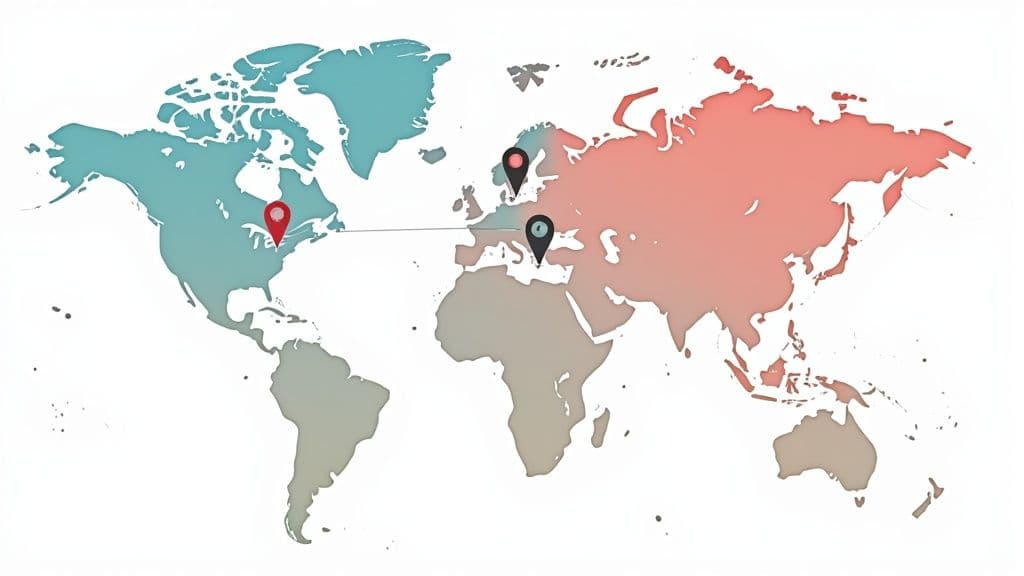
For a franchise brand, this means a lead from Phoenix is automatically sent to the sales rep managing the Arizona territory. This rep can speak intelligently about local market conditions, competitor presence, and regional consumer behavior. This approach not only improves the quality of the sales conversation but also facilitates potential in-person meetings and streamlines compliance with state-specific franchise laws. Enterprise software companies like Oracle and SAP have long used this model to align sales teams with regional customer needs.
Why It's a Foundational Practice
Territory-based routing leverages the powerful advantage of local expertise. A representative familiar with a territory can build stronger rapport and provide more relevant insights, significantly improving lead quality and conversion rates. This method aligns sales efforts with market potential, ensuring that your team's resources are deployed where they can be most effective. It moves beyond simple fairness to strategic alignment, allowing reps to become true experts in their assigned areas.
Actionable Implementation Tips
To effectively implement geographic routing, you need a system that is both precise and flexible. Consider these specific actions:
*Use Rich Geodata: Go beyond simple state or ZIP code assignments. Use IP address data or form fields to capture city and county information for more granular assignments. Create territories based on Designated Market Areas (DMAs) or Metropolitan Statistical Areas (MSAs) to align with marketing campaigns and population density. *Implement Overflow and Proximity Rules: What happens when your New York City rep is swamped but your New Jersey rep has capacity? Implement overflow rules that automatically re-route leads to the next-closest or an available national rep. This maintains speed-to-lead even during high-volume periods. *Visualize and Analyze Territory Performance: Use mapping tools within your CRM or a dedicated platform to visualize your territories. Regularly analyze performance metrics like lead volume, conversion rates, and sales cycle length for each territory. This data will reveal if boundaries need to be redrawn to balance workload or capitalize on emerging market opportunities.
- Lead Scoring and Priority-Based Routing
Lead scoring and priority-based routing elevates your strategy from equitable distribution to intelligent assignment. This model moves beyond simply assigning the next lead in the queue; instead, it analyzes and scores each incoming prospect against a set of predefined criteria. Higher-scored, sales-ready leads are automatically routed to your most experienced franchise development representatives (FDRs), while lower-scored leads can be placed into a nurturing sequence or assigned to a junior team member for further qualification.
For a franchise system, this means a candidate who has downloaded your Franchise Disclosure Document (FDD), has the stated capital required, and works in a relevant industry will receive a high score and be fast-tracked to a senior FDR. Conversely, a lead from a general "business opportunities" portal with an unverified email address might receive a low score and enter an automated email drip campaign. This targeted approach is a core component of advanced lead routing best practices, ensuring your top talent focuses their energy on the most promising opportunities.
Why It's an Essential Practice
This method maximizes sales efficiency by aligning lead quality with representative skill. Instead of having senior reps waste valuable time on lukewarm or unqualified leads, you empower them to engage with candidates who are already far along the consideration path. It also creates a structured development path for junior team members, allowing them to hone their skills on lower-stakes leads. This data-driven approach removes guesswork and ensures high-value prospects receive immediate, expert attention.
Actionable Implementation Tips
To effectively implement lead scoring, you must be strategic and data-focused. Consider these specific actions:
*Define Clear Scoring Criteria: Analyze your historical data to identify the attributes of successfully closed deals. Assign point values to criteria like liquid capital, net worth, geographic location (target markets), lead source (e.g., franchise portal vs. direct website inquiry), and specific behaviors like visiting the franchise investment page. *Establish Priority Tiers: Create distinct routing rules based on score ranges. For example, leads scoring 80-100 are "hot" and go to top-tier reps instantly. Leads scoring 50-79 are "warm" and might go to a general pool or junior reps. Leads below 50 could be automatically enrolled in a long-term nurturing workflow. *Regularly Review and Refine: Lead scoring is not a "set it and forget it" system. Review your scoring model quarterly to ensure it accurately predicts lead quality. If reps are closing deals from "low-score" leads, your criteria may need adjustment. For more detailed guidance, you can explore information about specialized lead scoring software on franfunnel.com.
- Speed-to-Lead Optimization
In franchise development, the window of opportunity with a new lead is incredibly brief. Speed-to-lead optimization is a routing strategy designed to capitalize on this critical moment by minimizing the time between when a lead submits their information and when a franchise development representative (FDR) makes initial contact. This approach uses immediate notifications, real-time availability tracking, and automated assignments to connect with prospects while their interest is at its peak. The core principle is simple: the faster you respond, the higher your chance of converting the lead into a qualified candidate.

This strategy is not just about being fast; it's about being first. When a potential franchisee is researching opportunities, they are likely exploring multiple brands. A routing system built for speed, like those offered by Chili Piper or Velocify, ensures your brand is the first to engage, setting a professional and responsive tone from the very beginning. This immediate engagement dramatically increases the likelihood of a meaningful conversation, making speed-to-lead a non-negotiable part of modern lead routing best practices. High-growth franchise systems often rely on this principle to manage high lead flow effectively without needing more salespeople.
Why It's a Foundational Practice
The data overwhelmingly supports the value of a rapid response. Studies consistently show that contacting a new lead within the first five minutes can increase conversion rates by several hundred percent. For franchises, this means more discovery calls booked and more candidates entering the sales funnel. By prioritizing speed, you capture the prospect's attention before competitors can, demonstrating efficiency and organization, which are attractive qualities for any potential business owner.
Actionable Implementation Tips
Optimizing for speed requires a combination of technology and process. Here’s how to implement it effectively:
*Set Up Instant Notifications: Configure your CRM or lead routing software to send immediate alerts to the assigned FDR via multiple channels like email, SMS, and mobile push notifications. This ensures reps are aware of new leads the moment they arrive, regardless of where they are. *Implement Backup Assignment Rules: What happens if the primary rep is on a call or in a meeting? Your system must have rules to automatically re-route the lead to the next available rep after a short, predefined period (e.g., 2-3 minutes). This prevents leads from going cold in someone’s queue. *Track and Measure Response Times: You cannot improve what you do not measure. Use your system’s reporting to track the average time-to-contact for each rep and the team as a whole. Set clear goals and use this data to identify bottlenecks and coaching opportunities. *Create Response Templates: Equip your team with pre-written but customizable email and text message templates. This allows them to send a personalized, relevant first touch within seconds of receiving a lead notification, blending speed with quality communication.
- Leverage Skills and Expertise-Based Routing
Skills-based routing is a sophisticated strategy that moves beyond simple rotation or geography to match leads with the sales representative best equipped to handle their specific needs. It directs prospects based on criteria like industry knowledge, language proficiency, product specialization, or experience with a particular customer segment. For a franchise, this could mean routing a lead with a background in multi-unit restaurant management directly to a Franchise Development Representative (FDR) who specializes in that owner profile. This method is one of the most effective lead routing best practices for ensuring a high-quality initial interaction.
Imagine a prospective franchisee indicates on an inquiry form that they are interested in converting their existing independent business into a franchise location. Instead of sending this lead to the next rep in the queue, a skills-based system would instantly assign it to the FDR who has successfully managed the most conversion deals. This targeted approach dramatically increases the odds of building immediate rapport and demonstrating a deep understanding of the prospect's unique situation, leading to higher conversion rates for complex or high-value leads.
Why It's a High-Impact Practice
This approach optimizes for quality of engagement over quantity of leads. It positions your franchise as a team of specialists, not generalists, which builds credibility from the very first touchpoint. When a prospect speaks with someone who truly understands their background, challenges, and goals, the sales cycle can be shortened, and trust is established much faster. It ensures your most valuable or niche opportunities are handled by the reps with the highest probability of closing them.
Actionable Implementation Tips
To effectively implement skills-based routing, you need a clear and systematic approach.
*Develop and Maintain a Skills Matrix: Create a detailed, living document or database that maps each FDR’s competencies. Include categories like "multi-unit experience," "veteran-focused financing," "real estate negotiation," or "international development." This matrix becomes the backbone of your routing logic. *Establish Backup Assignment Rules: What happens if your single "retail conversion specialist" is on vacation? Your system must have secondary and tertiary rules to prevent bottlenecks. This could involve routing the lead to a closely-related expert or a specially trained senior team member. *Use Lead Capture Forms to Gather Data: Your inquiry forms are critical for collecting the data needed for this strategy to work. Add fields that help you identify a lead’s specific needs, such as "What is your professional background?" or "Are you interested in a single or multi-unit opportunity?" *Regularly Assess and Certify Expertise: Skills can become outdated. Implement a process for regularly assessing and certifying rep expertise to ensure your skills matrix remains accurate. This could involve periodic training, testing, or performance reviews tied to specific lead types.
- Account-Based Routing and Relationship Mapping
While round-robin focuses on fairness, account-based routing prioritizes continuity and leveraging existing relationships. This strategic method assigns new leads based on their connection to an existing company or account already managed by a sales representative. Instead of sending a new contact from an established client company into a random queue, this approach ensures they are directed to the representative who already holds that relationship. This is one of the most powerful lead routing best practices for B2B or multi-unit franchise sales.
This model is crucial for franchises targeting investment groups or existing business owners looking to diversify. For example, if Rep A is already working with a partner at a specific investment firm, any new lead from that same firm should automatically route to Rep A. This maintains a consistent point of contact, avoids internal confusion, and leverages the trust and rapport already built. Platforms like Salesforce and HubSpot facilitate this with company-based assignment rules, while tools like 6sense integrate it into a broader account-based marketing strategy.
Why It's a Foundational Practice
Account-based routing prevents the cardinal sin of making a warm prospect feel like a cold lead. It acknowledges and respects the history between your brand and a potential franchisee's organization. This continuity builds significant trust and accelerates the sales cycle, as the representative can draw upon established context and relationships from day one. It transforms lead routing from a purely logistical task into a strategic relationship management tool.
Actionable Implementation Tips
To effectively use account-based routing, you must have a clear view of your customer and prospect landscape.
*Implement Comprehensive Account Mapping: Your CRM must be the single source of truth for account ownership. Diligently map all contacts to their respective parent companies and assign a clear owner to each account. This foundational data is what powers the entire routing logic. *Create Handoff Protocols: When a sales representative leaves or changes territories, you need a clear, documented process for reassigning their accounts. This ensures no relationships fall through the cracks and that the new representative has all the historical context needed to succeed. To effectively implement this strategy and foster continuity, a comprehensive account-based sales playbook can provide invaluable guidance. *Set Up New Contact Alerts: Configure your system to notify an account owner immediately when a new contact from one of their assigned companies submits a form or engages with your brand. This allows the rep to reach out with personalized context, such as, "I see you've joined the team at ABC Corp; I've been working with your colleague Jane for the past six months."
- Implement Omnichannel Lead Source Routing
Omnichannel lead source routing directs incoming leads to representatives best equipped to handle them based on their point of origin. Not all leads are created equal; a prospect who submitted a form after a detailed webinar has a different context and expectation than someone who clicked a PPC ad. This strategy acknowledges these differences by matching the lead’s source channel, such as social media, paid search, or a specific content download, with a sales rep who specializes in that type of engagement. It’s a sophisticated evolution of basic routing that aligns marketing efforts directly with sales expertise.
For a franchise, this means a lead from a Google Ads campaign could be routed to an FDR who excels at converting high-intent, quick-response inquiries. In contrast, a lead from a LinkedIn organic post might go to a rep skilled in nurturing long-term relationships with prospects who are earlier in their research phase. This method is one of the most impactful lead routing best practices because it maximizes the ROI of each marketing channel by ensuring a specialized and contextual follow-up.
Why It's a Strategic Practice
This approach connects the dots between your marketing spend and sales performance. By understanding which channels produce the most valuable leads and ensuring they are handled by the right people, you create a powerful feedback loop. It allows you to double down on successful campaigns and provide targeted coaching for reps handling specific lead types. This alignment ensures a smoother handoff from marketing to sales, improving the candidate experience and boosting conversion rates.
Actionable Implementation Tips
To effectively implement source-based routing, you need a clear view of your marketing funnel and sales capabilities.
*Map Lead Sources to Specialist Reps: Create a clear matrix that assigns each lead source (e.g., Facebook Ads, organic search, specific landing pages, webinar sign-ups) to the FDR or team with the highest conversion rate for that channel. For instance, route all leads from industry portal listings to a rep who understands how to handle candidates comparing multiple brands. *Implement Robust UTM Tracking: Accurate source attribution is non-negotiable. Use UTM parameters consistently across all digital marketing campaigns to tag every incoming lead with its precise source, medium, and campaign. This data is the fuel that powers your routing engine and provides clarity on campaign performance. *Unify the Prospect View: Leads often interact with your brand across multiple channels before converting. Your CRM should consolidate these touchpoints into a single contact record. This gives the assigned FDR a complete history, enabling a more informed and personalized conversation from the very first interaction. To gain deeper insights into the latest digital marketing strategies that feed your lead routing system, explore relevant articles and case studies from a dedicated source for digital marketing insights.
- Dynamic Load Balancing and Capacity Management
Beyond simple fairness, the most advanced lead routing best practices focus on optimizing team productivity in real time. Dynamic load balancing moves past static rules to consider the current capacity and performance of each representative. It’s an intelligent system that asks not just "whose turn is it?" but "who is best equipped to handle this lead right now?" This prevents top performers from being overwhelmed while ensuring underutilized reps receive opportunities to contribute.
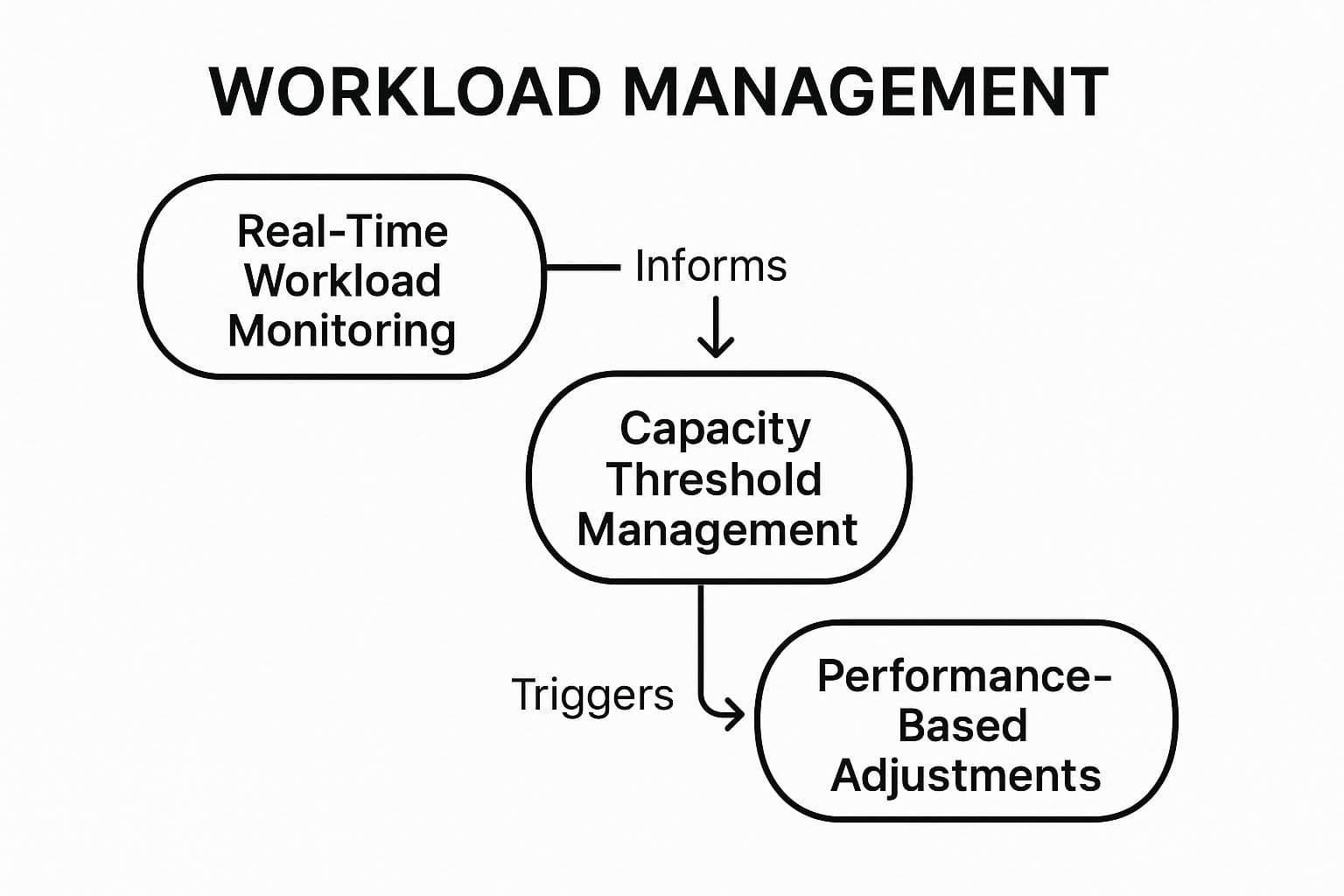
For a growing franchise, this means your routing system can automatically divert leads from an FDR who is currently in a long discovery call to one who just closed a file. This concept map illustrates the interconnected components that make this system work, linking real-time workload tracking to capacity rules and performance-based adjustments. By integrating these three pillars, you create a responsive and efficient sales engine that maximizes every opportunity. Platforms like LeanData and Salesforce offer robust tools to build these sophisticated, capacity-aware workflows.
Why It's a Foundational Practice
Dynamic load balancing is foundational for scaling a sales team without sacrificing speed-to-lead or quality of engagement. It directly prevents two major problems: FDR burnout from overwhelming lead volume and lead neglect from assigning opportunities to reps who are already at capacity. This intelligent approach ensures that every incoming lead is routed to a representative who has the bandwidth to provide a prompt and thorough follow-up, dramatically improving conversion potential and the candidate experience. It turns your lead distribution from a simple administrative task into a strategic asset for revenue operations.
Actionable Implementation Tips
To effectively implement dynamic load balancing, you need a system that can track and act on data in real time. Here are the key steps:
*Define Clear Capacity Metrics: Establish a maximum number of active leads or open opportunities each rep can handle at one time. This "capacity threshold" should be based on historical performance data and can vary by role or experience level. For instance, a senior FDR might have a capacity of 40 active leads, while a junior rep's threshold is 25. *Implement Automated Alerts and Pauses: Configure your CRM or routing tool to automatically pause lead assignment to any rep who hits their defined capacity threshold. Set up alerts for managers when a rep is approaching or has exceeded their limit, signaling potential bottlenecks in the sales process. *Regularly Monitor and Adjust Rules: Load balancing is not a "set it and forget it" strategy. Continuously review team dashboards to analyze how capacity rules are impacting performance. If the entire team is consistently at capacity, it's a clear signal that you need to either hire more FDRs or re-evaluate your lead qualification process.
Lead Routing Strategies Comparison
| Lead Routing Method | Implementation Complexity | Resource Requirements | Expected Outcomes | Ideal Use Cases | Key Advantages ★ |
|---|---|---|---|---|---|
| Round-Robin Lead Distribution | Low - simple sequential setup | Low - integrates easily with CRM | Fair lead distribution, balanced workload | Teams needing equal opportunity assignment | Prevents bias, easy to understand and audit |
| Geographic Territory-Based Routing | Medium - requires territory mapping | Medium - requires geographic and timezone data | Improved local relationships and reduced costs | Sales needing local presence and compliance | Leverages local knowledge, reduces travel |
| Lead Scoring and Priority-Based | High - needs scoring models and automation | High - ongoing calibration and data analysis | Matches lead quality to rep expertise | Complex sales with varied lead values | Maximizes conversions via targeted assignment |
| Speed-to-Lead Optimization | Medium-High - requires real-time tracking | Medium-High - needs instant notifications | Faster response, higher conversion rates | High-volume, time-sensitive lead follow-up | Captures prospects at peak interest |
| Skills and Expertise-Based Routing | High - detailed skills and expertise mapping | Medium-High - requires regular updates | Improved customer satisfaction and shorter cycles | Specialized products/services requiring experts | Matches leads to right expertise, boosts performance |
| Account-Based Routing and Relationship Mapping | High - comprehensive relationship data and mapping | High - maintains contact history and hierarchies | Maintains relationship continuity and trust | Enterprise accounts with existing relationships | Enhances account penetration and lifetime value |
| Omnichannel Lead Source Routing | Medium-High - complex channel tracking setup | Medium-High - multi-source data integration | Better marketing-sales alignment and ROI | Multi-channel marketing and diverse lead sources | Leverages channel expertise, improves ROI |
| Dynamic Load Balancing and Capacity Management | High - real-time monitoring and predictive analytics | High - sophisticated tracking and reporting | Optimized productivity, prevents burnout | Large teams with variable workloads | Balances workload dynamically for efficiency |
From Chaos to Conversion: Building Your Ultimate Franchise Lead Routing System
Navigating the landscape of franchise lead management can feel like orchestrating a complex symphony. Each potential franchisee is a unique instrument, and every lead source is a different section of the orchestra. Without a skilled conductor and a clear score, the result is noise and chaos. The lead routing best practices we've explored throughout this guide are your sheet music, designed to transform that potential chaos into a powerful, conversion-focused harmony.
We’ve moved beyond the simplistic idea of just getting a lead to a salesperson. Instead, we've dissected the strategic layers required for a truly elite franchise development process. From the foundational fairness of Round-Robin distribution to the precision of Geographic Territory-Based Routing, these methods form the bedrock of an organized system. But modern franchise growth demands more sophistication.
That's where advanced strategies come into play. By integrating Lead Scoring, you stop treating every inquiry as equal and start prioritizing candidates who signal a higher intent and better fit for your brand. This ensures your top development managers invest their valuable time where it yields the greatest return. Similarly, Skills-Based Routing ensures that a complex multi-unit inquiry is handled by your seasoned expert, not a rookie, maximizing the potential of high-value deals.
Synthesizing Strategy for Maximum Impact
The true power of these lead routing best practices is not found in isolation but in their integration. A world-class system doesn't just choose one method; it artfully blends them into a dynamic, automated workflow tailored to its specific needs.
Imagine this powerful combination in action for your franchise:
*Initial Filter: A new lead arrives and is instantly routed based on Geographic Territory to the manager responsible for that region. *Priority Layer: Simultaneously, your system’s Lead Scoring algorithm analyzes the inquiry. A lead from a high-performing portal who requested information on a five-unit package is flagged as "high priority," while a simple "more info" request from a generic source is marked "standard." *Workload Management: Your system, using Dynamic Load Balancing, notes that the primary territory manager is already handling three high-priority conversations. To maintain optimal speed-to-lead, it temporarily assigns this new high-priority lead to another qualified manager with available capacity. *Speed-to-Lead Activation: The instant the lead is assigned, an automated workflow kicks in, sending a personalized text and email to the candidate, referencing their specific interest and promising a call within minutes. This immediate, relevant engagement is the cornerstone of Speed-to-Lead Optimization.
This multi-layered approach transforms lead routing from a passive administrative task into a proactive strategic weapon. It acknowledges that the journey from initial interest to a signed franchise agreement is fragile. The first few minutes are critical, and a single misstep, a delayed response, or a mismatched conversation can send a promising candidate straight to your competitor.
Your Action Plan for Implementation
Mastering this process is an ongoing journey of refinement, not a one-time setup. Your immediate next steps should be grounded in analysis and strategic implementation. Begin by auditing your current process. Where are the leaks? Is it response time? Are leads being misassigned? Is your team’s workload uneven, leading to burnout and missed opportunities?
Use this audit to identify your biggest bottleneck and select the one or two practices from this guide that will have the most immediate impact. Don't try to boil the ocean. Perhaps your first move is simply implementing a territory-based system with an automated first response. Once that is perfected, you can layer on lead scoring or capacity management.
The goal is not perfection on day one, but progress every day. An effective lead routing system is a living entity; it must be measured, analyzed, and optimized continuously. Track your response times, contact rates, and ultimately, your lead-to-deal conversion rates for each strategy you implement. This data will be your guide, illuminating what works and where to focus your efforts next.
By adopting and integrating these sophisticated lead routing best practices, you are building more than just an efficient sales process. You are constructing a competitive advantage that ensures every hard-won lead is given the absolute best chance to become the next successful franchisee in your growing network.
Tired of watching high-intent franchise leads go cold before your team can even respond? The single most important factor in converting a new lead is speed, and FranFunnel is purpose-built to solve that problem. Our platform provides instant, automated, and multi-channel communication to engage your candidates the moment they show interest, seamlessly integrating into the lead routing best practices you've learned about. See how FranFunnel can help you win the race to the lead and close more deals.
Further reading: FranFunnel vs hiring an SDR.