The first text a franchise lead receives from your brand is the first impression, the first qualifier, and the first chance to start an actual conversation — all in one message. Most brands waste it.
The failure is not slowness, though that is a real problem. The failure is generic. A text that says "Thanks for your interest! Someone will be in touch soon." is an acknowledgment. It tells the candidate their form arrived. It does not ask them anything. It does not invite a reply. It is a dead end dressed up as outreach.
The good news: an automated text can read exactly like a rep sent it. The structure is not complicated, but every element earns its place.
The Enemy Is Generic, Not Automated
Before getting into structure, one framing point matters: automation is not the problem here. The problem is what most automation sends.
FranFunnel's own study of 530 franchise brands found that 44% never sent a personal reply to a new lead inquiry — most of them sent an automated acknowledgment and stopped there, while 28% sent nothing at all. The brands that sent something fast but generic were not better off than the brands that were slow. The candidate got a message. The message said nothing worth replying to.
FranFunnel's first text is automated too. The difference is that it is written to the candidate and it asks a question. That is the only axis that matters: personal versus generic. Not human versus automated.
"44% of franchise brands never send a personal reply — an automated acknowledgment or nothing at all." — FranFunnel Franchise Lead Response Time Study · 530 brands · fielded March–April 2025
The Four Elements of a First Text That Gets a Reply
A first text to a franchise lead has one job: get a reply. Everything else — qualification, booking a meeting, explaining the opportunity — comes after. The message that earns a reply has four elements, in this order.
1. The candidate's first name. Not "Hi there." Not "Hello." First name, right at the top. This is the minimum viable signal that a human (or something behaving like one) is paying attention to them specifically. It takes one merge field.
2. Who you are, in one phrase. The rep's first name and the brand. Not a tagline. Not a legal name with LLC. "This is Marcus with Lunchbox Franchise Development" is enough. The candidate needs to place the message — they may have submitted three forms this week.
3. One specific question. This is where most automated texts fail. They either ask nothing (dead end) or ask five things at once (overwhelming). One question. It should be something the candidate can answer in a sentence, and it should be something only they can answer about themselves — their market, their background, what drew them to this brand, whether they are looking at this full-time. The question proves the message is for them, not for a list.
4. Nothing else. No link. No brochure. No "feel free to reply or call us at." The candidate who reads to the end of a four-sentence text with a question is primed to reply. Add more and they skim to the bottom and forget what they were going to say.
What This Looks Like in Practice
Here is a first text that follows the structure:
"Hi Sarah — this is Marcus with Lunchbox Franchise Development. I saw you submitted an inquiry this evening. Quick question before I send anything over: are you looking at this as a full-time owner-operator situation, or more of a semi-absentee setup? Either works, just want to make sure I point you in the right direction."
That text does several things at once. It uses her name. It acknowledges when she submitted (evening — meaning the system sent this within 60 seconds of her form submit, and Marcus sounds like he noticed). It frames the question as being in her interest, not as a screener. It signals there is more coming once she answers, which creates forward momentum. And it closes with a soft reassurance that neither answer is wrong.
Compare that to: "Thank you for your interest in Lunchbox! A member of our team will reach out within 1–2 business days. In the meantime, please visit our website to learn more about our opportunity."
The second one is not a conversation. It is a waiting room.
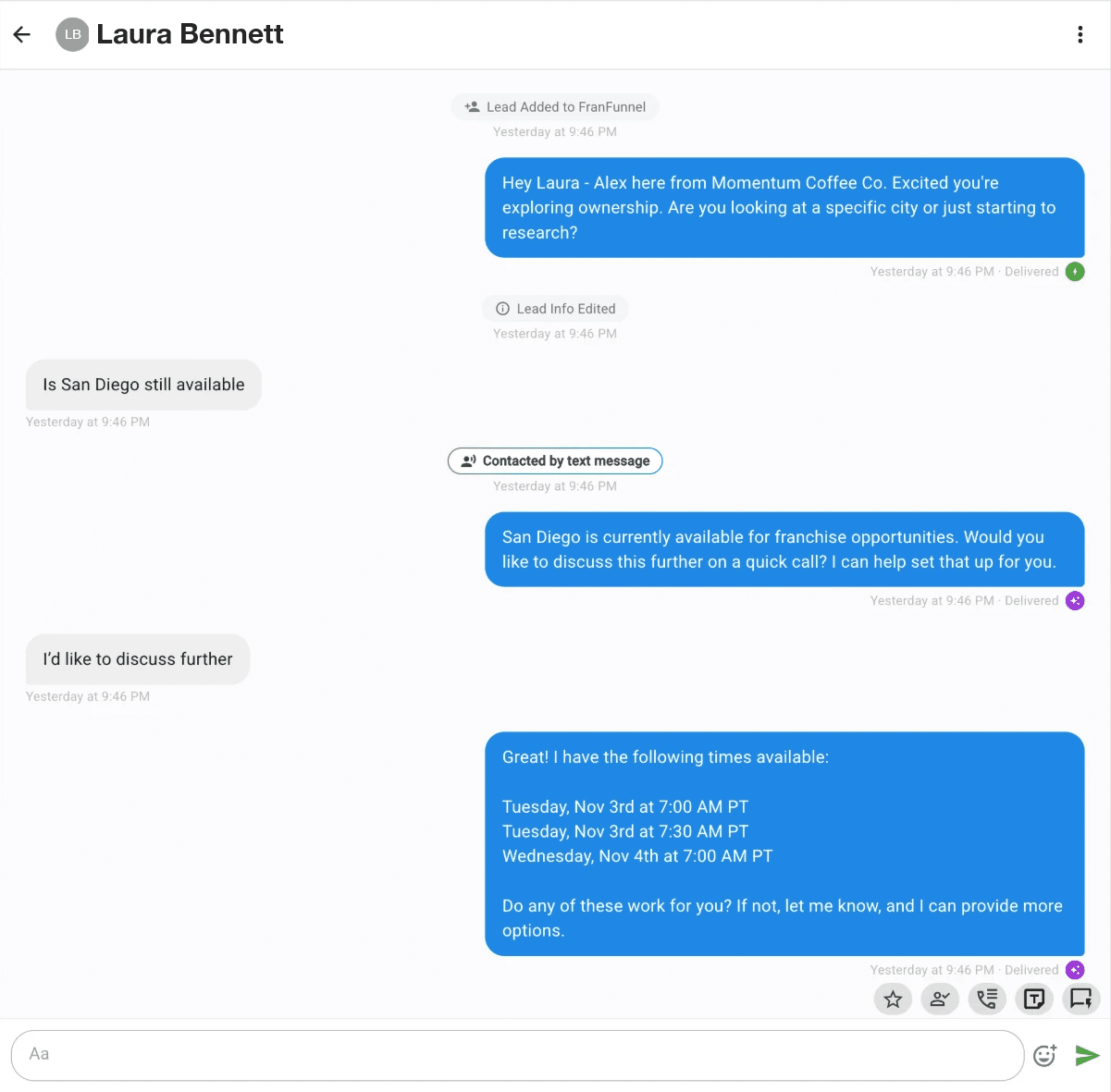 FranFunnel sends the first text within 60 seconds of a form submit, then moves the conversation toward a booked meeting — all inside the text thread. Names changed.
When to Bring Up the Meeting
The meeting comes after the first reply, not before it. Once a candidate responds — even a short answer — the conversation has started. That is the signal that they are present and engaged. Now you offer times.
The right move here is not a booking link. A link asks the candidate to leave the conversation, find a slot on a calendar page, fill out a form, and come back. Each of those steps is a place the conversation dies. FranFunnel offers the next available times directly in the text thread instead — the candidate replies with which one works, and the invite goes out on the rep's behalf. No form. No leaving the thread.
The difference in outcome is measurable. FranFunnel books 14.6% of the leads it texts when times are offered this way. Across nearly 20,000 leads sent a scheduling link instead, only 6.7% clicked through to open the booking page — and fewer than that actually booked. (Select FranFunnel client data, 2025-2026. Booking rate: 1,535 booked appointments from 10,506 leads texted by the assistant. Link click rate: 1,338 clicks from 19,904 leads sent a scheduling link, across client accounts with click tracking confirmed active. We compare our bookings to their clicks because a click is all a scheduling link lets us see, and it is the generous read for the link. Their real booking rate is lower than their click rate; we cannot tell you how much lower.)
The structure of the meeting offer follows the same logic as the first text: specific, short, one ask. "I have Tuesday at 2 PM or Wednesday at 10 AM — which works better for a quick 20-minute intro call?" reads like a rep who checked their calendar. It does not read like a tool.
What the Rep Sees When They Show Up
If the first text is built correctly and the conversation runs on autopilot through booking, the rep arrives at a scheduled call with a candidate who has already answered a qualifying question, picked a time, and received a confirmed invite. The rep has the full thread in front of them — every message in and out, in order.
That is not replacing the rep. That is a rep who shows up to a warm conversation instead of spending the morning chasing down cold leads who filled out a form three days ago and have already talked to two other brands.
The agent stays in the thread until the rep wants in. The moment a rep sends a manual message, the agent for that stage shuts off. The rep is driving. The next agent picks up when the pipeline stage changes — application follow-up, FDD check-in, Discovery Day confirmation — each one built for that specific moment in the candidate's journey.
The first 60 seconds set all of this in motion. Get the structure right, and the rest of the conversation has somewhere to go.
See how FranFunnel builds the first text for your brand and watches your leads reply. Book a demo at franfunnel.com.