Hiring a franchise lead gen agency before your engagement infrastructure is ready does not accelerate your pipeline — it accelerates your leak. More leads arriving into a broken follow-up process just means more leads going cold at a higher cost per lead. The agency is not the problem. The timing is.
Here is what to build before you make that call.
Most Brands Are Not Ready to Convert the Leads They Already Have
This is not a theory. FranFunnel's Franchise Lead Response Time Study tested 530 major franchise brands and measured every inbound inquiry from submission to first reply. The finding is hard to look at: 44% of brands never sent a personal reply at all — an automated receipt, or nothing. More than a quarter sent nothing at any kind.
"44% of franchise brands never sent a personal reply to an inbound inquiry — just an automated acknowledgment, or nothing at all." — FranFunnel Franchise Lead Response Time Study · 530 brands · fielded March–April 2025
That 44% is not all dark-age franchisors ignoring their email. Many of them have CRMs, portals, and marketing stacks. The gap between "we have tools" and "we engage leads personally and fast" is exactly where franchise deals die. If your team is anywhere in that 44%, adding lead volume before closing that gap is the wrong order of operations.
The five things below fix that gap. Build them first. Then hire the agency.
1. A First Text That Goes Out in Under 60 Seconds
A lead who submits a form at 9 PM does not wait until 9 AM. They submit the same form to three other brands before they close their laptop. The first responder sets the frame for the entire relationship — the later responders are playing catch-up from the first message.
Your first text needs three things: it goes out fast (under 60 seconds from form submission), it is written to the candidate (their name, the brand, a question that invites a reply), and it goes out 24 hours a day, seven days a week. An automated receipt is not this. A drip email is not this. A text from a rep who saw the notification at 7 AM the next morning is not this.
This is the floor. Everything else builds on top of it. Without it, you are spending agency money to fill a bucket with a hole in the bottom.
2. A Follow-Up Sequence for Each Pipeline Stage
One generic follow-up bot does a mediocre job across every stage of your funnel because every stage has different goals. The question a candidate needs answered on day one of an application review is not the same question they need answered four days into their FDD window.
Before you scale inbound, map your pipeline stages and assign a follow-up track to each one:
| Pipeline Stage | Primary Goal | What Follow-Up Should Do |
|---|---|---|
| Lead capture / intro | Book the discovery call | Engage fast, answer basic questions, offer calendar times |
| Application | Move the form to submitted | Follow up on missing sections, answer process questions |
| FDD issuance | Keep the candidate engaged during the 14-day window | Check in, answer fee and territory questions, remind of deadlines |
| Discovery Day | Confirm attendance, reduce no-shows | Send reminders, answer logistics questions, re-book if needed |
A stage-specific sequence does not have to be elaborate. It has to be relevant. A candidate in FDD review who receives the same "just checking in" text that went to a cold lead two days after their inquiry form will notice. That mismatch signals that the brand's follow-up is automated and generic — the exact thing the best candidates are least tolerant of.
When a lead gen agency drives volume at the top of this funnel, every stage below it has to be ready. Otherwise you book more intro calls and lose candidates somewhere between application and FDD.
3. Calendar-Connected Booking That Keeps the Lead in the Conversation
Booking links are a valid fallback. They are not the best path.
A booking link asks the candidate to do three things: leave the text conversation, open a scheduling form, pick a slot on their own, and fill out the form. Every step is a drop-off point. FranFunnel books 14.6% of the leads it texts when times are offered directly in the text thread. Across nearly 20,000 leads sent a scheduling link instead, only 6.7% clicked through to even open the booking page — and fewer than that actually booked. (Select FranFunnel client data, 2025-2026. Booking rate: 1,535 booked appointments from 10,506 leads texted by the assistant. Link click rate: 1,338 clicks from 19,904 leads sent a scheduling link, across client accounts with click tracking confirmed active.)
Calendar-connected booking in the text thread means the assistant scans the rep's calendar, surfaces three available times in the same message, and books the invite the moment the candidate picks one. No link. No form. No leaving the conversation.
Before you scale inbound, make sure your booking flow is connected to real availability and lives inside the channel where your leads are already talking to you.
4. A Bidirectional CRM Sync That Logs Everything
An agency will ask you which sources are performing. If you cannot answer that question with contact rate and booking rate by lead source, you cannot hold them accountable — and you cannot pull budget from the sources that are burning it.
Bidirectional CRM sync means two things: every text in and out logs automatically as activity on the lead record, and a stage change in your CRM triggers the right follow-up sequence in your engagement platform. The CRM is the system of record. The engagement layer is what makes it move.
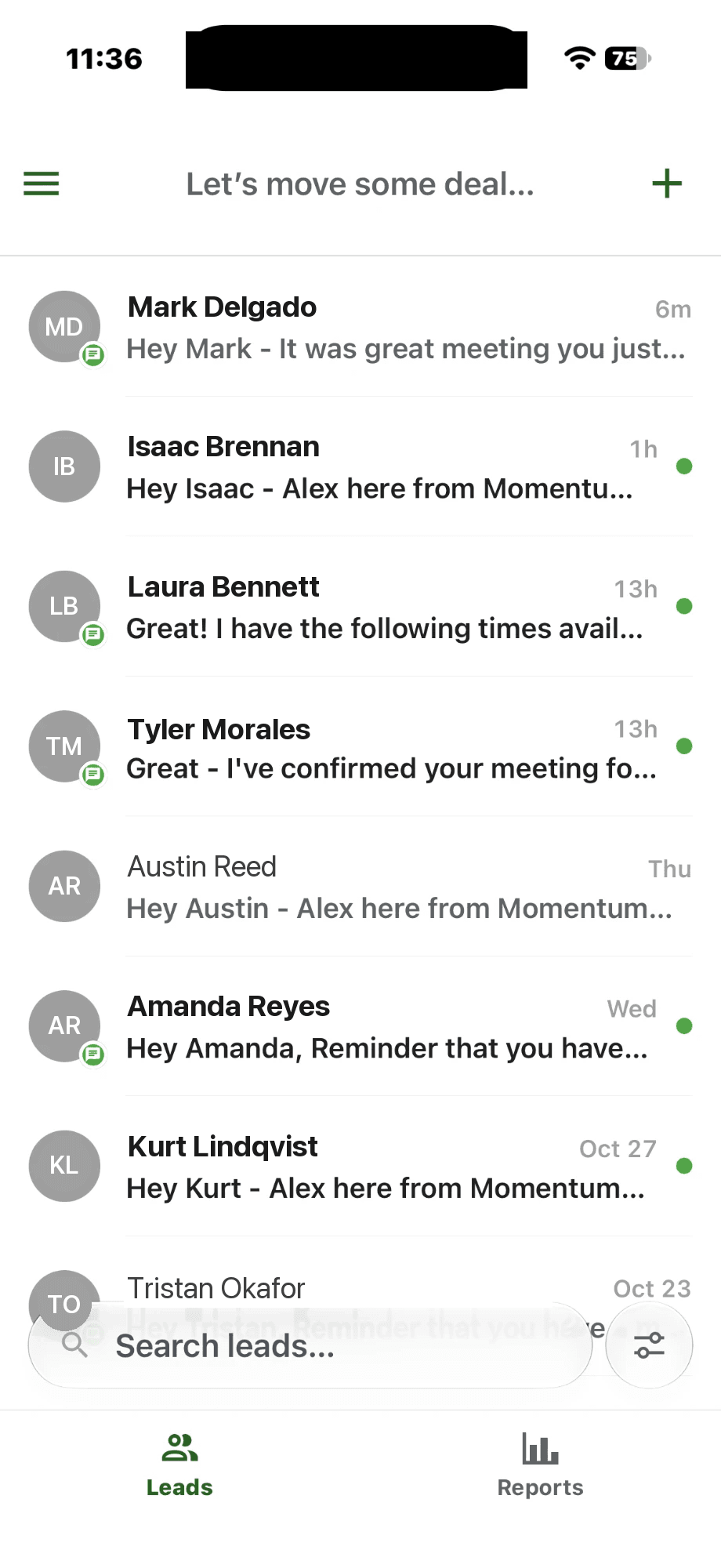 Rep's inbox view: each thread shows the last message and whether the agent is handling it. Names changed.
Without this sync in place before your agency starts, you will have leads who engaged, went quiet, and re-engaged — none of which is visible in the CRM because it was happening in a text thread no one logged. Decisions made from that CRM will be wrong.
5. A Re-Engagement Plan for Leads Who Go Quiet
Franchise candidates go quiet for reasons that have nothing to do with disqualification. They got busy. They asked a question and the reply came four days later. They are still in consideration but not in conversation.
A re-engagement sequence is not a last-ditch email blast. It is a planned outreach track that fires when a lead has been silent for a defined window — 14 days, 21 days, 30 days — with a message that reconnects without sounding like a form letter.
Before you spend money driving new volume, work out what happens to the leads who already came in and went quiet. For most brands, there is a year's worth of pipeline sitting in that bucket. Re-engagement campaigns often recover candidates who were better qualified than whoever replied to your last portal ad.
The agency's job is to drive new leads. Your job is to make sure no prior lead was left in an inbox they never checked.
The five things above are not complicated to build. They are easy to skip when the pressure is on to drive volume. Build them first, and the agency's work compounds instead of leaking out. Skip them, and you will be back in six months trying to explain why the pipeline looks full but the closings do not.
See how FranFunnel builds this infrastructure for franchise development teams — usually live in 48 hours. Book a demo at franfunnel.com.