Paid media fills your pipeline faster than any other channel — and it fills it with more unqualified leads than any other channel. That is not a reason to stop running it. It is a reason to stop letting every lead it generates trigger the same full AI agent sequence before anyone has checked whether that candidate can actually buy.
The Problem Is Not Volume — It Is Undifferentiated Volume
Franchise portals and consultant referrals carry implicit pre-qualification. A candidate who shows up through a broker has already talked to someone. A candidate who submits through FranConnect's directory has at minimum self-selected into a franchise-specific context. Neither is a perfect filter, but both carry more signal than a click on a Meta ad.
Paid media carries almost none. A click on a Facebook ad, a YouTube pre-roll, a Google search for "own your own business" — these are the top of the top of funnel. Geography might match. Investment range almost certainly has not been confirmed. Net worth is unknown. Urgency is indeterminate. And yet, without a pre-qualification layer, every one of those form fills triggers the identical agent engagement your genuinely qualified candidates receive.
That matters for two reasons. First, your AI agent capacity is not infinite — it is finite in the same way a rep's time is finite, and spending it on candidates who do not meet your financial qualifications is the same waste. Second, your contact rate and booking rate numbers become meaningless. If 60% of the leads in a given week came from a paid media blitz targeting broad interest signals, the contacts and bookings that result tell you very little about your pipeline health.
What Pre-Qualification Actually Does (and Does Not Do)
Pre-qualification at FranFunnel is a system-level routing decision, not something the AI agent does inside a conversation. The agent itself does not qualify the candidate. The system reads the signals you send — form fields, lead source tags, scoring rules from your CRM — and routes each lead into the right messaging track before a single message sends.
Qualified candidates get the full agent engagement: a personalized first text in under 60 seconds, the intro-call agent running the conversation, in-thread time offers, a booked discovery call. Leads that do not meet your criteria get a different track — a lighter, shorter engagement that acknowledges the inquiry and captures any missing information without committing your full pipeline capacity to a candidate who cannot buy.
Pre-qualification is off by default. It requires you to send us the signals we score against. If you are running paid media campaigns and already capturing investment-range or liquid-capital fields on your landing pages, that data can go straight into the routing logic. If you are not capturing those fields yet, that is the first conversation to have — because without input signals, the routing has nothing to work with.
"73% of franchise brands never used SMS to contact leads — not because they chose email, but because they never built the follow-up infrastructure at all." — FranFunnel Franchise Lead Response Time Study · 530 brands · fielded March–April 2025
The Cost of Skipping This Step
Consider what happens when a brand runs a national Meta campaign without a pre-qualification layer in place. The campaign drives 400 form fills in a month. The intro-call agent texts all 400 within 60 seconds, engages every thread, offers calendar times, books meetings. Contact rate looks strong. Booking rate looks strong. Then the discovery calls happen.
Reps spend the first week clearing calls with candidates who are $100,000 short of the minimum liquid capital requirement, candidates who are geographically in a territory the brand has already sold, candidates who clicked the ad because they were curious about franchising in general and had no idea what the investment level was. Each of those calls is 30–45 minutes that could have gone to a qualified candidate who went cold in the meantime.
Pre-qualification does not make this problem disappear — some mismatched candidates will always slip through any scoring model. But it creates a meaningful triage layer that stops the worst-fit leads from consuming the same resources as your best-fit candidates, and it makes your pipeline metrics actually useful for decisions about where to shift media spend.
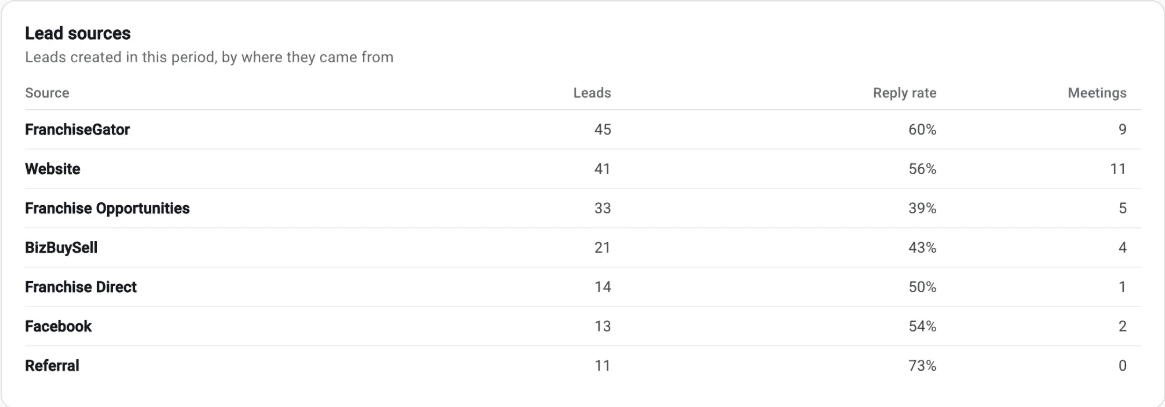 Lead-source report for one FranFunnel client account showing meetings booked by source. These are one account's figures, not benchmarks. Names changed.
How the Routing Logic Works in Practice
The setup is white-glove. Your FranFunnel account team maps the routing logic against your specific qualification criteria — you do not configure it yourself. The conversation starts with what you are already capturing: if your paid media landing page asks for liquid capital range, that field drives the routing. If your CRM applies a lead score or a source tag before the record arrives in FranFunnel, we read that tag and route accordingly.
A common setup looks like this: leads that meet the financial threshold and fall within an available territory enter the intro-call agent track immediately. Leads that do not meet the financial threshold receive a lighter acknowledgment track — a message that confirms the inquiry, asks one or two additional qualification questions, and holds the record in a pending state until the information arrives. Leads from certain source tags that consistently produce low-fit candidates can be routed to a manual review queue rather than any agent at all.
The trigger for each track is whatever signal you can send us. CRM stage change, form field value, webhook payload from the landing page — if the signal exists, the routing can use it.
Speed Does Not Change — The Destination Does
The concern that sometimes comes up here is whether adding a pre-qualification layer slows down the response for qualified candidates. It does not. The routing decision happens at the point of ingestion, in the same instant the lead record arrives. Qualified candidates still receive a first text in under 60 seconds. The pre-qualification logic runs before the message sends, not between send attempts.
Unqualified candidates receive a first message just as fast — it is a different message, on a lighter track, but it goes out immediately. No lead sits uncontacted while the system deliberates. Speed is preserved on every path.
What changes is where each lead lands after that first message — and that is precisely the point. The same speed that makes FranFunnel effective for qualified candidates can inadvertently make it equally fast at filling a rep's calendar with the wrong conversations. Pre-qualification is what ensures the speed works for you rather than against you.
The Right Time to Add a Pre-Qualification Layer
If you are running paid media and your team already suspects that a meaningful share of the leads coming in do not meet your financial or geographic criteria, the pre-qualification layer is the right next step — not a later step once the volume gets worse. The setup cost is low; the ongoing cost of skipping it compounds every month the campaign runs.
The conversation with your FranFunnel account team starts with your qualification criteria and what signals you are currently capturing at the point of lead submission. From there, the routing logic is built against your process. You approve it. It goes live with everything else in the standard 48-hour window.
For teams that do not have a lead-quality problem — brands running mostly broker or portal traffic, consultants whose inbound is already pre-screened — the layer stays off. It is not something you need to manage or monitor once it is configured. It runs in the background, and your pipeline reflects the result.
If your paid media spend is growing and your reps are spending discovery calls on candidates who cannot buy, that is the conversation to have. Book a demo at franfunnel.com and we will walk through what pre-qualification would look like against your current lead flow.