The intro call agent booked the meeting. The candidate submitted an application three days later. And then both agents fired at the same time — the intro agent because the CRM stage had not been updated yet, and the application agent because the stage change that updated it was wired to launch immediately on the same event that should have ended the first agent.
The candidate got two texts in forty seconds from different scripts. Neither made sense in context. The rep got a support ticket.
This is a pipeline stage collision, and it is not rare. It is what happens when brands use a single CRM trigger to simultaneously shut off one agent and activate the next.
A Booked Meeting and a Submitted Application Are Different Events
The intro call agent has one job: get the candidate to book a discovery call. The proof it finished that job is a booked meeting — not a CRM stage change, not a rep clicking a button, and not the application coming in.
The application agent has one job: follow up on an open application, answer the candidate's questions about next steps, and keep the conversation alive until the application is submitted. The proof it should activate is an application received.
These two events — meeting booked, application received — are almost never simultaneous. The discovery call might happen two days after the meeting books. The application might arrive two days after the call. There is a window between them, sometimes a week or longer, where neither agent should be active. That window belongs to the rep.
When brands collapse both conditions into one CRM stage change — say, moving the lead to "Discovery Call Scheduled" — they force the system to decide in the same instant whether the intro agent should stop and the application agent should start. The answer is usually neither is quite right.
What a Stage Collision Looks Like From the Candidate's Side
Franchise candidates do not think in pipeline stages. They think in terms of what just happened to them and what they need to do next. When two agents fire simultaneously, or in rapid succession, the candidate sees:
- Two texts from the same sender, seconds apart, with different tones and different asks
- An intro-call reminder for a meeting they already attended
- An application follow-up before they have been told to apply
Each of these creates friction at the moment when friction is most expensive — right after a candidate has shown genuine intent. A candidate who submits an application is a warm lead. A confused or annoyed candidate after that submission is a problem the data never captures, because they just go quiet.
"44% of franchise brands never send a personal reply — an automated acknowledgment, or nothing at all." — FranFunnel Franchise Lead Response Time Study · 530 brands · fielded March–April 2025
The study measured what happens at the top of the funnel. Stage collisions are a mid-funnel version of the same failure: the system is active, but it is not saying the right thing at the right moment.
The Fix: Separate the Shutoff from the Activation
The intro call agent needs its own shutoff condition, independent of whatever activates the application agent. The right shutoff condition is the meeting booking itself — a signal that FranFunnel can receive directly from the calendar integration, without waiting for a rep to update the CRM.
The application agent needs its own activation condition, independent of whatever ended the intro agent. The right activation condition is the application receipt — a CRM stage change, a webhook, a form submission notification, or any signal the customer can send when the application actually arrives.
The gap between them is intentional. During that gap, the rep owns the thread. The discovery call happens, the rep follows up, and when the application comes in, the system picks it back up. The application agent activates on a clean signal, with no overlap and no duplicate outreach.
| Transition Point | Shutoff Condition | Activation Condition |
|---|---|---|
| Intro call → gap | Meeting booked (calendar event created) | — |
| Gap → application follow-up | — | Application received (CRM stage change or webhook) |
| Application → FDD | Application reviewed (CRM stage change) | FDD issued (CRM stage change) |
| FDD → Discovery Day | FDD review period closed (14-day wait) | Discovery Day confirmed (CRM stage change) |
Each row is a one-to-one relationship. No shutoff and activation share a signal.
CRM Triggers Are Not the Only Option
FranFunnel can receive a stage change from your CRM, a button click inside FranFunnel, a webhook, or an inbound notification as a trigger. The common case is a CRM stage change, because most franchise development teams already have stages that map roughly to the pipeline. But the stage change is a proxy for the event, not the event itself.
If your CRM's stage names do not match your actual pipeline milestones cleanly — which is common after a CRM has been in use for a few years and the stages have been renamed twice — you can use a webhook from the booking confirmation, a button the rep clicks after the discovery call, or a field-level update when the application is marked received. The signal matters less than its specificity.
A vague signal produces a vague handoff. "Lead is active" does not tell the system whether to run the intro agent or the application agent. "Application received at 2:14 PM" does.
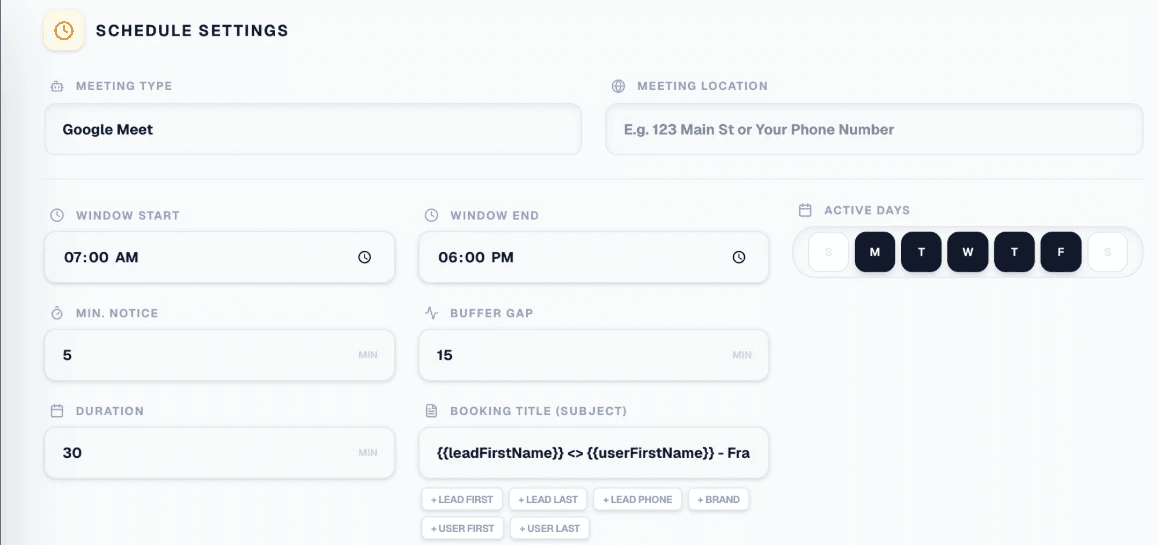 The meeting booking controls in FranFunnel. Setting a minimum notice window and buffer gap gives the intro call agent a clean shutoff point before the next agent activates. Names changed.
Why This Matters More as the Pipeline Gets Longer
A two-stage pipeline — intro call, close — has limited collision surface. A full franchise development pipeline has eight stages and four or five agents, each with its own shutoff and activation condition.
In canonical order: lead capture and pre-screen, intro call, application, FDD issuance and 14-day wait, franchisee validation, Discovery Day, franchise agreement execution, onboarding handoff to ops. FranFunnel typically runs agents for intro, application, FDD, and Discovery Day — four agents, each with its own trigger, each with its own shutoff.
Every additional agent is another opportunity for a collision if the conditions are shared. It is also another opportunity for a gap if the activation fires too late. The more stages in your pipeline, the more precise your trigger logic needs to be.
FranFunnel's client solutions team maps this during setup. You describe your sales process — what happens at each stage, what signals you can send, what proof looks like for each transition — and the team builds the agent logic to match. When the process changes, you tell your client solutions manager and they update it. You do not own the configuration.
One Extra Signing Closes the Business Case
The setup work to separate shutoff and activation conditions adds a few hours of configuration time and some specificity in how you describe your pipeline milestones. The payoff is a funnel that does not send two contradictory messages to a candidate who just submitted an application — which is to say, your most interested candidates get the clearest signal at the moment they are most likely to move forward.
A single franchise signing is worth $250,000 or more in fees and royalties. The business case for getting the stage handoff logic right is not complicated.
See how FranFunnel maps your pipeline and builds the stage agents for you. Book a demo at franfunnel.com.