An FSO managing ten or more client brands is not running one franchise sales process. It is running ten. Each brand has its own territory rules, its own fee structure, its own discovery day format, and its own sales team expectations. The idea that a single AI bot can serve every candidate, at every stage, across every brand — without sounding wrong most of the time — is not a strategy. It is a liability.
One Script Cannot Do Ten Jobs
A generic bot has one voice, one script, and one set of follow-up logic. It fires the same message whether the candidate just submitted a form or just received an FDD. It answers questions with whatever it was trained on — which, for a shared tool across brands, is usually a lowest-common-denominator prompt that doesn't belong to any brand specifically.
The problem compounds fast at scale. When a candidate who is mid-FDD-review gets a message better suited to an intro call, the message either confuses them or signals that the process is automated in the worst sense — nobody read the file, nobody knows where they are, and nothing was written for them. That is the moment a candidate starts returning calls more slowly, or stops returning them at all.
An FSO's accountability to its client brands is measured in booked meetings and closed deals. A bot that can't distinguish pipeline stages is not a tool — it is a contact-rate problem waiting to show up in reporting.
The Stage Problem Is a Structure Problem
Franchise development has a fixed sequence: lead capture and pre-screen, intro call, application, FDD issuance and the 14-day review window, franchisee validation, Discovery Day, agreement execution, and onboarding handoff. Each stage has a different job to do in the conversation.
The intro-call stage needs to engage the candidate, answer early questions about the opportunity, offer specific calendar times in the text thread, and get a meeting on the books. The application stage needs to follow up on a missing or incomplete submission, answer process questions, and keep the candidate moving. The FDD stage needs to check in during the 14-day window, answer questions about territory, fees, and royalties, and drive toward a validation call. The Discovery Day stage needs to confirm attendance, handle logistics, and send reminders at the right intervals.
A single bot cannot hold all four of those jobs at once without losing specificity in every one of them. The only architecture that works is one agent per stage, each one purpose-built for the conversation that stage actually requires.
"44% of franchise brands never sent a personal reply — just an automated acknowledgment, or nothing at all." — FranFunnel Franchise Lead Response Time Study · 530 brands · fielded March–April 2025
That figure comes from a study of 530 brands across 12 franchise verticals. The finding is not that brands are ignoring leads on purpose. It is that the follow-up infrastructure is not built to respond personally — it is built to acknowledge. A shared bot at the wrong stage produces the same result: something went out, but nothing started a conversation.
What Stage-Specific Agents Actually Do for an FSO
FranFunnel builds a different agent for each pipeline stage of each client brand. The trigger is typically a CRM stage change — the stage moves, the agent activates, and the agent stays live until the next stage transition proves the candidate completed the step or a rep manually takes over. The setup is white-glove: the FranFunnel team maps the agents to the brand's sales process, the FSO approves it, and it goes live in 48 hours. No prompt engineering, no workflow maintenance.
| Stage | What the Agent Does | What Triggers It |
|---|---|---|
| Intro / Discovery Call | Engages candidate, answers early questions, offers calendar times in the thread, books the call | Lead enters pipeline or CRM stage change to Inquiry |
| Application | Follows up on open application, answers next-step questions, keeps candidate engaged | CRM stage change to Application |
| FDD Issuance | Checks in during 14-day window, answers FDD questions, drives toward validation | CRM stage change to FDD Sent |
| Discovery Day | Confirms attendance, handles logistics questions, sends reminders | CRM stage change to Discovery Day Scheduled |
| Missed Meeting | Re-engages no-shows, offers next available times, re-books | Any missed-meeting signal the customer sends |
Each row is a separate agent. Each one is built for one job. The candidate never receives an FDD check-in message when they are still deciding whether to submit an application.
The Rep Stays in Control — Always
The mechanic matters for any FSO that has introduced automation to a client brand and watched a rep push back on losing control of their threads. It is simpler than it sounds: the moment a rep sends a manual message into any conversation, the AI agent for that stage shuts off. The rep is now driving. The candidate stays in SMS, in the same thread, with full conversation history visible. The next agent activates when the CRM stage transitions to its trigger — not before.
This means a rep can take over a Discovery Day confirmation thread to add a personal note, then step back out, and the next stage agent will pick up cleanly after the stage moves. No settings to change, no toggle to flip. The rep just messages.
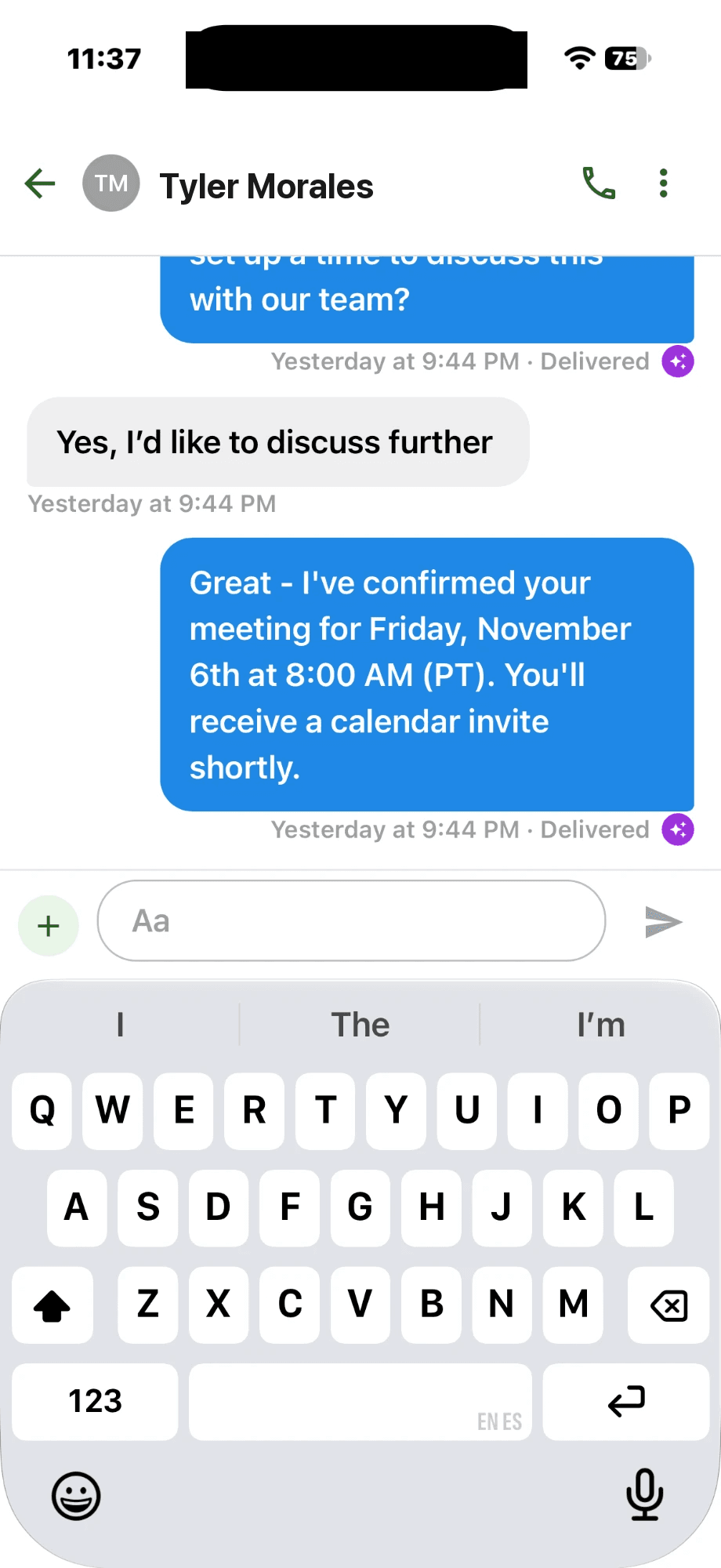 The agent booked the call. The rep can type into the same thread at any moment — the agent shuts off the instant they do. Names changed.
For an FSO, this resolves the objection client brands raise most often: they want speed and consistency, but they do not want a bot speaking for them in moments that matter. Stage-specific agents with clean manual takeover give them both.
The Reporting Case for Stage-Specific Architecture
An FSO's value to its client brands is not just pipeline performance. It is visibility into pipeline performance. Stage-specific agents produce stage-specific data: contact rates at intro, application completion rates, FDD-window drop-off, Discovery Day show rates. When every interaction runs through one shared bot, that data collapses into a single undifferentiated feed. Reporting becomes "we followed up" rather than "here is where candidates are slowing down and why."
The brands that renew an FSO relationship are the ones seeing clear attribution for booked meetings and clean data on where the pipeline is strong and where it is leaking. Stage-specific agents make that reporting possible. A single shared bot makes it noise.
If you are running pipeline for ten or more brands and your current setup fires the same message at a new inquiry and an FDD candidate, you are not running automation. You are running risk. Book a demo at franfunnel.com and see how stage-specific agents are built for your brand mix.