The candidate who just came through FranConnect from a franchise consultant and the person who clicked your Meta ad at 10 PM are not in the same place in their buying journey. Sending them the same first text is not efficient — it is a signal to both of them that nobody read their inquiry.
The first message is the only moment you get to match the energy of where the lead is coming from. Get it wrong and a warm candidate cools off; get it wrong in the other direction and you book a call with someone who had no idea what they were signing up for. Source-matched messaging is not a nice-to-have — it is the difference between a first text that opens a conversation and one that gets ignored.
Broker Portal Leads Arrived Warm — Your First Message Should Know That
A candidate who comes through a broker portal has already done real work. They talked to a franchise consultant, filtered through options, and selected your brand as one worth a conversation. They are not browsing. They are not kicking tires. They arrived with intent, some education, and a relationship with an intermediary who thinks your brand is a fit.
The standard "Thanks for your interest in [Brand]. We will be in touch soon" message is an insult to that process. It tells the candidate — and their consultant — that you have no idea who they are or how they got to you.
The first text to a broker portal lead should acknowledge the relationship and move fast. Something that references the consultant channel, confirms you are following up specifically on their inquiry (not blasting a list), and offers next steps — a question about their timeline, or three available times to talk. These candidates have often already been pre-qualified by the consultant for financial fit and brand alignment. The job of your first message is not to re-qualify them. It is to keep the momentum the consultant already built.
Paid Media Leads Need a Different Kind of Conversation Starter
A lead from a paid media campaign — Meta, Google, a portal ad, a co-registration form — often carries much less context. Some clicked because the category interested them. Some filled out a form because the offer caught them while scrolling. A meaningful percentage did not fully read what they were signing up for. Their intent exists, but it is unproven.
Sending a paid media lead the same message you send a broker-referred candidate creates two problems. First, it assumes qualification that has not happened. If you text three available call times to someone who half-remembers clicking an ad, you are likely to get silence or a confused response. Second, it skips the question that actually tells you whether this lead is worth a rep's time.
The better first text to a paid media lead opens a dialogue. A short message that confirms you got their inquiry, reminds them of the brand or opportunity they asked about, and asks one qualifying question — timeline, what drew them to franchising, their market — does two things at once: it starts a conversation and it begins to separate serious candidates from casual clickers before anyone schedules a call.
"44% of franchise brands never send a personal reply to a new lead — an automated acknowledgment, or nothing at all." — FranFunnel Franchise Lead Response Time Study · 530 brands · fielded March–April 2025
The Gap Is Not Just Tone — It Is Who Does the Work Next
Here is what the source distinction actually tells you: for a broker lead, the consultant has already done the early qualification work. Your team's job is to get to a discovery call without losing the energy the consultant built. Delay, or a generic opener, cools that off fast.
For a paid media lead, the qualification work has not been done yet. The first message is where it starts. A reply that skips that step and jumps to scheduling is premature, and reps end up on calls that should not have been booked yet.
| Lead type | Intent level | Pre-qualification done? | First message goal |
|---|---|---|---|
| Broker portal | High | Yes — by the consultant | Confirm receipt, acknowledge the channel, offer calendar time |
| Paid media | Variable | No | Open dialogue, gather one qualifying signal |
| Organic / direct | Medium | Partial | Confirm intent, ask about timeline or interest |
The table is a rough frame, not a rulebook. Within each source category there is variance. A paid media lead who filled out a detailed form is worth treating differently from one who submitted a one-field pop-up. A broker portal lead from a consultant you have a close relationship with is worth a different opener than one from an unfamiliar network. Source-matched routing is the floor — form-field signals and lead scoring can take it further.
Why Most Brands Still Send One Message to Everyone
Building multiple first-contact workflows is operationally hard when your CRM is doing the triggering. Most brands set up one automation and apply it to all inbound because nobody agreed on which signals to use, how to pass them to the follow-up system, or who owns the logic when it breaks. The result is a lowest-common-denominator message — usually a name merge and nothing else — that fits nobody well.
The cost shows up in contact rate and booking rate by source. Broker portal leads that do not convert at the rate they should, despite higher cost per lead, are often suffering from follow-up that ignores where they came from. When you can see booking rate broken down by lead source, the gap between portal leads handled with a source-matched message and those handled generically is usually where the conversation about messaging tracks starts.
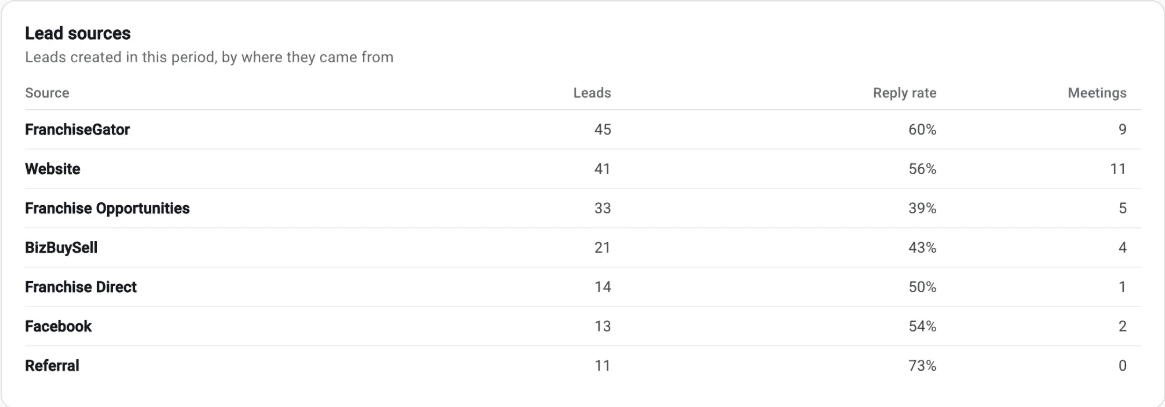 Lead-source report inside FranFunnel. Reply rate and meetings booked broken out by source — not benchmarks, one account. Names changed.
This kind of view is what tells you whether your portal spend is converting the way it should. If broker portal leads are coming in at a higher cost and booking at the same rate as cold paid media, the first message is usually the first place to look.
How Source-Matched Routing Works in Practice
FranFunnel reads the lead source signal — from a form field, a CRM tag, a webhook, or how the lead arrived — and routes the candidate into the matching messaging track automatically. A broker portal lead enters a track built for warm, pre-qualified candidates: fast first text, acknowledgment of the consultant relationship, in-thread time offers within the same message thread. A paid media lead enters a track that opens a conversation, gathers a qualifying signal, and moves toward calendar time only after the candidate engages.
This is system-level routing, not something the agent decides conversation by conversation. It is opt-in and requires the brand to send the signal — the lead source field, a tag, however your process already captures it. Without the signal, every lead enters the standard engagement track. With it, the routing is automatic and the first message fits the person on the other end.
Reps can step in at any point in either track. The moment a rep sends a manual message into a thread, the agent for that stage shuts off and the rep is driving — the same mechanic regardless of which source track the lead came in on.
If you are spending on broker portals and not seeing the booking rates those leads should produce, source-matched first messages are where to start. FranFunnel will show you what the routing looks like on a live call. Book a demo at franfunnel.com.