Signing with a franchise lead-gen agency before auditing your routing is roughly equivalent to hiring a contractor before confirming the electricity is on. The leads will arrive. Whether your system can do anything useful with them in the first 60 seconds is a different question entirely.
Here are the six things to verify before the first lead comes through the new source.
Confirm Your First-Contact Trigger Actually Covers the New Source
Most franchise development teams have a first-contact trigger that fires on a specific form submission or a specific CRM entry point. When a lead-gen agency delivers leads through a different form, a different webhook, or a different field mapping, that trigger can sit silent while the lead waits.
Before the agency goes live, trace the exact path a new lead will take from the agency's form submission to your CRM. Confirm the webhook is registered, that it posts to the right endpoint, and that it populates the fields your trigger checks. Then submit a test lead and time the first text. If a personal reply does not go out within 60 seconds, the trigger is not covering the new source.
This is the step most teams skip because it feels obvious. It is the step that most often explains why the first batch of paid leads produced a 20% contact rate.
Check That Your Stage Mapping Drops Agency Leads Into the Right Pipeline Stage
A new lead source frequently comes with a new tag, a new campaign field, or a new form identifier. If your CRM stage mapping does not account for that identifier, agency leads can land in a catch-all stage — or no stage at all — rather than entering the intro-call sequence they should trigger.
Pull up the stage that new agency leads are expected to enter. Confirm that the routing rule that sends a lead to that stage includes the agency's source identifier. If your routing is field-based, confirm the agency's form is populating that field consistently. A lead sitting in the wrong stage at intake is a lead that gets no follow-up, because the follow-up is attached to the right stage, not the limbo one.
Verify That Your CRM Stage Triggers Are Actually Firing
This check is not specific to new agencies, but adding a new source is the right moment to run it. CRM stage automations are fragile in a specific way: they break silently when a stage is renamed, when a workflow is cloned without updating its conditions, or when a user changes a stage manually rather than through the expected mechanism.
Go into your automation logs and find the last five leads that moved through the intro-call stage. Confirm that the stage trigger fired for each of them and that the follow-up sequence launched. If you see gaps, find the cause before the agency goes live. A misfiring trigger on your existing source volume is a problem; the same misfiring trigger on paid agency leads is an expensive problem.
"44% of franchise brands never send a personal reply — just an automated acknowledgment, or nothing at all."
— FranFunnel Franchise Lead Response Time Study · 530 brands · fielded March–April 2025
Audit Your Calendar Integration Before the First Agency Lead Books
If you use a calendar-connected tool to offer meeting times directly in the text thread, your calendar integration needs to be live, authorized, and showing current availability before the first agency lead arrives. An integration that worked three weeks ago may have lost authorization when a rep rotated their password or when a Google OAuth token expired.
Send a test from the same number and account that agency leads will hit. Confirm that available times are surfacing correctly. Confirm that the minimum notice window and buffer gaps are configured so a lead cannot book a slot that is already gone or one that starts in five minutes. A lead who picks a time and gets no confirmation invite is a lead who does not show up — and a lead-gen agency does not refund for no-shows.
The table below summarizes where each of these routing layers tends to break and what to check at each one.
| Routing Layer | Common Failure Mode | What to Verify |
|---|---|---|
| First-contact trigger | Does not cover new source identifier | Test webhook delivery and time the first text |
| Stage mapping | Agency leads land in wrong or no stage | Confirm source identifier is in routing rules |
| Stage automation | Workflow misfiring after rename or clone | Review automation logs for last 5 leads |
| Calendar integration | OAuth token expired, no times surfacing | Submit a test lead and confirm invite sends |
| Source-level reporting | Agency leads mixed into aggregate numbers | Confirm source tag appears as its own row in reports |
| Pre-qualification rules | Agency volume bypasses or breaks scoring logic | Test one lead against each qualification condition |
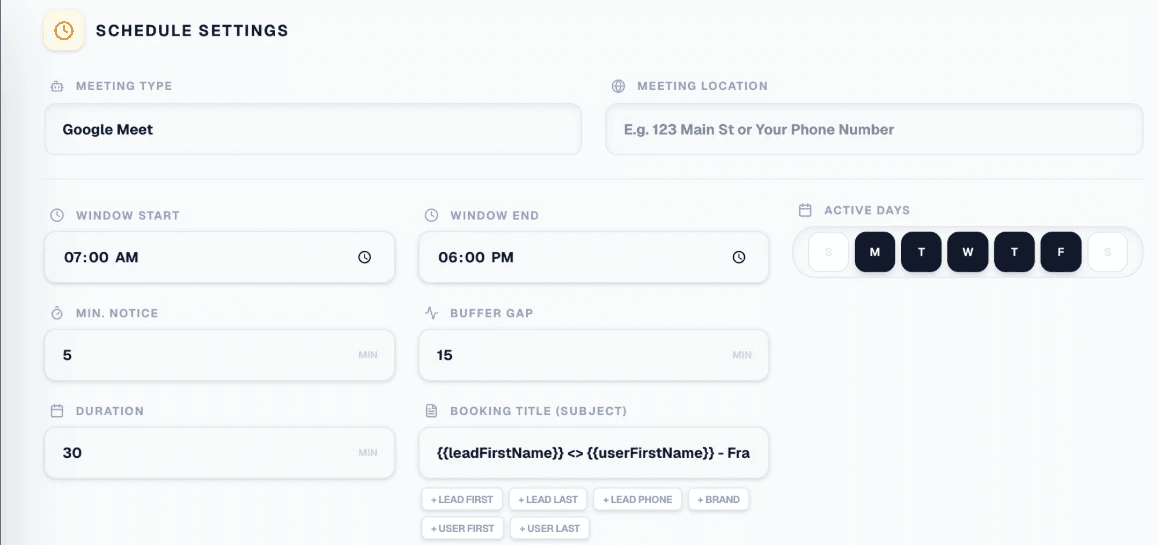 FranFunnel meeting controls — the minimum notice and buffer settings to review before a new lead source goes live. Names changed.
Set Up Source-Level Reporting Before the First Invoice Arrives
You cannot evaluate a lead-gen agency using aggregate contact rate and booking rate. You need those numbers broken out by source, by the agency, and ideally by the agency's campaign if they are running more than one.
Before the agency goes live, confirm that their source identifier will appear as its own row in your contact rate and booking rate reports. If your reporting is built around manual filters, set the filter now and confirm it returns nothing — which proves it is scoped to the right identifier and waiting for real data. If your reporting is built by a third party or by your platform's account team, give them the new source name and confirm the report will be ready when the first leads arrive.
A lead-gen contract renewed on "it felt like it performed okay" is a contract renewed with no information. Source-level reporting gives you the numbers to decide.
Test Your Pre-Qualification Rules Against the Agency's Likely Lead Profile
If you have pre-qualification rules configured — scoring based on liquid capital, geography, or lead source tier — confirm those rules will apply cleanly to agency leads, and that the agency's form is populating the fields you score against.
This matters in two directions. First, if your qualification rules are field-dependent and the agency does not populate those fields, every agency lead may be treated as unqualified and routed into a dead-end track. Second, if your rules are set up to fast-track leads above a certain threshold, confirm the agency's leads will actually hit that threshold often enough for the fast-track to matter.
Pre-qualification is a system-level decision, not something the follow-up agent does on its own. The agent engages the candidate within the track the system assigns. If the system assigns the wrong track because the agency's field mapping is off, the agent will engage the right way in the wrong context.
Run the Audit as a Single Session, Not a Checklist Over Weeks
The six checkpoints above are most useful when run together, in one session, with a test lead submitted through the actual agency integration at the end. That test lead will either surface the gap you missed or confirm that the system is clean.
The teams that get the most out of a new lead-gen agency are almost never the ones with the best agency. They are the ones whose routing was already tight when the first lead arrived. The agency provides the volume. The routing determines whether that volume turns into booked calls.
If your routing is not ready, the agency's performance will look worse than it is — and you will have no way to know it.
See how FranFunnel builds stage-specific routing, source-level reporting, and calendar-connected meeting booking into a single follow-up system. Book a demo at franfunnel.com.