A single AI agent running from first inquiry through FDD review is not a convenience. It is a liability. The moment the pipeline stage changes, the candidate's context shifts — and an agent built for one moment in the sale becomes actively wrong for the next.
The Problem Is Not Automation. It Is the Wrong Script at the Wrong Moment.
When a lead first fills out a franchise inquiry form, they need three things fast: acknowledgment that they were heard, a quick answer to whatever question is sharpest in their mind, and a path to a conversation. The goal of first contact is simple — book the intro call before the candidate cools off.
That is a completely different job from what a candidate needs three weeks later, sitting inside a federally mandated 14-day FDD review window. Now they have a 300-page document in front of them. They want to know what territory they'd actually get, what item 19 says about unit economics, and whether the royalty structure makes sense for their market. Pushing them toward "just get on a call" — the right message at inquiry — lands as dismissive when they are trying to do the diligence your own process requires.
A single-script agent gets this wrong systematically. It does not know what stage the candidate is in. It fires the same follow-up regardless of context. And the candidate, who is making a six-figure financial decision, notices.
Every Major Stage Transition Changes What the Candidate Needs to Hear
The franchise development pipeline is not a straight line of identical check-ins. It is a sequence of distinct phases, each with its own emotional register and its own set of open questions.
At intro call, the candidate is curious and evaluating whether this is worth their time. The agent's job is engagement, light qualification, and fast booking.
At application, the candidate has committed enough to submit a form. Now they are waiting and wondering whether they made the cut. The agent's job is to follow up on missing information, answer questions about the process, and keep the momentum from dying in the inbox.
At FDD issuance, the candidate has entered a legally protected review period. The 14-day clock is running. They are reading a dense document, often for the first time, and comparing it to other opportunities. The agent's job is to be a knowledgeable resource — not to rush them, not to repeat the pitch, but to answer specific FDD questions and keep the relationship warm through a period where it is easy for a deal to quietly die.
At Discovery Day, the candidate is days away from your highest-stakes in-person or video meeting. The agent's job is attendance confirmation, logistics answers, and reminders timed to drive show rate.
None of these jobs are the same. An agent optimized for one of them is miscalibrated for all the others.
"44% of franchise brands never send a personal reply — just an automated acknowledgment, or nothing at all." — FranFunnel Franchise Lead Response Time Study · 530 brands · fielded March–April 2025
The irony is that most brands who invest in AI follow-up solve the top-of-funnel problem — first contact is fast, the lead gets a personalized text — and then lose the candidate at the first stage transition because the agent keeps sending intro-call follow-up to someone who already booked the call and submitted an application two weeks ago.
What Stage-Specific Agents Actually Do Differently
| Pipeline Stage | What the Candidate Needs | What a Single Script Does | What a Stage-Specific Agent Does |
|---|---|---|---|
| Inquiry / Intro Call | Fast acknowledgment, booking | Sends a follow-up — right timing, right goal | Engages, answers initial questions, offers calendar times in the thread, books the call |
| Application | Status update, next steps | Still pushing for the intro call | Follows up on the application, answers process questions, keeps momentum |
| FDD Review | Document answers, reassurance | Repeating the pitch | Checks in, answers FDD questions (territory, fees, royalty), sends reminders during the 14-day window |
| Discovery Day | Logistics, confirmation | Generic follow-up | Confirms attendance, answers travel questions, sends nudges timed to the event |
Each FranFunnel stage agent is built by our team, not configured by yours. When your CRM moves a lead from application to FDD sent, that stage change fires the FDD agent automatically. The intro call agent stops. The FDD agent takes over. The candidate receives a message that matches where they actually are in the process.
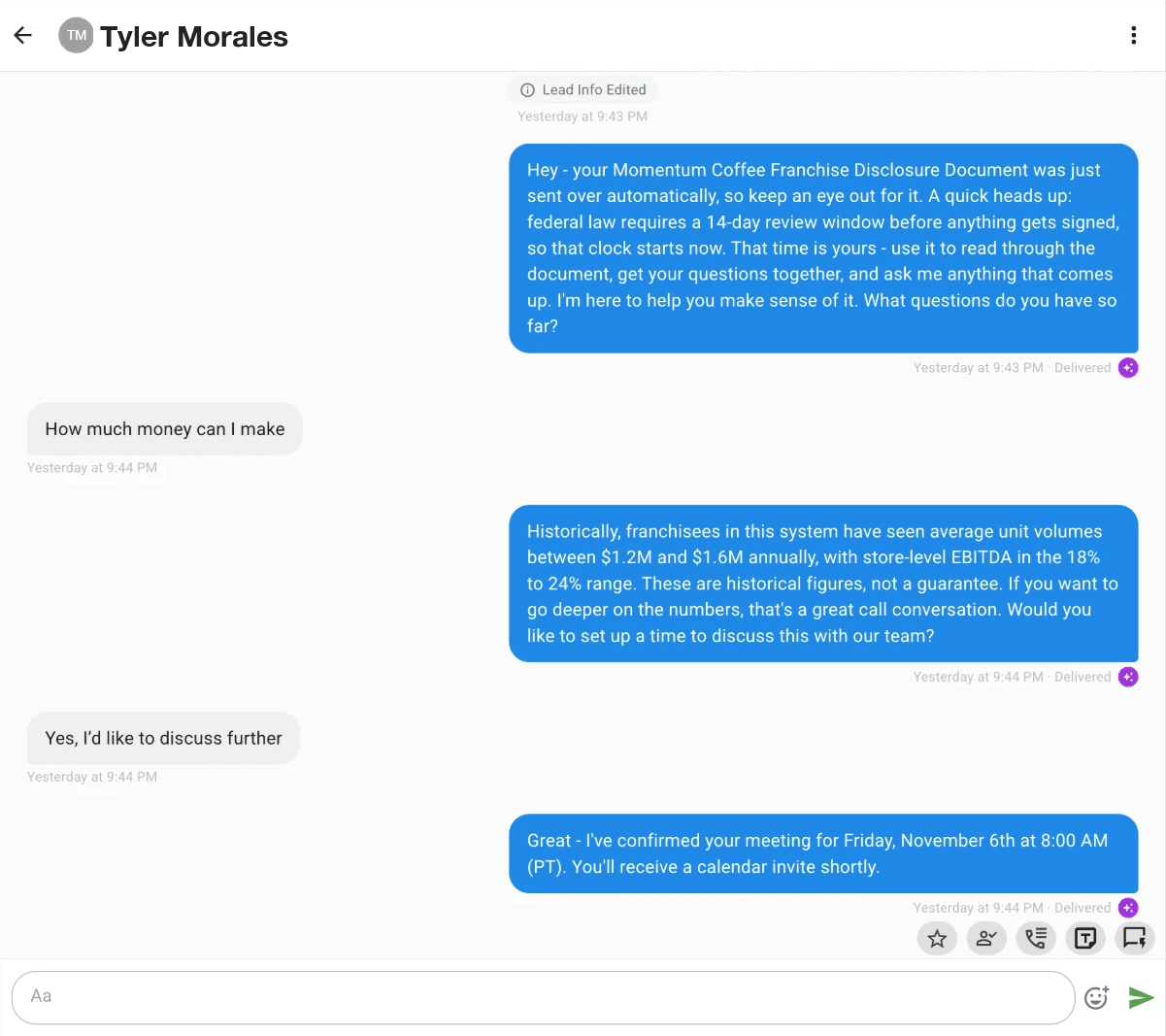 FDD agent activates when the CRM stage changes to FDD Sent, answers document questions, and keeps the candidate moving toward Discovery Day. Names changed.
The agent stays active until the next stage transition — confirmation that the candidate completed the step or that a rep has manually stepped in. If a rep sends a message into any thread at any point, the agent for that stage shuts off immediately. The rep is driving. The next agent activates when the CRM stage changes again.
The Setup Cost of Owning One Generic Bot Is Higher Than It Looks
Brands that run a single AI agent across the full funnel typically own the prompt engineering themselves. That means when the sales process changes — a new FDD question comes up repeatedly, a stage gets renamed, the team adds a validation call before Discovery Day — someone has to find the prompt, update it, test it, and hope it still works for the stages it was not intended for.
That maintenance cost compounds. And it falls on the person least likely to have time for it: the development director who is also managing an active pipeline.
FranFunnel's stage agents are built and maintained by our team. When your process changes, your client solutions manager makes the update. You do not own the prompts. You approve the output.
The Candidate Who Ghosts at FDD Is Not Bored. They Are Confused and Unsupported.
Franchise sales teams often diagnose FDD-stage drop-off as a candidate who changed their mind. Sometimes that is true. More often, the candidate hit a question they could not answer, did not feel like they had a resource to ask, and the momentum drained out of the process over the 14-day wait.
A generic follow-up during that window — "just checking in, let me know if you have questions" — does not help. It signals that no one on the other side has actually read the FDD or thought about what a candidate encounters in it. A stage-specific agent that proactively addresses common FDD questions, acknowledges the review period, and offers a call specifically to work through document questions is a different experience entirely.
The candidate who felt supported through FDD review shows up to Discovery Day. The one who felt handed off to a bot that did not know what stage they were in does not.
One extra signing at any stage of the funnel covers FranFunnel for years. The candidates you are losing at stage transitions are not choosing another brand. They are going quiet because the follow-up stopped matching where they were. Book a demo at franfunnel.com and we will show you how stage-specific agents work across your actual pipeline.