
Think about having a tireless assistant on your team. One who works 24/7, instantly greeting every single lead, answering their basic questions, and even scheduling appointments for you. That, in a nutshell, is SMS automation. It's the engine that sends personalized, timely text messages to your contacts based on specific triggers or schedules, all without you lifting a finger.
What Is SMS Automation and How Does It Work?
At its core, SMS automation runs on a simple "if this, then that" logic. It's a lot like the smart lights in your home. If the sun sets (the trigger), then the lights turn on (the action). SMS automation applies this exact principle to your business communications, creating a surprisingly powerful way to keep leads engaged. And this isn't some niche gadget; it's a massive, growing part of modern business. The SMS marketing space in the U.S. is on track to be worth $12.6 billion by 2025. This explosive growth is fueled by a huge shift toward mobile-first strategies, proving that businesses are betting big on text messaging as a direct line to their customers. You can dig deeper into these SMS marketing best practices to see just how the best performers leverage this powerful platform.
The Building Blocks of SMS Automation
To really get how it all works, you need to understand the three main components. These pieces work together to create automated conversations that feel personal and responsive, guiding potential customers smoothly toward the next step.
- Triggers: This is the starting gun. A trigger is the specific event that kicks off a pre-planned messaging sequence. It’s the "if this" part of the equation.
- Workflows: This is the "then that" part. A workflow is the path your messages follow after a trigger—like sending an initial text, waiting a bit, then sending another. It's the strategic roadmap for your conversation.
- Personalization: This is the secret sauce that keeps your messages from sounding like a robot. Using details like a lead's name or the specific service they asked about makes each text feel like a one-on-one chat.
This simple concept map shows how these parts interact to create a powerful communication loop.
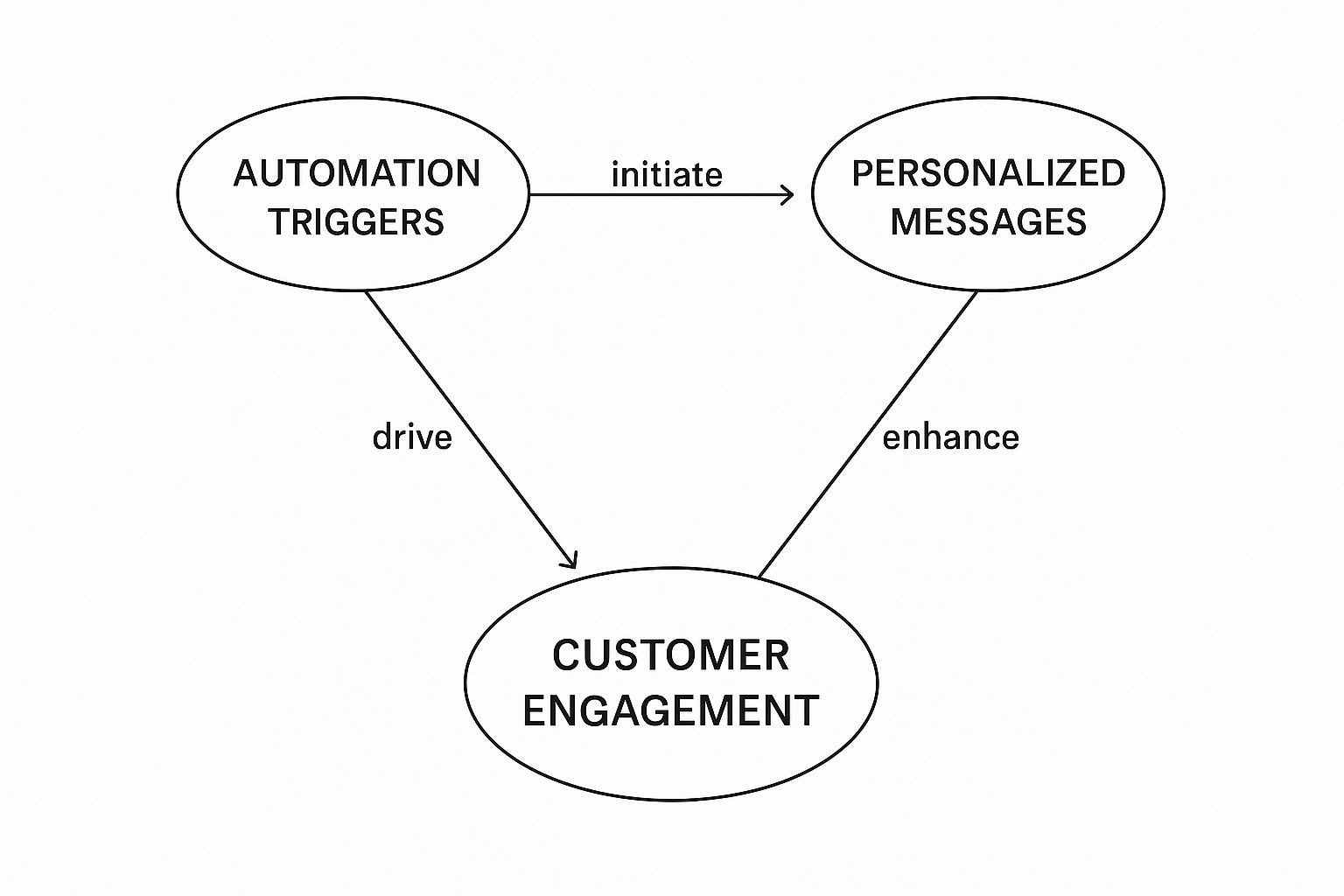 As you can see, it all starts with a specific trigger, which launches a personalized message and, in turn, drives real engagement.
To help you quickly see the upside, here’s a high-level look at the immediate advantages of bringing SMS automation into your workflow.
As you can see, it all starts with a specific trigger, which launches a personalized message and, in turn, drives real engagement.
To help you quickly see the upside, here’s a high-level look at the immediate advantages of bringing SMS automation into your workflow.
Immediate Benefits of SMS Automation at a Glance
| Benefit | Impact on Your Business |
|---|---|
| Instant Lead Engagement | Connect with leads within seconds, while their interest is at its peak. |
| Increased Efficiency | Free up your team from repetitive follow-up to focus on high-value conversations. |
| Consistent Follow-Up | Ensure no lead is ever forgotten or falls through the cracks. |
| Higher Response Rates | Get more replies and conversations started compared to email or phone calls. |
| 24/7 Availability | Capture and nurture leads around the clock, even outside of business hours. |
These benefits aren't just incremental improvements; they fundamentally change how you manage your lead flow, turning missed opportunities into real conversations.
A Real-World Example in Action
Let's see how this plays out for a franchise business. Imagine a potential franchisee, Sarah, is on your website and fills out a form to get more info about opening a location.
- The Trigger: The moment Sarah clicks "Submit" on your web form, that's the trigger. Your SMS automation platform, like FranFunnel, catches this event instantly.
- The Workflow Begins: The system immediately kicks off a "New Lead" workflow.
- The First Message: Within 60 seconds, Sarah’s phone buzzes with a text: "Hi Sarah, this is Mike from [Franchise Name]. Thanks for your interest! Are you available for a quick chat tomorrow?"
This immediate, personal touch is everything. It hits Sarah’s phone while she’s still thinking about your brand, massively boosting your odds of getting a reply compared to an email that shows up hours later.
But the automation doesn’t stop there. If Sarah texts back "yes," the system can send her a link to book a time directly on a calendar. If she doesn’t respond within 24 hours, the workflow can automatically send a friendly follow-up. This entire dance happens on its own, ensuring no lead ever goes cold and your team can focus on talking to qualified, engaged prospects.
The Real-World Business Wins From Automating SMS
We’ve talked about the "how," but the "why" is where things get interesting. Putting SMS automation to work isn't just about sending texts on autopilot; it’s about fundamentally changing how your business operates and getting results you can actually measure. Think of it as a force multiplier for your team, turning casual interest into real conversations.
At its core, the power comes from a simple truth: texting is the most direct and immediate way to reach someone. It's projected that by 2025, there will be 5.9 billion SMS users worldwide—that's nearly 65% of the global population. With an incredible open rate of around 98% and a response rate near 45%, it blows email out of the water. If you want to dive deeper, txtcartapp.com has some powerful text marketing statistics worth checking out. This direct line to your prospects is the foundation for some serious business benefits.
Slash Response Times and Capture Leads at Peak Interest
When it comes to lead generation, speed is everything. A lead's interest is at its absolute peak in the first few minutes after they hit "submit." Wait a few hours—or worse, a day—and that red-hot opportunity has gone ice-cold. SMS automation makes that delay a thing of the past. By setting up an automated welcome text, you can be in a new lead's inbox just seconds after they fill out your form. That instant ping not only confirms their inquiry was received but also shows your brand is on the ball, professional, and ready to talk.
Think of it this way: a lead who gets an instant text feels heard. A lead who gets an email tomorrow has probably already talked to your competitor. That first, fast touchpoint is often the deciding factor in whether a conversation even starts.
Boost Team Efficiency and Focus
Your team's time is your most valuable resource. Every minute they spend manually sending "just following up" texts or appointment reminders is a minute they aren't spending on high-value work, like building relationships and closing deals. Automated SMS workflows take all those repetitive tasks off their plate. This frees up your people to focus on what they do best: having meaningful conversations with qualified, engaged leads who have already been warmed up. When your team can skip the busywork and jump straight to the good stuff, productivity and morale go through the roof. This kind of operational smarts is a key piece of any solid franchise marketing automation strategy.
Deliver Consistent and Personalized Nurturing
Let's be honest—not every lead is ready to sign on the dotted line the moment they reach out. Most need more time and information. This is where automated nurturing sequences, often called "drip campaigns," really shine. You can map out a series of messages that go out automatically over days or weeks, delivering helpful content and gentle check-ins without you lifting a finger.
- Initial Follow-Up: A quick text a day after the first inquiry to ask if they have questions.
- Helpful Content: A message three days later with a link to a useful blog post or video.
- Gentle Nudge: A final check-in a week later to see where their head is at.
This systematic approach makes sure every single lead gets consistent, on-brand communication that guides them along their journey. It keeps your franchise top-of-mind and builds trust over time, which dramatically increases your chances of actually closing the deal.
Actionable Use Cases For SMS Automation
Theory is great, but let's get down to business. This is where SMS automation stops being a concept and starts being a powerful engine for managing leads and growing your franchise.
This is your playbook. We're going to walk through real-world scenarios where automated texting solves the nagging problems that slow down franchise development teams. Think of it as creating a consistent, scalable communication system that works for you, 24/7.
 From that first "hello" to waking up cold leads, each of these use cases is a clear roadmap to building a system that actually gets responses.
Instant Welcome For New Leads
The first few minutes after a lead inquires are the most critical. Their interest is peaked, and they're actively looking for a response. An instant welcome text confirms you got their info and immediately opens a line of communication. This one simple action can be a game-changer for your engagement rates. It tells the prospect your brand is on the ball and ready to talk from the very first second.
- Trigger: A new lead fills out a form on your website or a lead portal.
- Strategy: The message needs to feel personal, not robotic. Identify your brand and ask a simple, low-effort question to get a conversation started.
- Sample Message: "Hi [Lead Name], this is Mike from [Franchise Name]. Thanks for your interest! I just got your info. Are you free for a quick call later today to answer any questions?"
This automated text sets a professional tone and, most importantly, starts a real conversation right away.
Automated Appointment Reminders
No-shows are the silent killer of your sales calendar. They waste time and kill momentum. Manually calling or texting every single person to confirm appointments is a chore that easily falls through the cracks. SMS automation makes this process foolproof. Sending an automated reminder 24 hours before a scheduled call dramatically cuts down your no-show rate and keeps your team's schedule packed with productive conversations.
A simple reminder text is one of the highest-ROI automations you can implement. It protects your team's valuable time and ensures that confirmed appointments actually happen, keeping your sales pipeline moving forward.
Here’s a simple but effective way to structure it:
- First Reminder (24 hours before): Send a friendly confirmation with the date, time, and topic. Ask for a simple reply (e.g., "Reply YES to confirm").
- Second Reminder (1 hour before): A quick heads-up about the upcoming call. If it's a video call, pop the meeting link right in the text for easy access.
This two-step process makes it almost impossible for a prospect to forget.
Nurture Leads With Drip Campaigns
Let's face it, not every lead is ready to sign on the dotted line today. Many need more information and time to think things over. An automated SMS drip campaign is the perfect way to stay top-of-mind without burying your team in manual follow-up. These campaigns deliver helpful content over a set period, building trust and keeping your brand in the running. A great workflow here is key, and for teams looking to master their follow-up game, diving into detailed lead follow-up best practices can give you a serious advantage. And once you've got your drip campaigns down, exploring different bulk messaging strategies can help you scale your outreach even further. To give you a clearer picture, here are a few common workflows that franchises use to keep leads warm.
Sample SMS Automation Workflows for Business
| Scenario | Trigger | Automated Action (Sample Message) |
|---|---|---|
| Welcome New Lead | Lead submits a form on the website. | "Hi [Lead Name]! This is Sarah from [Franchise]. Got your info. Quick question - what sparked your interest in us?" |
| Appointment Reminder | 24 hours before a scheduled call. | "Hey [Lead Name], friendly reminder about our call tomorrow at 10 AM to discuss [Franchise]. Reply YES to confirm." |
| Re-Engagement | No contact for 90 days. | "Hi [Lead Name], Mike from [Franchise] here. We connected a while back. Just checking in to see if you're still exploring new opportunities." |
| Post-Call Follow-Up | 1 hour after a discovery call ends. | "Great chatting with you, [Lead Name]! As promised, here's the link to our franchise info kit. Let me know if any questions pop up." |
These are just starting points, of course. The real power comes from tailoring these messages to fit your brand's unique voice and your prospects' journey.
Revive Dormant Contacts
What about all those leads that went silent months ago? Your database is likely full of them. A re-engagement campaign is a low-cost, high-impact way to uncover hidden opportunities you already paid for. The idea is to send a carefully worded message to contacts who haven't engaged in a while. You're not looking for a hard sell; you just want to gently reopen the door and see if anything has changed.
- Trigger: A contact has had zero engagement for 90+ days.
- Strategy: Keep it simple and direct. It should feel like a personal check-in, not a mass marketing blast.
- Sample Message: "Hi [Lead Name], it's Mike from [Franchise Name]. We connected a while back. Just wanted to check in and see if you were still exploring franchise opportunities. Let me know!"
You’d be amazed how many "dead" leads are just waiting for the right nudge. This tactic can breathe new life into your pipeline with almost zero effort.
Best Practices for Effective and Compliant Messaging
Having a powerful tool like **SMS automation** is one thing, but using it smartly is another. Simply blasting out texts won’t get you very far. To build trust and actually drive results, your messages need to be effective, respectful, and completely legal. Getting this right ensures your texts are a welcome touchpoint, not an annoying intrusion. The foundation of any good SMS program is compliance. Think of it as the price of admission. Without it, you’re not just risking your brand’s reputation—you’re facing serious legal heat.
Prioritize Consent and Compliance
Before a single automated text leaves your system, you need explicit, undeniable permission from the person you're messaging. This isn't just a friendly suggestion; it's a hard-and-fast legal requirement under regulations like the Telephone Consumer Protection Act (TCPA) in the United States.
The Golden Rule of SMS: Always get clear consent (opt-in) and always provide a simple way to leave (opt-out). This is non-negotiable. It's the bedrock of a trustworthy and sustainable SMS strategy.
This is usually handled with a clear, unticked checkbox on your lead forms—something straightforward like, "I agree to receive text messages from [Your Brand] at the number provided." Just as important is giving people an easy out. The standard "Reply STOP to unsubscribe" in your messages is a must. And if you operate globally, you have to be mindful of international rules, too. Staying on the right side of the law means understanding different frameworks, so it's a good idea to review resources like these GDPR compliance guidelines.
Personalize Beyond the First Name
Real personalization goes deeper than just dropping in a lead’s first name. To make your messages actually connect, they need to reflect the context of your conversation. It shows you’re paying attention. This could mean referencing the specific franchise location they asked about, the service that caught their eye, or a question they asked in a previous exchange. That small detail transforms a generic broadcast into what feels like a one-on-one conversation, and engagement skyrockets. This is more important than ever as people get more comfortable with business texting. It's estimated that by 2025, 84% of consumers worldwide will have opted-in to receive business texts—a 35% jump since 2021. To keep up, 67% of businesses are planning to increase their SMS budgets, which means the bar for high-quality, personal communication is only getting higher.
Optimize Timing and Message Value
When you send a text can be the difference between being helpful and being flat-out annoying. A message at 3 AM is a guaranteed way to get an opt-out. Be respectful and send your texts during normal business hours in your lead's local time zone. On top of that, every single message has to offer clear value. Is it a quick answer? A helpful resource? A simple confirmation? Whatever it is, make sure each text serves a real purpose for the recipient.
- Be Concise: Get straight to the point. Texting is built for brevity.
- Be Valuable: Give them information that helps them take the next step.
- Be Clear: End every message with a crystal-clear call-to-action (CTA).
A strong CTA tells the lead exactly what to do next, whether it’s "Reply YES to confirm," "Click here to see our info kit," or "Is now a good time for a quick call?" This clarity guides the conversation and is a key part of any solid franchise marketing strategy. By nailing compliance, personalization, and value, you build a program that people actually want to be a part of.
Integrating SMS Automation Into Your Tech Stack
True SMS automation doesn't work in a vacuum. Its real power is unleashed when it’s wired into your entire technology ecosystem. Think of it less like another app on your computer and more like the central nervous system for your lead communications, connecting all your other platforms into a single, intelligent unit. The whole point is to create a seamless flow of information between your systems. When your SMS platform can talk to your Customer Relationship Management (CRM) system, every action and piece of data becomes more valuable. This unified approach gets rid of those frustrating data silos that lead to missed opportunities and disjointed, confusing experiences for your prospects.
Creating a Unified Communication Hub
The most important connection you can make is between your SMS platform and your CRM or lead management system. When these two systems are properly connected, they create a powerful feedback loop. An action in one system can automatically trigger a reaction in the other, keeping everything perfectly in sync without any manual effort.
Imagine this: a lead’s status changes in your CRM, which instantly kicks off a tailored SMS workflow. On the flip side, when that prospect texts you back, their reply can automatically update their record in the CRM. Suddenly, your entire team has a real-time, context-rich view of every conversation.
This connection ensures every single message you send is based on the most current information you have. It gives you a complete, 360-degree picture of the lead's journey, making your team more efficient and every interaction much smarter.
Platforms designed specifically for franchise development, like FranFunnel, make this kind of integration dead simple. Here’s a look at how a dedicated platform visualizes this streamlined process.
 This dashboard gives you a clear, at-a-glance view of lead activity, showing exactly how text message interactions tie directly into your overall sales funnel and pipeline.
Key Integration Points for Maximum Impact
To really get the most out of your setup, you’ll want to focus on connecting your SMS automation software at a few critical points. These are the integrations that turn a good system into a great one.
- Lead Source Integration: Connect your web forms, landing pages, and lead portals directly to your SMS platform. This is a game-changer because it ensures every new lead gets a text within seconds, not hours.
- CRM Data Sync: Make sure new contacts and all text conversations are automatically logged in your CRM. This creates a single source of truth for every prospect interaction, eliminating the guesswork for your sales team.
- Calendar and Scheduling Tools: Integrate with tools like Calendly so leads can book appointments with you directly from a text message. The confirmed meeting can then automatically update both your calendar and the lead's status in your CRM.
This level of integration transforms your tech stack from a clumsy collection of separate tools into a cohesive, lead-generating machine. It guarantees that data flows freely, automations run smoothly, and your team has the information it needs to close more deals. A well-integrated system is the bedrock for scaling your franchise development efforts effectively. Diving into something as personal and powerful as SMS automation always brings up a few questions. It’s smart to get a clear picture of how it all works before you jump in. Let’s tackle some of the most common questions we hear so you can move forward with confidence.
Is SMS Automation Only for Big Companies?
Absolutely not. This is probably the biggest myth out there about SMS automation. While massive corporations definitely use it, the technology is incredibly scalable and, frankly, even more valuable for small to mid-sized franchises. Modern platforms are built to be affordable and easy to use, letting even a one-person team set up powerful, automated messages. Think about it: the core benefits—saving time, guaranteeing instant follow-up, and never missing an opportunity—are most critical when every single lead is precious and your resources are tight. It’s the great equalizer. It allows smaller operations to deliver the same speedy, professional communication that used to require a huge sales team.
How Do I Keep Automated Texts from Sounding Robotic?
The fear of sounding like a soulless machine is real, but it’s easy to avoid with a little bit of thought. The trick is to blend smart personalization with a genuinely human, conversational tone. Just write your messages like you’re texting a new acquaintance—be friendly, direct, and helpful. Ditch the corporate jargon and stiff, formal language. The best automated texts feel like they were typed out by a real person just a moment ago.
The secret to human-sounding automation is knowing when to let a human take over. Use automation for the first few repetitive steps, but build in a clear handoff point for when a lead shows they're serious. That’s how you create a seamless experience that actually works.
Here are a few practical tips to get that natural feel:
- Go Beyond Just the First Name: Use personalization that adds real context. Mention the specific franchise location they asked about or the ad they clicked. "Hi John, saw you were looking at our opportunity in Austin." feels much more personal than a generic greeting.
- Program Slight Delays: Instead of blasting three messages in 30 seconds, program short delays between them. A pause of a few hours or even a day can make a follow-up sequence feel far more natural and less aggressive.
- Mix Up Your Language: Create a few different versions of your key messages. A good platform can rotate them, so not every lead gets the exact same text word-for-word.
What Are the Most Important Metrics to Track?
To know if your SMS strategy is actually working, you need to look past vanity metrics like "messages sent." You have to focus on the numbers that tie directly to your business goals. Tracking the right key performance indicators (KPIs) shows you what's working, what's not, and where you can make small tweaks for a big impact on your ROI. Here are the four most critical metrics to keep an eye on:
- Response Rate: This is the big one. What percentage of people are actually replying to your texts? A high response rate is a clear signal that your messages are engaging and your opening questions are easy to answer.
- Conversion Rate: This tracks how many leads actually did the thing you wanted them to do—whether that was scheduling a call, using a promo code, or confirming an appointment. This metric connects your SMS automation directly to real business results.
- Opt-Out Rate: A sudden spike in your opt-out (or "STOP" reply) rate is a huge red flag. It usually means your messages are too frequent, not relevant, or sent at the wrong times. Keeping this number low is crucial.
- Cost Per Conversion: This is where you find your true ROI. Divide the total cost of your SMS platform by the number of conversions. This tells you exactly how much you're paying to land a qualified prospect through this channel.
How Does SMS Automation Handle Compliance and Regulations?
Compliance isn't just a box to check; it's the foundation of a sustainable SMS program. Good platforms have safeguards built-in, but the responsibility ultimately falls on the business sending the messages. The biggest rule in the U.S. is the Telephone Consumer Protection Act (TCPA), which governs all marketing communications. The absolute cornerstone of TCPA is getting express written consent before you send a single promotional text. This is usually handled with a clear, un-checked box on your web forms that says something like: "I agree to receive text messages from [Your Franchise Brand] at the number provided." Beyond that, your system needs to handle two other key things:
- Identify Yourself: Your very first message to a new contact must clearly state who you are.
- Provide an Easy Opt-Out: You have to include a simple way for people to unsubscribe, like "Reply STOP to end."
A compliant automation platform will handle these STOP requests instantly and automatically, making sure you don't message someone who has opted out. By playing by the rules and using a trusted platform, you can use the power of automation with confidence, respecting your prospects and avoiding hefty fines.
Ready to see how seamless SMS automation can transform your franchise development? FranFunnel is purpose-built to turn more of your leads into owners by ensuring no one ever goes cold. Learn more and see how it works.