New lead sources do not fail on their own. They fail because nobody audited the pipeline before letting them in.
A lead gen agency can send you two hundred inquiries in a month. If your team has no way to track those leads separately, no agreed response SLA, and no defined criteria for what good looks like, you will spend ninety days watching the pipeline fill — and then renew the contract because canceling feels riskier than continuing.
Marketing directors in franchise development own the budget for lead generation and the accountability for pipeline quality. That accountability starts before the first lead arrives.
Most Pipelines Are Not Ready for a New Source
Adding a new lead source to an unaudited pipeline is like adding a second vendor to a kitchen with no expediter. Volume goes up. Coordination breaks down. By the time you notice the problem, the data is too mixed to read.
The most common version of this mistake: an agency goes live, their leads flow into the same CRM stage as every other inbound inquiry, response times are inconsistent, and three months later the marketing director is trying to figure out whether the source underperformed or whether the team just never followed up quickly enough.
Both are real possibilities. Without source-level tracking and a consistent follow-up baseline, you cannot tell which one it is.
Before any new agency feed goes live, there are four things every franchise marketing director should have in writing.
1. The Submission Spec
Ask the agency to show you exactly how their leads will arrive in your CRM — field names, delivery format, timing, and what happens when a required field is missing.
This sounds administrative. It is. But a lead that arrives with a mismatched field name does not get routed correctly. A lead that arrives four hours after the form submission — because the agency's system batches exports — has already been waiting four hours before your team sees it. A lead that arrives without a phone number cannot receive a text.
The submission spec tells you whether the agency's technical setup is compatible with how your pipeline actually works. It also tells you whether anyone on their side has thought through the integration, or whether they are expecting your ops team to figure it out.
Required items in the spec: field names and mapping, delivery method and timing, source identifier on every record, and a defined behavior for incomplete or duplicate submissions.
2. A Unique Source Tag on Every Lead
This is the single most important structural requirement, and it is the one most often skipped.
Every lead from a new agency source needs a tag, UTM, or CRM field that identifies it as belonging to that source — and only that source. Without it, you cannot run a source-level contact-rate report. You cannot see whether leads from this agency book discovery calls at a higher or lower rate than your other inbound channels. You cannot make a data-backed renewal decision.
Source tags are not optional reporting hygiene. They are what make the difference between managing a lead generation budget and guessing at it.
If an agency resists tagging their leads separately — because it makes their performance visible in isolation — that resistance is the data point.
3. A Stated Contact-Rate Benchmark
Ask the agency what contact rate you should expect from their leads. Then ask them to put it in the agreement.
Contact rate — the percentage of leads your team actually reaches — is the first gate any lead source has to clear. A source can deliver high volume and still perform poorly if the leads are unresponsive, the phone numbers are wrong, or the submission-to-contact window is too long by the time the lead arrives.
A good agency has seen enough of their leads move through franchise development pipelines to have a view on this. If they cannot state an expected contact rate, or if they decline to include one in writing, they are not structured to be accountable for lead quality.
Pair this with a defined review window. Sixty to ninety days is standard. Agree in advance on what numbers, measured at the source level, would constitute a successful trial — and what would trigger a conversation about canceling.
"44% of franchise brands never send a personal reply to an inbound lead — just an automated acknowledgment, or nothing at all." — FranFunnel Franchise Lead Response Time Study · 530 brands · fielded March–April 2025
4. An Honest Look at Your Own Follow-Up Before the Feed Goes Live
This is the part most marketing directors skip because it is uncomfortable.
A new lead source can only be evaluated fairly if your team is actually reaching its leads. If your current follow-up is inconsistent — if some leads get a text in two minutes and others get an email three hours later, or nothing — then the data you collect on the new source is unreliable.
The 44% figure above is not an indictment of one bad agency. It is a description of how most franchise pipelines operate: a form confirmation goes out automatically, a personal reply sometimes follows, and the candidate who does not hear back within the first hour is already half out the door.
Before a new source goes live, confirm three things about your own pipeline:
| What to audit | What good looks like | What breaks source measurement |
|---|---|---|
| Time from form submit to first text or personal outreach | Under 5 minutes (under 60 seconds is achievable) | First contact varies by rep or time of day |
| Source tag on every inbound lead | Unique tag per channel, applied automatically on submission | Source mixed with other inbound; no tag at all |
| Reporting by source | Contact rate and booking rate viewable per source | Only total pipeline metrics available |
If the first column is true for your pipeline today, adding a new source gives you clean data. If the third column is where you are, the agency is not the problem you should solve first.
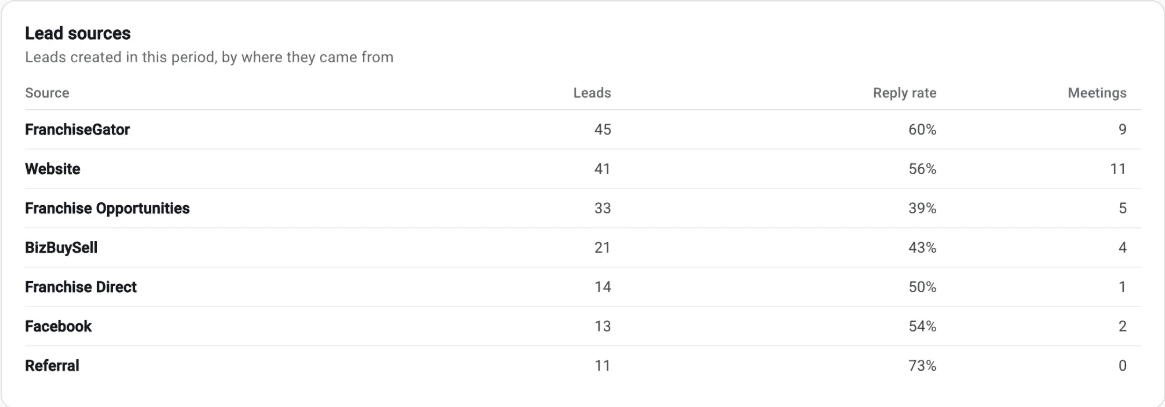 Lead-source report inside FranFunnel, showing contact rate and meetings booked broken out by source for a single account. One account's figures, not benchmarks.
The Conversation That Protects Your Budget
None of this requires a lengthy procurement process. It requires one conversation with the agency before the feed goes live, structured around four questions:
How will the leads arrive and in what format? What identifier will mark every lead as belonging to your source? What contact rate do you expect us to see, and are you willing to put that in writing? And what should we be measuring at day 30, 60, and 90 to decide whether this continues?
An agency that answers all four clearly is ready to be held accountable. One that hedges on the benchmark or resists source-level tracking is telling you something important about how they view the relationship.
The pipeline is yours. The budget is yours. The discipline to protect both starts before the first lead arrives.
See how FranFunnel tracks contact rate and booking rate by source — and what happens when a new lead arrives at 11 PM on a Saturday. Book a demo at franfunnel.com.