A broker-referred candidate and someone who clicked a Facebook ad and filled out a form at midnight are not the same lead. Treating them as if they are -- sending the same opening text, asking the same first question, running the same agent conversation -- is one of the quieter ways franchise development teams leave deals on the table. The fix is routing: a system-level decision that reads the source before any agent fires, and sends each lead into the track built for where it came from.
The Routing Decision Happens Before the First Text
Most franchise development teams think about lead source after the fact -- in a report, when they are trying to figure out which portal to renew. Routing moves that decision to the front of the process, before any message goes out.
The mechanic is simple. A signal travels with the lead when it arrives -- a hidden form field, a UTM parameter that lands in a CRM field, a webhook payload from a portal, a tag applied on import. The routing layer reads that signal and assigns the lead to a track. The agent for that track sends the first message. The whole sequence is automatic and runs in under 60 seconds.
What routing does not do is make assumptions. If the signal is not there, the system cannot guess. A lead that arrives without a source marker falls through to a default track -- usually your standard first-contact agent. That is fine. The goal is to route what can be routed, not to hold leads while the system searches for a signal that never comes.
Broker Referrals Arrive Pre-Screened. Your First Message Should Reflect That.
When a franchise consultant refers a candidate, that candidate has already had a real conversation. The consultant knows their liquidity, their timeline, their industry background. They have been told what your brand costs to open, roughly what it takes to qualify, and what kind of operator the brand is looking for. They showed up anyway.
Your first text to that candidate is not an introduction to the concept of franchising. It is not a qualification filter. It is the start of a conversation with someone who already has context.
The agent track for broker referrals should acknowledge that:
- Confirm receipt and reference the consulting firm or the consultant's name, if the signal carries it
- Skip the financial-fit questions -- those have been handled
- Move directly toward booking the intro call
A generic "Hi, thanks for your interest in franchising with us -- can you tell me a little about your background?" reads as though the system does not know who it is talking to. It is accurate -- the system did not know, because no routing signal told it -- but it feels like the brand is not paying attention. For a candidate who is already warm, that is a friction point that should not exist.
Paid Media Submissions Need a Different First Move
A paid media lead has done exactly one thing: they saw an ad, they were interested enough to fill out a form, and they submitted. That is a meaningful signal of intent -- but it is not the same as a broker referral. The candidate may not fully understand the investment level, the net worth requirements, or whether this brand fits the market they have in mind.
The agent track for paid media submissions should do more early qualification work:
- Confirm receipt and set a brief, specific expectation ("Someone will follow up within the hour -- in the meantime, can I ask a couple quick questions?")
- Ask one or two qualification questions that surface fit signals early -- investment range, ownership timeline, market of interest
- Route candidates who answer well toward a fast path to a booked call; use a softer track for leads that do not meet threshold
The goal is not to filter out paid media leads as a category -- some of the best franchise buyers come through paid channels. The goal is to do the fit work at the top of the funnel, before a rep's time is committed, so the conversations reps actually have are with candidates who have a reasonable chance of closing.
"44% of franchise brands never sent a personal reply -- just an automated acknowledgment, or nothing at all."
-- FranFunnel Franchise Lead Response Time Study, 530 brands, fielded March-April 2025
What the Routing Configuration Actually Looks Like
The configuration has three parts: the signal, the rule, and the track.
| Component | Broker Referral Setup | Paid Media Setup |
|---|---|---|
| Signal source | Hidden form field, portal webhook, or CRM import tag | UTM parameter (utm_source / utm_medium), CRM field on form submit |
| Routing rule | Signal matches known broker portal name or consulting network | Signal matches paid campaign identifier or medium |
| Agent track | Warm intro track: acknowledges context, skips fit questions, books the call | Qualification track: confirms receipt, asks 1-2 fit questions, routes based on answers |
| Fallback | Standard first-contact agent | Standard first-contact agent |
The FranFunnel team builds both tracks and the routing logic. You approve the messaging before anything goes live. The signals need to come from your side -- consistently, on every lead -- but the wiring from signal to track is handled in the setup. Once it is in place, routing runs automatically on every new submission with no manual intervention required.
The most common setup failure is inconsistent signals. A hidden form field that fires on some inquiry forms but not others means some broker referrals land in the paid media track and some land in the default. Auditing signal consistency before launch is the step most teams skip. Run a handful of test submissions through every entry point and confirm the signal arrives on each one.
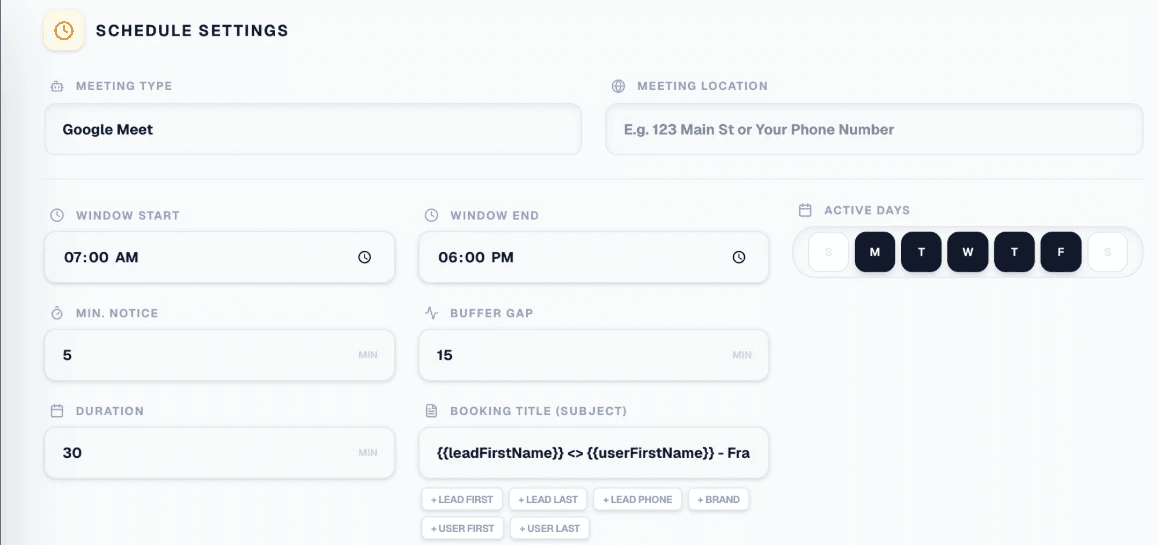 Meeting controls in FranFunnel -- the same settings panel configures how each track handles calendar offers, minimum notice windows, and buffer gaps between calls. Names changed.
Lead Source Reporting Closes the Loop
Routing is not just about the first message. It is about knowing, over time, which sources produce candidates who actually book calls, complete applications, and reach Discovery Day.
FranFunnel's lead source report shows contact rate and booking rate by source for every account. Once routing is in place and the signals are consistent, that report tells you something actionable: broker referrals from one network convert at a materially different rate than broker referrals from another; one paid media campaign books calls at twice the rate of a second one running in the same market.
That data is what moves the conversation from "which portals should we renew" to "here is what each source actually returned." Budget decisions built on booking rate by source are more defensible than budget decisions built on lead volume alone. Routing is what makes the data clean enough to trust.
The Short Version: Signals In, Routing Automatic, Reps on Warm Calls
The setup is not complicated. Send consistent source signals with every lead. The FranFunnel team builds the routing rules and the stage-specific agent tracks. You approve the messaging. After that, every broker referral hears from your brand in the voice of a team that knew who was coming. Every paid media submission gets a first message that does real qualification work before anyone's calendar is touched.
Your reps show up to calls, not inboxes -- and the calls they show up to have been pre-sorted by source before anyone typed a single word.
See how FranFunnel builds lead routing for your specific source mix. Book a 20-minute demo at franfunnel.com.