The same agent that books an intro call should not be the agent running when a candidate is 72 hours into reading a Franchise Disclosure Document. Those are different conversations, different stakes, and different questions — and treating them the same way does real damage to pipeline velocity.
The One-Bot Problem Is Not Unique to Inquiry Response
Most teams have already felt the cost of slow follow-up at the top of the funnel. The research is unambiguous: 44% of franchise brands never send a personal reply to a new inquiry — just an automated acknowledgment, or nothing at all (FranFunnel Franchise Lead Response Time Study · 530 brands · fielded March–April 2025). The candidate submits a form, gets a generic receipt, and waits. The conversation never starts.
The fix most brands reach for is some version of an AI agent. Set it up once, it texts every new lead, books the intro call, done. And that part works. The problem comes later, when that same agent — trained to introduce the opportunity, answer curiosity-stage questions, and push toward a first meeting — is still running while the candidate is 10 days into the FDD review window.
The agent keeps sending the wrong messages. The candidate keeps getting the wrong answers. Pipeline stalls, and nobody knows why.
What a Candidate Needs at Inquiry vs. What They Need During FDD Review
These are not variations on the same conversation. They are categorically different interactions.
At inquiry, a candidate wants to know whether this opportunity is worth their time. They are curious. They need fast engagement, a personalized first message, a few answers to basic questions, and a path to a real call. Speed is everything. The agent should be built to move: engage, answer, offer times, book the meeting.
During FDD review, that candidate is a different person. They have already committed enough to submit an application. They are reading a legal document that covers territory rights, fees, royalties, franchisee obligations, and earnings. They have specific questions — often detailed ones — and they are evaluating whether to trust you with a six-figure decision.
An inquiry agent responding to those questions with a re-introduction to the brand opportunity is not just unhelpful. It signals that no one is actually paying attention.
"44% of franchise brands never send a personal reply — just an automated acknowledgment, or nothing at all." — FranFunnel Franchise Lead Response Time Study · 530 brands · fielded March–April 2025
Stage Mismatch Creates Mid-Funnel Drop-Off
Franchise deals do not only die at the top of the funnel. They die in the middle — and mid-funnel drop-off is harder to diagnose because the candidate does not send a rejection. They just stop replying.
When a candidate gets an inquiry-stage message during FDD review, they interpret it one of two ways: either the brand's system does not know where they are in the process, or no one is actually tracking their journey. Either way, trust erodes. And once trust erodes during the FDD window — when the candidate is already assessing whether to trust you with a franchise agreement — the deal is usually gone.
The pipeline velocity impact is measurable even when the cause is not immediately obvious. Applications submitted but not followed through. Discovery Days scheduled but not attended. Candidates who seemed warm going quiet after the FDD was sent.
| Stage | What the Candidate Needs | What a Generic Agent Provides | The Gap |
|---|---|---|---|
| Inquiry | Fast, personal first contact, booking a call | Generic intro script, booking push | Minimal — this is what it was built for |
| Application | Follow-up on missing info, next-step clarity | Same intro script on repeat | Moderate — feels like nobody checked |
| FDD Review | FDD question answers, check-ins, validation prep | Inquiry-stage messaging | High — actively damages trust |
| Discovery Day | Logistics, confirmations, attendance reminders | Wrong tone, wrong focus | High — candidate feels unmanaged |
The gap widens at every stage after inquiry. By Discovery Day, a single generic agent is delivering messages that contradict the seriousness of the moment.
What Stage-Specific Agents Actually Do
A stage-specific agent is built for one job — the job that stage requires — and activated by the signal that proves the candidate reached it.
An intro call agent engages the new inquiry, answers curiosity-stage questions, offers available calendar times directly in the text thread, and books the meeting. It stays active until the CRM stage transitions, which is the proof the candidate completed the step.
An application agent follows up on the submitted application, answers questions about what comes next, and keeps the conversation alive while the team reviews the file. It is not trying to re-sell the opportunity. The candidate is past that.
An FDD agent activates the moment the FDD is sent. It is built specifically for the 14-day review window — checking in on the candidate's progress, answering questions about territory, fees, royalties, and earnings representations, and moving the candidate toward franchisee validation calls and Discovery Day without pressuring them during a legally protected review period. This agent sounds nothing like the inquiry agent. It should not.
A Discovery Day agent confirms attendance, answers logistics and travel questions, and sends reminders at the right intervals. By this stage, the candidate is close to a decision. The agent's job is to protect that momentum, not introduce friction.
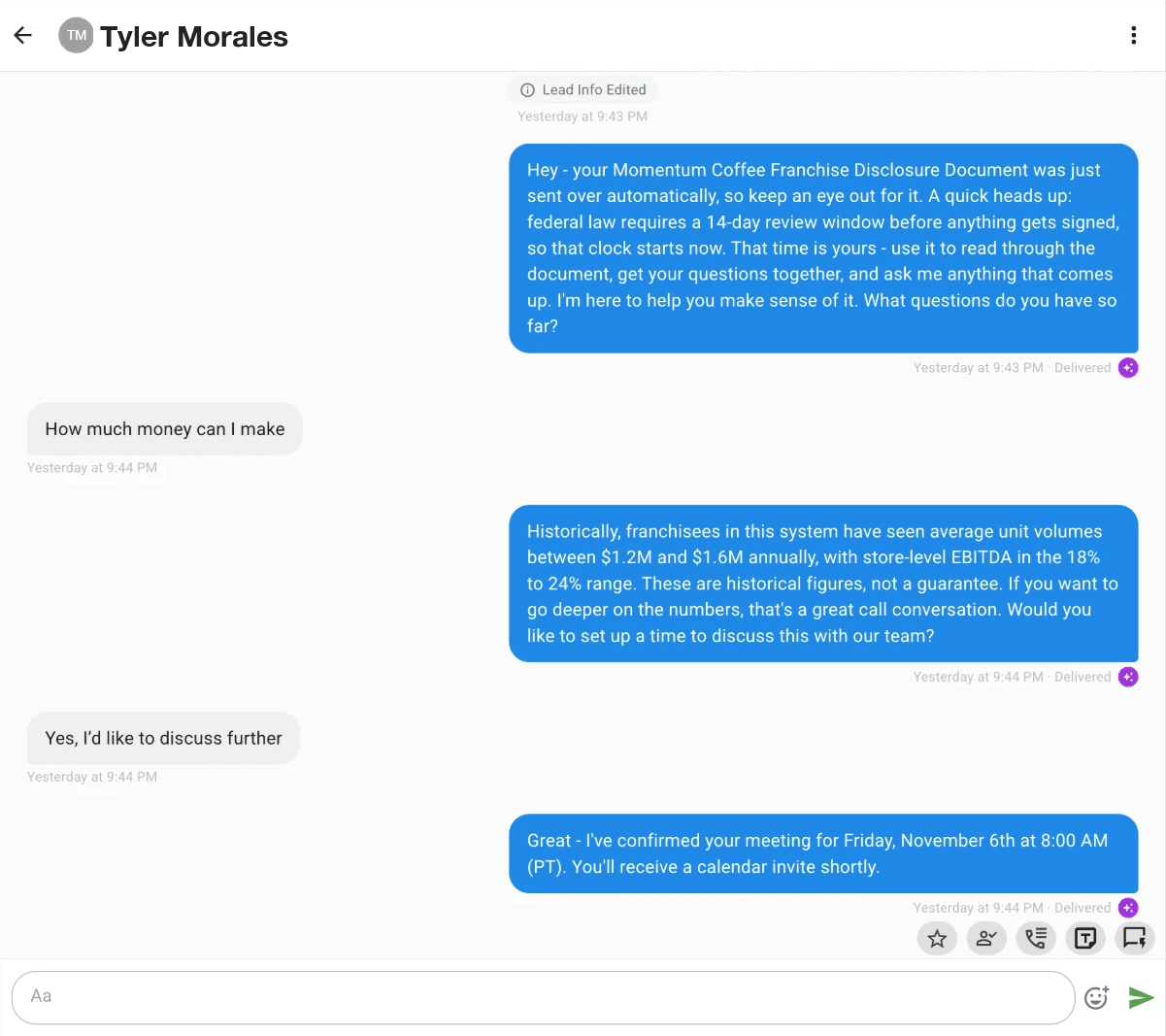 FDD agent thread after the CRM stage changed to FDD Sent. The agent addresses the review window and earnings questions directly. Names changed.
Each agent is custom-built by the FranFunnel team to match the engagement, questions, and follow-up that stage actually requires. The customer does not configure prompts. The agents are built to their specific sales process, then activated by signals they already send — CRM stage changes, webhooks, button clicks, or inbound notifications.
The Rep Is Never Out of the Loop
Stage-specific agents are not autonomous. The intervention mechanic is straightforward: the moment a rep sends a manual message into any thread the agent is handling, the agent for that stage shuts off. The conversation stays in SMS. The rep is driving it. The next agent activates when the CRM stage transitions to its trigger.
This matters especially during FDD review, when a candidate's question is specific enough that a rep should answer it personally. The agent handles the routine check-ins and the common questions. The rep steps in when it matters. No toggle, no settings screen — just message.
The planned handoff works the same way at every stage. The intro call agent books the meeting and the rep arrives to a warm scheduled call with full conversation context. The FDD agent keeps the candidate engaged through the review window and the rep shows up to Discovery Day with a candidate who stayed in the conversation.
One Agent Cannot Do All of This Well
The temptation to run one agent across the whole funnel is understandable. Setup is simpler. There are fewer decisions to make. But a single agent is a single script, and no single script fits a candidate who just submitted a form and a candidate who is evaluating an item 19 earnings table on the same call.
Pipeline velocity comes from candidates getting the right message at the right moment. When the message is wrong for the moment, candidates stall — and stalled candidates rarely self-recover without direct rep intervention. Stage-specific agents remove that bottleneck systematically. Each stage gets an agent built for it. Each candidate moves through the funnel with a conversation that tracks where they are.
That is what keeps pipeline moving from inquiry through Discovery Day without drop-off in the middle.
If your pipeline stalls between application and Discovery Day and you are not sure why, the agent running in the middle of your funnel is a good place to start. Book a demo at franfunnel.com and see how stage-specific agents are built for your process.