When franchise development marketing spend scales faster than the infrastructure behind it, more leads does not mean more deals. It means more leads going cold at a higher cost per lead.
This is the gap most marketing directors don't see until they're in a budget review asking why conversion rates dropped in the same quarter they increased spend. The answer is almost always the same: the top of funnel grew and the response layer didn't.
More Ad Spend on a Broken Response System Amplifies the Break
A franchise brand spending $10,000 a month on portal placements, paid search, and social is buying attention. What it does with that attention in the next 60 minutes is what determines whether the spend returns anything.
Most brands are losing that window. The FranFunnel Franchise Lead Response Time Study found that 44% of franchise brands never send a personal reply to a new lead — not a conversation, not a question, not an invitation to talk. Some send nothing at all; others send an automated receipt that confirms the form went through and stops there.
When a brand scales ad spend without fixing that, they are not scaling lead generation. They are scaling lead waste.
"44% of franchise brands never send a personal reply to a new lead — an automated acknowledgment, or nothing at all." — FranFunnel Franchise Lead Response Time Study · 530 brands · fielded March–April 2025
The math is uncomfortable. If a brand is converting 8% of leads at $5,000 per month in spend, and they double the budget, they expect roughly twice the signings. What they often get is twice the volume into the same manual follow-up process, which now misses more leads in absolute terms than it did before. The conversion rate drops. Cost per signing climbs. The budget team asks what happened.
What happened is that lead volume scaled and response infrastructure didn't.
The Manual Follow-Up Ceiling Is Lower Than It Looks
Franchise development teams are small by design. A director, two or three reps, and a coordinator managing several hundred leads a month is a typical setup. That team can manually follow up reasonably well when volume is controlled.
The moment a campaign performs and inbound doubles over 90 days — which is what success looks like when spend scales — that same team hits a ceiling. Reps begin triaging. They follow up with the leads that look best on paper and let the rest age. Some of those aged leads were excellent candidates who filled out a form at 9 PM on a Thursday and never heard back.
This is not a people problem. The reps are doing what any reasonable person does when demand exceeds capacity. It is an infrastructure problem. And it is invisible until the reporting catches up.
By the time conversion data reflects the gap, months of spend have already compounded it.
Lead Source Reporting Hides the Problem Until It's Expensive
Most franchise development teams track lead volume by source and cost per lead. Fewer track contact rate and booking rate by source. That gap in reporting is where budget decisions go wrong.
A portal generating 80 leads a month at $60 per lead looks expensive when measured against cost per lead. It looks like the right bet when measured against contact rate and booked meetings. The inverse is also true: a cheap source generating 200 leads at $30 each looks efficient until you discover 60% of those leads never received a personal reply.
When response infrastructure is manual and inconsistent, lead source performance data is unreliable. The data reflects which sources your reps happened to prioritize, not which sources actually produce qualified candidates. That is not information you can make confident budget decisions with.
The fix is contact rate and booking rate tracked by source, not just volume and cost. With that data — broken down by portal, campaign, or channel — marketing directors can shift budget toward the sources that actually produce booked meetings, and away from the ones filling a CRM with names no one has spoken to.
| What you can see without response infrastructure | What you need to make confident budget decisions |
|---|---|
| Leads by source | Contact rate by source |
| Cost per lead | Booking rate by source |
| Total lead volume | Personal reply rate |
| CRM stage at last update | Time to first personal reply |
The Infrastructure Gap Has a Specific Anatomy
Describing the response infrastructure problem in the abstract makes it sound like a process issue. It is actually a set of specific, concrete failures that stack.
A lead submits a form. The CRM creates a record. An automated receipt goes out. A rep sees the lead the next morning. By the time they call or text, the candidate has heard from two other brands — or hasn't heard from anyone and has started to doubt the opportunity is real.
That is the first gap: speed to first personal contact. Twenty-five percent of franchise brands send a personal reply within five minutes. The other 75% are slower than the window that matters most.
The second gap is follow-up persistence. A rep who calls once and doesn't reach the candidate often moves on. The lead sits in a "contacted" stage in the CRM without ever having had a conversation.
The third gap is stage-specific engagement. Once a candidate submits an application or receives an FDD, the follow-up they need is different from the follow-up that got them to apply. A single generic follow-up sequence does not hold a candidate through eight or nine weeks of a franchise sales process.
Each of these gaps exists independently of marketing spend. But all three become more expensive as spend increases, because every dollar of budget is now funding a lead that has a higher chance of falling through one of them.
What Response Infrastructure That Scales Actually Looks Like
The answer is not more reps. Headcount scales linearly with cost and does not cover nights, weekends, or the moment a campaign peaks unexpectedly. What scales is automation built specifically for the franchise sales process.
A first text in under 60 seconds, every time, regardless of volume. Not an automated receipt — a message written to the candidate, using their name, referencing what they inquired about, and asking a question that starts a conversation.
Stage-specific follow-up agents that change with the candidate's position in the pipeline. An intro call agent for a new lead is not the same as an FDD agent for a candidate 14 days into their disclosure review. Running the same message sequence across both stages tells the candidate you are not paying attention.
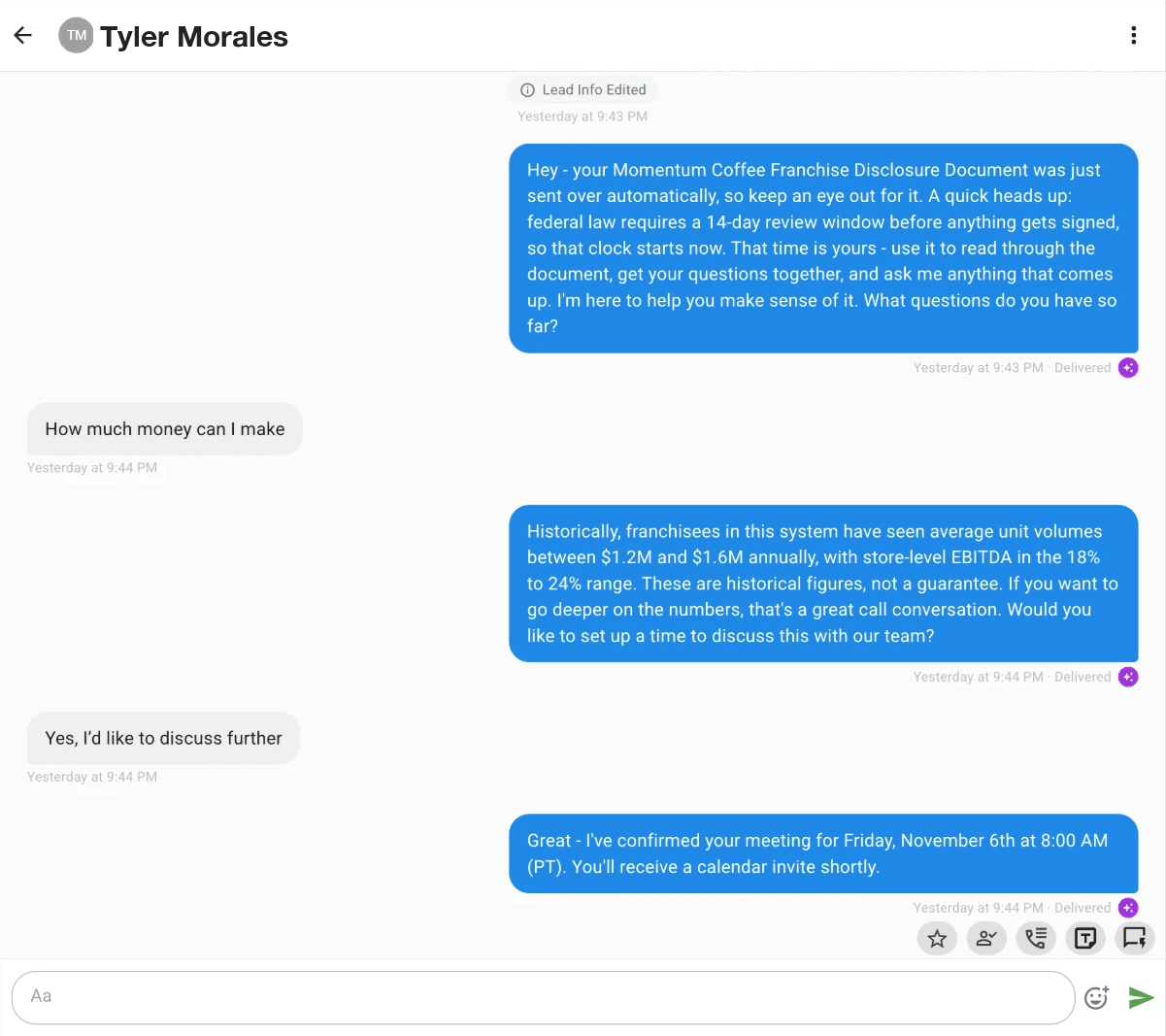 The FDD agent picks up the conversation automatically when the CRM stage changes to FDD Sent. Names changed.
In-thread meeting booking instead of a scheduling link. When a lead gets a text that offers three available times and asks which works, they reply. When they get a link to a booking page, they may not click it at all. FranFunnel books 14.6% of the leads it texts, while only 6.7% of nearly 20,000 leads sent a scheduling link even opened the booking page — and fewer than that actually booked. (Select FranFunnel client data, 2025-2026.)
None of this requires replacing a CRM or rebuilding a sales process. It runs on top of the infrastructure already in place, triggered by the stage changes the team is already making.
When response infrastructure scales with lead generation spend, the ROI math works the way a marketing director expects it to. When it doesn't, more spend just means a larger gap — and a larger gap means more $250,000 decisions going to whoever picked up the phone first.
See how FranFunnel closes that gap. Book a demo at franfunnel.com.