Your franchise development marketing is working. Impressions are climbing. Portal placements are generating form fills. Paid campaigns are hitting target cost-per-lead. And yet your discovery call calendar does not reflect any of it.
That is not a marketing problem. That is a routing problem.
Marketing Fills the Top of the Funnel. Routing Determines What Survives It.
Every dollar your brand spends on franchise development marketing — portal listings, paid search, SEO content, broker relationships — is an investment in generating an inquiry. The inquiry is not the win. The discovery call is the win. What happens in the minutes between those two things determines whether your marketing budget compounds or leaks.
The gap is almost never lead quality. Franchise development leaders who diagnose flat discovery call volume as a targeting problem are usually looking at the wrong variable. The leads are there. The issue is that nothing is meeting them on the other side of the form submission.
A candidate who fills out a franchise inquiry form is at peak intent. They researched the brand, decided it was worth their contact information, and submitted. That window does not stay open long. They are likely comparing two or three concepts simultaneously. The first brand that starts a real conversation — not an automated receipt, but a message written to them that asks a question — is the brand that earns the discovery call.
Most Brands Send Something Generic. Almost Half Send Nothing Personal at All.
The FranFunnel Franchise Lead Response Time Study measured exactly what franchise candidates receive after submitting an inquiry across 530 major brands.
44% of franchise brands never send a personal reply — just an automated acknowledgment, or nothing at all. FranFunnel Franchise Lead Response Time Study · 530 brands · fielded March–April 2025
Break that number down and the story is clearer: 28% of brands sent nothing whatsoever — no acknowledgment, no follow-up, no message of any kind. Another 16% sent an automated receipt that confirmed the form went through, then went silent. Neither group started a conversation. The marketing budget that drove those candidates to the form did nothing.
The remaining 56% did send something, but only 25% sent a personal reply within 5 minutes. That is the industry benchmark for franchise lead response — under 5 minutes. Three out of four brands are already behind it before anyone at the brand even knows the lead came in.
Franchise brands that invest in top-of-funnel marketing without fixing this layer are paying to generate leads they will never actually engage.
Impressions and Form Fills Are Lagging Indicators of a Future Problem
Here is why the gap takes so long to diagnose: marketing metrics move in one direction while pipeline metrics move in another, and the two dashboards rarely sit next to each other.
Impression volume, click-through rates, and cost-per-lead are reported weekly. Discovery call volume is tracked monthly, if at all. By the time a development leader notices the calendar is not filling, the disconnect has been compounding for months. The natural read is that the leads got worse. The more accurate read is that routing never scaled alongside the marketing.
The fix is not a bigger portal spend. It is not a new ad creative. It is what happens in the 60 seconds after the form is submitted.
| What strong top-of-funnel marketing delivers | What breaks without routing |
|---|---|
| High impression volume | Candidates receive a generic receipt |
| Qualified form fills | No personal reply within the benchmark window |
| Multiple-channel lead sourcing | Leads from different sources treated identically |
| Rising cost-per-lead investment | Discovery call volume stays flat |
| Detailed lead-source reporting | No data on which sources actually book meetings |
Comparison based on common franchise development patterns. Source-to-booking data from FranFunnel client reporting.
Stage-Specific Follow-Up Is Not a Nice-to-Have
The routing problem does not stop at first contact. Even brands that nail the initial reply often see candidates drop off between inquiry and discovery call, or between discovery call and application, because the follow-up becomes generic again once the lead enters the CRM.
A candidate who submitted a form three days ago is in a different conversation than a candidate who just received their FDD. Sending the same check-in message to both is not follow-up. It is noise.
Effective routing means a different engagement track for each pipeline stage: an intro call agent that surfaces available meeting times directly in the text thread and books the discovery call before a rep ever touches the thread; an application agent that follows up on incomplete submissions and answers questions about next steps; an FDD agent that checks in during the 14-day review window and answers earnings and territory questions. Each agent is built for the specific moment the candidate is in, not for the funnel in general.
The mechanic is concrete: when a CRM stage changes, the corresponding agent activates. When a rep sends a manual message into any thread at any time, that agent shuts off and the rep takes over the conversation. The next agent kicks in when the stage transitions again. The candidate never experiences a gap; the rep never loses control.
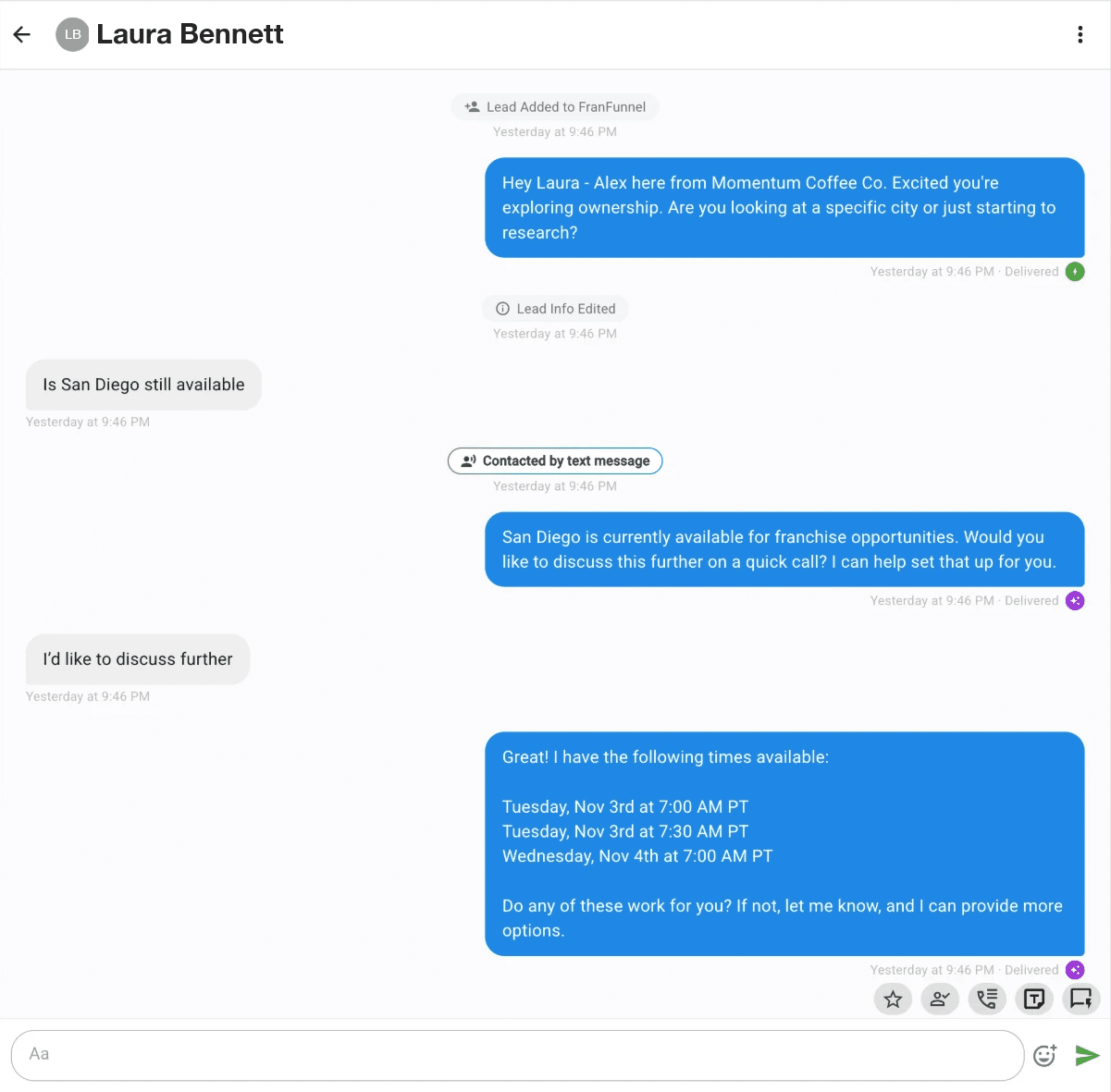 Intro call agent sends a first text the moment a lead comes in, answers a territory question, and offers three available times in the thread. Names changed.
The Metric That Actually Connects Marketing to Revenue
Lead volume tells you whether your marketing is working. Discovery call volume tells you whether your routing is working. Contact rate — the percentage of leads that enter a real two-way conversation — is the number that connects them.
A brand with a high contact rate converts its marketing investment efficiently. A brand with a low contact rate is paying for leads that evaporate before the conversation starts.
FranFunnel books 14.6% of the leads it texts. Across nearly 20,000 leads sent a scheduling link instead, only 6.7% clicked through to open the booking page — and fewer than that actually booked. The difference is not the quality of the leads. It is where the booking happens. Offering times directly in the text thread means no form, no click-out, no friction. The candidate replies with their pick and the invite goes out on the rep's behalf.
That figure — 14.6% of every lead texted ending in a booked appointment — is what strong routing looks like. It is also what turns rising impression counts into rising discovery call volume.
The Fix Is Faster Than the Diagnosis
Franchise development leaders who identify the routing gap often assume the fix is a long implementation — a new CRM, a rebuilt workflow, a months-long IT project. It is not.
FranFunnel sits on top of your existing CRM without replacing it. Setup is white-glove: the team builds the stage-specific agents, connects the CRM sync, files the carrier registration, and goes live in 48 hours. From there, a dedicated client solutions manager adjusts the setup as your process evolves.
The marketing investment you have already made is generating candidates. Routing is what decides whether they ever make it to the discovery call.
See how FranFunnel texts your next lead in under 60 seconds and books the discovery call before your rep opens the CRM. Book a demo at franfunnel.com.