Re-engaging a cold franchise lead with a message that ignores everything they told you on the inquiry form is not a follow-up — it is a second first impression, and usually a worse one. The fix is not better copy. It is better triggers.
Most Re-Engagement Sequences Inherit the Original Problem
When a franchise development team builds a re-engagement sequence, they typically set it to fire after a fixed number of days since last contact: 7 days, 14 days, 30 days. The logic is simple. The result is a blast of messages that treat a candidate who said "I'm ready to invest in the next 30 days" identically to one who said "I'm exploring options for 18 months from now."
Both candidates went quiet. That is where the similarity ends. One missed a window. One is right on schedule.
The form they filled out when they inquired holds the information you need to tell the difference. Investment timeline. Liquid capital. Territory. How they found you. Whether they own a business now. That data lives in your CRM. Most re-engagement sequences never touch it.
The result is a re-engagement cadence that fires generically at a calendar interval, with copy that could have been sent to anyone. That is not re-engagement. That is a newsletter to a lead who already ignored your newsletter.
The Form Fields That Should Drive Your Triggers
Before mapping a sequence, audit what your inquiry form actually collects. The fields that matter most for re-engagement triggers are:
Investment timeline. This is the most important field on the form and the most underused in re-engagement logic. A candidate who said "ready in 30 days" and went quiet for three weeks is worth a short, direct sequence that acknowledges the window is closing. A candidate who said "12 to 18 months" who went quiet after the first message is exactly where they expected to be — your sequence should match that pace, not rush it.
Liquid capital or net worth range. A candidate below your minimum is a different conversation than one who is a strong financial fit. Routing them into separate sequences — one that keeps the door open gently, one that moves with more urgency — prevents your re-engagement from burning a qualified candidate with the same cadence you use for unqualified ones.
Territory of interest. This is the easiest field to personalize around. "We still have availability in [territory] and wanted to follow up" is a concrete reason to reach out. It is not a trick. It is using what they told you. If that territory has closed or opened since they inquired, that is an even stronger hook.
Lead source. A candidate from a broker portal arrived with a different context than one who found you through organic search or a franchise trade show. The sequence that speaks to a broker-referred candidate should acknowledge the relationship, not pretend they found you cold.
"44% of franchise brands never send a personal reply — just an automated acknowledgment, or nothing at all." — FranFunnel Franchise Lead Response Time Study · 530 brands · fielded March–April 2025
That 44% is not all inactive brands. It includes brands that have re-engagement sequences — they just never sent a personal message first. When the first real outreach is a re-engagement, the form field data is all you have. Use it.
How to Map Triggers to Sequences (Not Delays)
The practical structure looks like this. For each major form field segment, define the trigger condition and the sequence behavior independently of the calendar.
| Trigger Condition | Sequence Behavior | Message Hook |
|---|---|---|
| Timeline: 0-3 months, no reply in 7 days | 3 messages over 10 days, direct | Window closing, specific territory availability |
| Timeline: 6-12 months, no reply in 30 days | 5 messages over 90 days, paced | Market trends, validation stories, Discovery Day upcoming |
| Timeline: 12+ months, no reply in 60 days | Longer drip, monthly cadence | Education content, low-pressure check-in |
| Capital below minimum, any timeline | Soft hold sequence | Alternative paths, referral ask, door open for later |
| Broker-referred, no reply in 14 days | Re-engage via broker relationship | Loop consultant in, acknowledge the referral context |
The table is a framework, not a final answer. Your form fields may not map exactly to these. The point is that each row generates a different sequence — different length, different cadence, different message hook — and none of them fire because "it has been X days." They fire because a condition is true about this candidate.
Connecting Form Field Triggers to Your CRM and Re-Engagement Agent
This is where most teams stall. The logic above is not hard to reason through. The execution requires your CRM to hold the form field values in structured fields (not buried in a notes block) and your re-engagement tool to listen for the right signals.
FranFunnel connects to your CRM and listens for the signals you send: a stage change, a webhook, a button, an inbound notification. When one fires for a lapsed lead, a re-engagement agent launches — not a generic blast, but a stage-specific agent built around the data attached to that lead's record.
What that means in practice: a candidate who reached the application stage and went quiet gets a different agent than one who went quiet after the initial inquiry. The FDD agent that re-engages a candidate mid-review window speaks the language of that specific moment in the process — the 14-day window, the questions they likely have, the validation calls that come next. It does not start over.
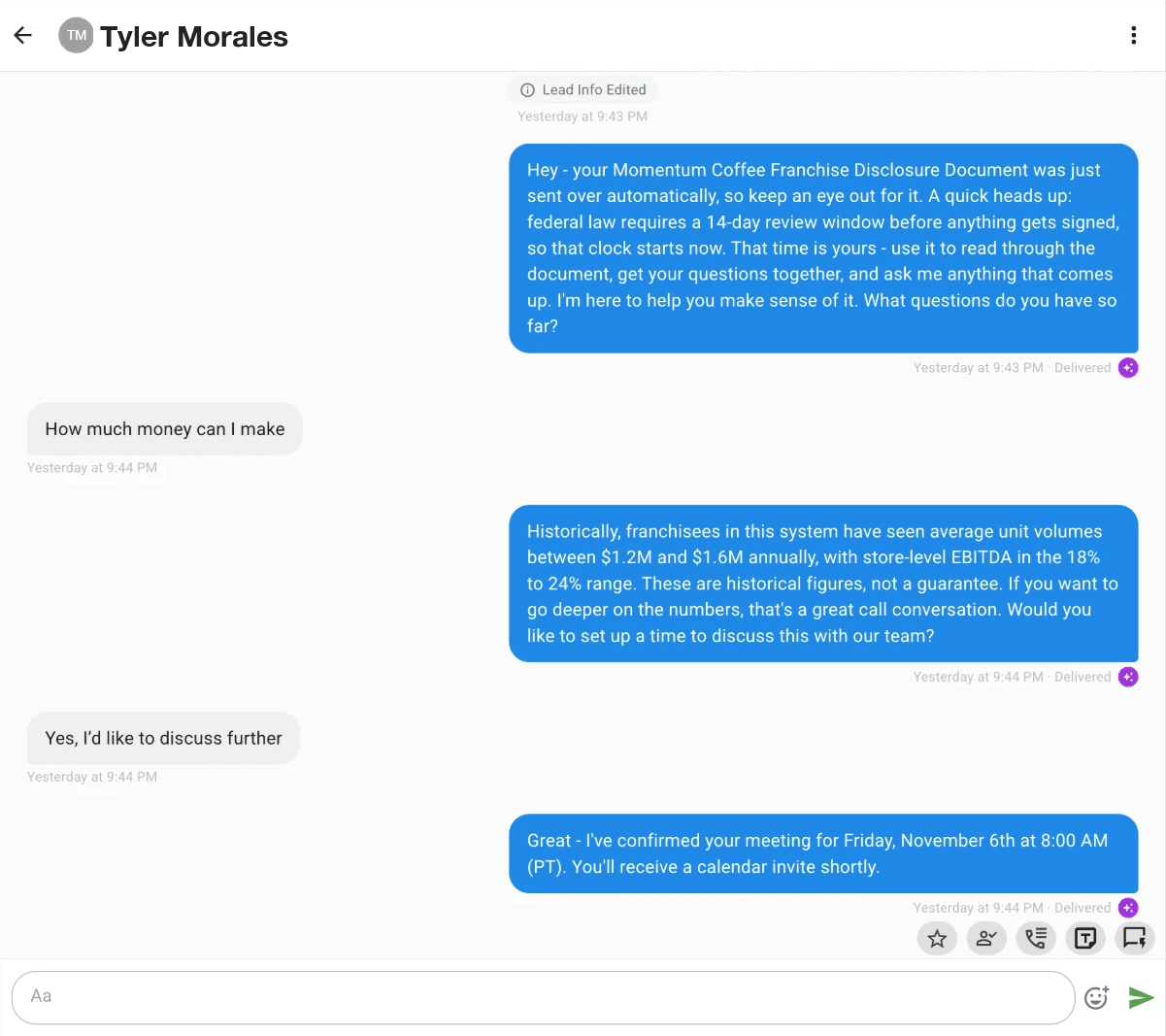 FDD stage agent activates after a CRM stage change, picks up the conversation where the candidate left off. Names changed.
The agent stays active until the next signal fires — a CRM stage transition that tells the system the candidate moved forward, or a rep manually stepping into the thread. The moment a rep sends a message, the agent for that stage shuts off and the rep is driving. The next agent activates when the CRM stage changes again. No configuration required.
What Happens When a Lapsed Candidate Replies
This is the moment most re-engagement sequences are not built for. A candidate who went cold for six weeks and responds to a re-engagement text is a warm lead again. The worst thing you can do is respond slowly or send them to a booking link.
FranFunnel's re-engagement agent handles the response in the same thread. It offers available times directly in the text, the candidate picks one, the invite goes out. No link, no form, no friction. The conversation that re-started in an SMS thread stays there through the booking.
That matters because a re-engaged candidate is not as committed as a fresh one. Any extra step between "I replied" and "I have a meeting on the calendar" is a place they can drop off again. Keep the path as short as possible.
One More Thing to Audit Before You Build
Before mapping any of this out, check whether your inquiry form is actually collecting the fields you plan to trigger from. Many franchise forms ask for name, email, and phone and stop there. If timeline and capital are not structured fields in your CRM — if they are free-text, or if they are only on the form but not mapped to a CRM field — none of the trigger logic above is executable yet.
That audit takes an afternoon. The re-engagement logic above is not useful without it. Start there.
If you want to see how FranFunnel builds stage-specific re-engagement agents against your existing CRM data, book a demo at franfunnel.com. We will map your current form fields to trigger logic before the call ends.