The wrong message at the wrong stage does not feel like a minor process gap. To the candidate, it reads as disorganization — and in franchise development, disorganization mid-pipeline is a reason to slow down or walk away.
Stage-specific AI agents only solve this problem if they also know exactly when to stop. An intro call agent that keeps pushing for a booking after the call is already scheduled creates the same friction as no agent at all. An application agent that fires after the candidate has already submitted makes the brand look like it is not watching. The fix is not better messaging. It is correct shutoff conditions, matched to each pipeline stage.
Most Teams Are Running One Agent Across the Whole Funnel
The common setup looks like this: a lead submits an inquiry, an AI bot fires a text, and that same bot — with the same script and the same goal — stays on the thread from first contact through application and sometimes beyond. It books the meeting if the candidate is early. It nudges for an application if they are further along. It sends the same re-engagement message whether the candidate went quiet on day two or day twenty-two.
This setup is better than nothing. But it treats the pipeline as a single undifferentiated zone, and that is not how franchise sales works. A candidate at intro is a different person than a candidate at application. They have different questions, different levels of commitment, and different things they need from a message. One agent with one script cannot serve both conversations well, and it certainly cannot know when to stop serving each one.
The failure mode is not always obvious. A generic nudge to "hop on a quick call" is easy to ignore. What surfaces the problem is when the timing is visibly wrong: the candidate booked their intro call two days ago and just received a text asking if they would like to schedule one.
The Shutoff Condition Is the Real Architecture Decision
An agent's shutoff condition is what tells the system the job is done. For the intro call agent, the job is done when the discovery call is booked or completed and the CRM stage transitions to Application. For the application agent, the job is done when the application is submitted and the CRM stage transitions to FDD Sent.
These are different signals. They happen at different times, triggered by different actions from the candidate. If both agents share the same shutoff condition — or if neither agent has a clearly defined one — the system cannot know which stage it is in, and messages fire without stage awareness.
The result is not random. It is predictable: whichever agent is running will keep running until the shutoff fires, regardless of what the candidate has already done. The intro call agent will push for a booking until something tells it to stop. If that something is the wrong signal — say, a time-elapsed trigger rather than a CRM stage change — it will push after the call is booked, after it is completed, and potentially into the application stage.
"44% of franchise brands never send a personal reply — just an automated acknowledgment, or nothing at all." — FranFunnel Franchise Lead Response Time Study · 530 brands · fielded March–April 2025
That gap between sending something and sending the right thing is exactly where shutoff conditions matter. A message that lands at the wrong stage is not a personal reply. It is noise that damages the relationship a good first text worked to build.
What Each Stage Agent Owns — and What It Does Not
Stage-specific agents work because each one is scoped to a single pipeline stage and monitored against the signal that marks the end of that stage. Here is how the first two handoffs work in canonical order:
| Stage | Agent's job | Activation trigger | Shutoff condition |
|---|---|---|---|
| Lead capture | Engage the candidate, answer initial questions, offer meeting times in the thread | Inbound form submission or CRM lead creation | Discovery call booked or completed; CRM transitions to Intro / Discovery Call stage |
| Intro / discovery call | Confirm the meeting, send reminders, re-engage if the candidate goes quiet before the call | CRM stage: Intro / Discovery Call | Intro call completed; CRM transitions to Application |
| Application | Follow up on the open application, answer questions about next steps, keep the conversation alive | CRM stage: Application | Application submitted; CRM transitions to FDD Sent |
| FDD issuance | Check in during the 14-day review window, answer FDD questions, drive toward franchisee validation | CRM stage: FDD Sent | 14-day window closes and validation begins; CRM transitions to Validation |
Each row has a different shutoff. None of them shares a condition. If the intro call agent's shutoff were "application submitted" rather than "intro call completed and CRM transitions to Application," it would keep firing through an entire stage it has no business occupying.
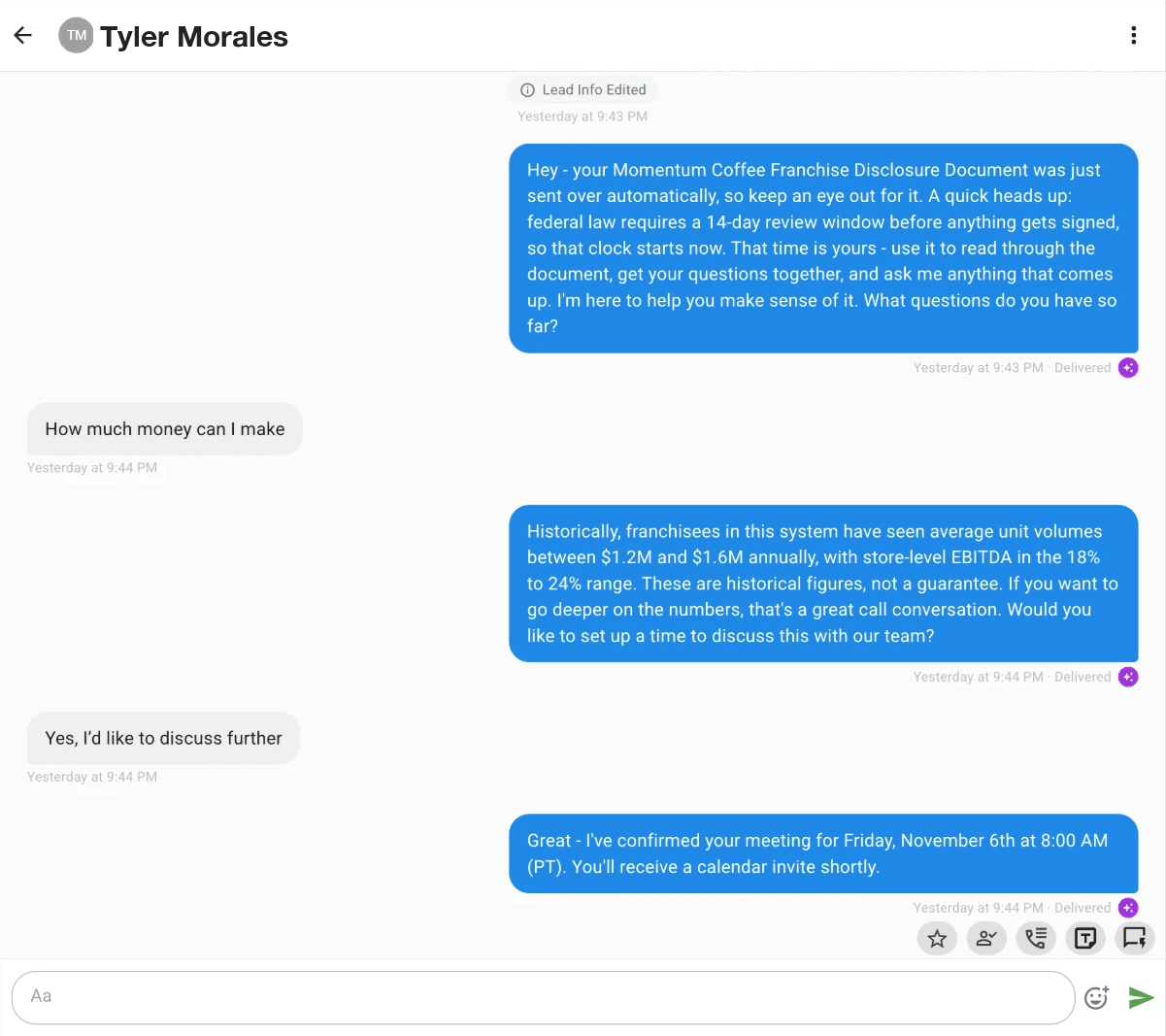 The FDD agent activates when the CRM stage changes to FDD Sent — not before, and not in place of the intro or application agent. Names changed.
The CRM Stage Change Is the Signal That Makes This Work
Tying shutoff conditions to CRM stage transitions matters because the CRM stage is the proof that the candidate completed the step. When a rep moves a candidate from Application to FDD Sent, it means the application came in and was reviewed. That action is the signal the application agent needs to stand down and the FDD agent needs to activate.
This is also why webhook and button triggers are equally valid. Not every pipeline moment maps to a named CRM stage. A no-show, for example, does not have a canonical stage in most CRMs. But a rep can send a signal — a button click, a webhook, an inbound notification — and FranFunnel can build a missed meeting agent that fires on exactly that trigger. The architecture is the same: one agent, one stage, one shutoff condition matched to the signal that proves the stage is done.
The rep's ability to intervene fits cleanly into this structure. The moment a rep sends a manual message into any thread, the AI agent for that stage shuts off. The conversation stays in SMS, the rep is driving it, and the next agent activates when the CRM stage transitions. The shutoff condition for intervention is the rep's own message — no toggle, no settings panel, no delay.
Why This Matters for the Candidate's Experience
Franchise development is a trust-building process. The candidate is evaluating whether to invest six figures with your brand, and every interaction is evidence for or against that decision. A message that reflects where the candidate actually is in the pipeline signals that the brand is paying attention. A message that reflects where the candidate was two stages ago signals the opposite.
Stage-specific agents with matched shutoff conditions are not primarily an efficiency play. They are a signal-quality play. The right message at the right stage, stopping at exactly the right moment, is what makes AI engagement feel like attentive follow-up rather than automated noise.
One agent across the whole funnel can follow up quickly. It cannot follow up correctly at every stage. That distinction is the difference between a candidate who moves forward and one who quietly stops responding.
See how FranFunnel builds stage-specific agents for your sales process — with shutoff conditions mapped to your CRM and your pipeline. Book a demo at franfunnel.com.